
|
| China |
| How a determined village chief transformed thorny wild roses into a lucrative industry in snow-capped mountains | |
|
|
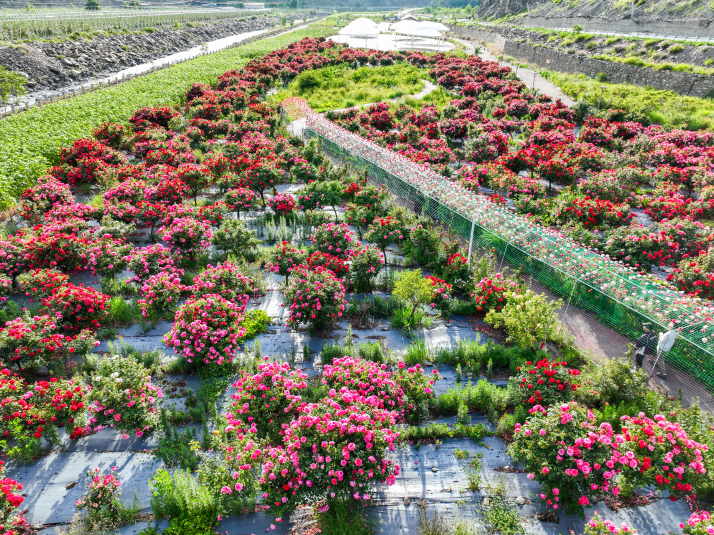 Damascus roses reach full bloom at a planting base in Maoshui Village on July 16 (WEI YAO)
High in the mountainous reaches of Aba Tibetan and Qiang Autonomous Prefecture in Sichuan Province, icy winds sweep through Mount Jiajin's high-altitude passes. For generations, local folklore described this rugged terrain as impassable, a place where even birds hesitated to fly. Yet today, nestled in the valleys at the foot of these snow-capped peaks, vibrant fields of pink Damascus roses roll across the slopes, filling the crisp alpine air with a rich, sweet fragrance. The striking landscape in Maoshui Village, Dawei Township of Xiaojin County, is home to the world's highest and largest high-altitude Damascus rose planting area. Behind this miraculous floral tapestry lies the story of Chen Wanghui, affectionately known by locals as "Rose Sister." Through years of grit, innovation and unwavering conviction, Chen has cultivated a thriving rose industry that has lifted thousands of rural families out of poverty. Hands of resilience Looking at Chen's weathered, calloused hands, one might not immediately associate her with delicate flowers. Her knuckles are swollen from years of hard labor, and faint white scars mark her palms, enduring reminders of thousands of rose thorns that have pricked her skin over the past decade. "When we first started planting, my hands were never free of injuries," Chen recalled with a gentle smile. "Thorns would embed deep under my skin. It hurt at first, but over time, thick calluses formed. Now, the thorns can hardly penetrate." Those scarred hands have reshaped the destiny of Xiaojin. In a region where high altitudes, steep ravines and long winter closures once severely restricted economic activity, Chen forged a path toward sustainable rural revitalization. 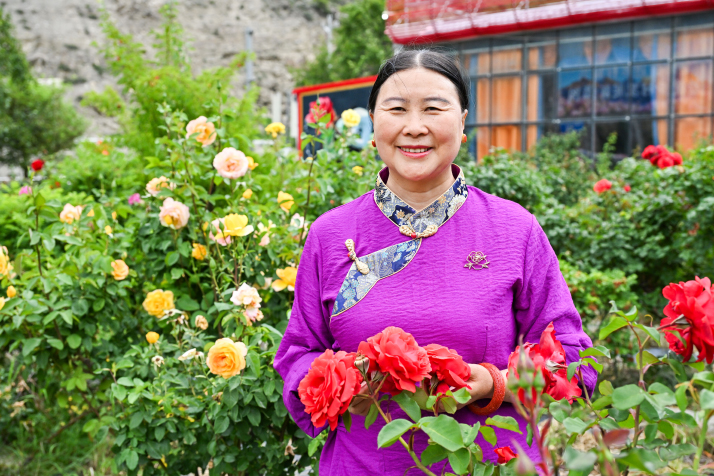 Chen Wanghui, Secretary of the Maoshui Village Branch of the Communist Party of China, in a rose garden at the village’s planting base in Dawei Township, Xiaojin County, Aba Tibetan and Qiang Autonomous Prefecture, Sichuan Province, on July 6 (WEI YAO)
Finding strength in thorns A turning point came in 2011, when Chen was elected chief of Maoshui. At the time, the community faced severe hardship. The thin, rocky soil yielded meager harvests of wheat and potatoes, generating scant returns. To make matters worse, herds of wild boars frequently descended from the mountains at night, destroying entire potato crops in hours. "Farmers would sit by the ruined fields in tears," Chen remembered. "Some couldn't afford even a few dozen yuan (a few dollars) for their children's school fees or basic medical care." One morning, while inspecting a trampled field, Chen noticed several wild rose bushes blooming brightly near her vegetable patch. Their sharp, dense thorns kept the wild boars at bay; even the hungriest animals steered clear of them. A bright idea struck Chen: If wild boars fear thorns, why don't we plant thorny roses across the mountains? For this community pushed to the brink by nature, thorns were expected to offer a natural defense mechanism for both crops and livelihoods. Flying far for answers Turning an unconventional idea into a viable industry required relentless perseverance. Ordinary ornamental roses could not survive the sub-zero winter temperatures of Mount Jiajin, nor did they carry sufficient economic value. Chen needed high-yielding, cold-resistant varieties rich in essential oil. Many people were skeptical, questioning the feasibility of large-scale rose cultivation in alpine valleys with stony soil and arid slopes. Though without related experience, Chen was undeterred. She boarded slow trains to visit research institutes and cultivation bases across Gansu, Shaanxi, Shandong and Henan provinces. Armed with a map, a notebook and endless determination, she sought advice from agricultural experts. Chen learned grafting, pruning and frost-prevention techniques from experienced farmers and purchased seedlings. "I felt like a small bird, constantly flying outward to bring back knowledge and roses, and then flying back to take our home's treasures to the world," Chen recalled. Back in Xiaojin, Chen spent freezing winter nights monitoring experimental fields, even when temperatures dropped below minus 20 degrees Celsius. She recorded soil freezing depths and checked young plants for frost damage. Her efforts paid off—the Damascus rose she selected successfully adapted. Highly resilient to drought and cold, this variety produces blossoms with exceptional oil content, a prized commodity in the global fragrance and cosmetics market. When agricultural experts returned to Xiaojin years later and beheld the vast sea of blooming pink roses, one remarked, "Rose Sister used a 'mad' idea and 'foolish' persistence to build Xiaojin's rose industry. The rose has truly found its home here." From petals to prosperity The region benefits from its unique geographical advantage: a blooming season lasting three and a half months, the longest high-altitude rose blooming season in the world. To ensure villagers benefited from the full value chain, Chen led the establishment of cooperatives and modern processing plants. Advanced steam distillation equipment was brought in to extract pure rose essential oil, expanding production beyond raw flowers to over 30 value-added goods, including rose tea, hydrosol (rose-infused water from the distillation process), skincare items and fresh flower pastries. Today, Xiaojin's rose industry stands as a cornerstone of local economic growth. Standardized cultivation has expanded to 1,000 hectares, spanning 13 townships and 46 villages across the county, producing a total annual output value exceeding 44.1 million yuan ($6.1 million) for the country. The industry has created stable jobs for villagers, including low-income families, and individuals with disabilities. This booming sector directly benefits 3,300 local households, raising average annual household income by more than 3,000 yuan ($420). Remarkably, Xiaojin's highland rose essential oil has earned international acclaim for its purity and aromatic quality. Today, it is exported to global markets, including Bulgaria, widely known as the "Kingdom of Roses," and France. It is China's first rose oil exported to these traditional rose-producing nations. The initiative's success earned it a spot among the Global Best Poverty Reduction Cases, recognized by international development organizations as inspiring models for rural empowerment in geographically isolated regions. The transformation of Xiaojin is further supported by major infrastructure developments in southwest China. The Mountain Jiajin Tunnel has pierced through the rugged heart of the mountain range, so that the hazardous and long mountain road is replaced with a safe and short route. This vital link has eliminated seasonal isolation caused by winter snows, ensuring seamless logistics. Freshly picked Damascus rose petals can now reach processing workshops within hours, while refined products are quickly dispatched to domestic and international markets. Beyond economic metrics, the rose industry has restored vitality and dignity to the mountain community. Villagers with disabilities are finding stable employment in processing centers, young people are returning home to earn livelihoods by marketing local products via e-commerce livestreams, and families are looking to the future with confidence. As the sun sets over Mount Jiajin, casting a warm golden glow across its snow-draped peaks, the valley below hums with life and color. The village's journey has proved that even in the toughest soils, dedication and vision can make hope bloom. "We were born on this land, and we hold deep affection for it," Chen said. "Harsh natural conditions and temporary hardships cannot diminish our love for life. As long as our convictions remain firm, the most barren soil can yield the sweetest blossoms." BR Printed edition title: Blooming on the Highlands (Reporting from Aba Tibetan and Qiang Autonomous Prefecture, Sichuan Province) Copyedited by G.P. Wilson Comments to taozihui@cicgamericas.com |
|
||||||||||||||||||||||||||||||
|