
|
| China |
| Goodbye gasoline | |
|
|
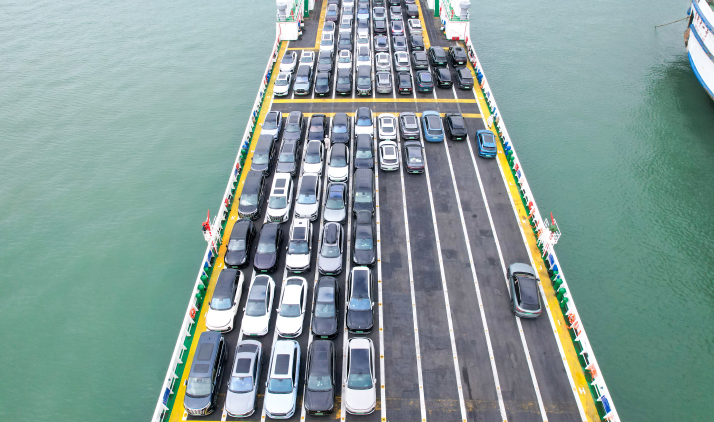 NEVs for export await shipment at Xiuying Port in Haikou, Hainan, on January 30 (XINHUA)
Hainan, China's southern island province, has become the country's first province-level region to set a timetable for ending sales of gasoline-powered cars, as it accelerates its building of the National Ecological Civilization Pilot Zone. Ecological civilization is a concept that emphasizes harmony between humans and nature, focusing on sustainable development and environmental stewardship. Hainan released in early July its 15th Five-Year Plan for Building a Beautiful Hainan, outlining a goal to steadily phase out the sale of cars powered solely by fossil fuels by 2030. Under the plan, which sets green development targets for the province over the 2026-30 period, new-energy vehicles (NEVs), including hybrid vehicles, are expected to account for 45 percent of its auto ownership by 2030, up from 23.75 percent in 2025, while gasoline-powered cars already in service will continue to be permitted on the roads. Championing the transition Hainan's decision to ban gasoline-powered car sales ahead of the rest of China is closely linked to its unique geography and economic structure. Hainan is an island province of around 35,400 square km, with a highway loop stretching approximately 600 km around its perimeter. The driving range of mainstream electric vehicles (EVs) is now sufficient to cover most journeys across the province, reducing one of the key barriers to EV adoption. The province's tropical climate also provides an advantage. Unlike north China, where winter temperatures can significantly reduce battery performance, Hainan's year-round warm weather creates more favorable conditions for EV operation. "NEVs are a perfect fit for Hainan, a tourism destination renowned for its ecological and environmental excellence," Zhang Xiang, a visiting professor at Hainan Vocational University of Science and Technology and an automotive industry analyst, said. A large-scale transition to NEVs would improve local air quality while enhancing visitor experience and further upgrading the tourism sector, he said. Green pilot The ban on gasoline-powered car sales also reflects Hainan's broader role as a National Ecological Civilization Pilot Zone. Shi Jianhua, Deputy Director of the China EV100 Association, a third-party think tank, told media that the timetable for the move is driven by both environmental considerations and the potential demonstrative value. Hainan has the conditions to develop a green special economic zone, Shi said, adding that the province's practices could provide a blueprint for wider adoption of NEVs across China. The policy is the latest step in a longer-term government strategy. The Central Government first called for Hainan to phase out the sale of gasoline-powered cars in 2018, as part of efforts to support the island's comprehensive reform and opening up. Since then, Hainan has introduced a series of provincial policies, including a clean energy vehicle development plan released in 2019 and the rollout in 2022 of its roadmap for fulfilling the national goal of peaking carbon emissions before 2030. Hainan has introduced a range of measures to encourage NEV adoption, including purchase incentives, trade-in subsidies, support for electric commercial vehicles, rural NEV promotion campaigns and battery-swapping pilot programs. The province has also invested heavily in charging networks to address concerns over charging availability. By August 2025, Hainan had built more than 230,000 charging piles and 4,895 charging stations, with a vehicle-to-charger ratio of about 2.1:1. Beyond urban centers, charging facilities had achieved full coverage of all expressway service areas and rural communities across the island. According to Zhang, Hainan's fuel pricing policy has also motivated consumers to shift toward NEVs. Unlike other regions of China, Hainan does not charge highway tolls directly. Instead, road maintenance and toll-related costs are incorporated into a fuel surcharge, making gasoline prices consistently higher than those in many other parts of the country. This has encouraged local consumers to consider NEVs when purchasing cars, Zhang said. According to Hainan's Bureau of Industry and Information Technology, 116,800 NEVs came into use in 2025 in the province, accounting for 62.9 percent of newly added vehicles. In April, Hainan recorded the highest NEV penetration rate in China, reaching 74.5 percent, according to the bureau. NEV penetration rate refers to the proportion of NEVs in the total number of new passenger cars sold. The ban is expected to create new opportunities for NEV manufacturers. Zhang said NEV maker BYD held a 33.6 percent market share in Hainan in 2025, selling about 48,000 vehicles during the year, while U.S. EV brand Tesla ranked second with a 14.7-percent share and around 21,000 sales. The policy is also part of a broader green transport transformation strategy. The 15th Five-Year Plan for Building a Beautiful Hainan calls for all new and replacement vehicles used for public services and commercial operations, excluding special-purpose vehicles, to be NEVs by 2030. The same requirement applies to all newly added and replaced private cars. The province also plans to expand trials of fuel-cell truck use in heavy-duty transport, cold-chain logistics and public transport, while advancing other green transportation initiatives. 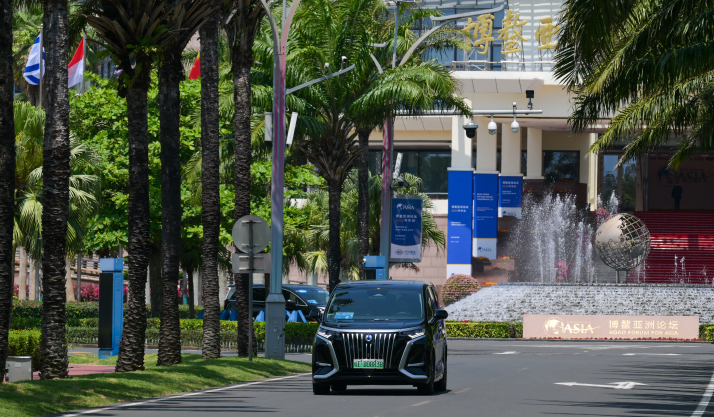 A new-energy vehicle (NEV) at the Boao zero-carbon demonstration zone in Boao, Hainan Province, on March 24(XINHUA)
Prudence needed China officially ended its national NEV purchase subsidies, which had been in place for 13 years, at the end of 2022. According to a notice released on July 3, starting from January 1, 2027, the country will cancel the policies of halving the vehicle and vessel tax for energy-saving vehicles and exempting certain NEVs, including pure electric commercial vehicles, plug-in hybrid electric vehicles and fuel cell commercial vehicles from the tax. As a result, localities seeking to accelerate the NEV transition will have to bear much of the cost themselves. On the other hand, the traditional automotive industry has developed a long and mature supply chain. The sector remains an important source of local tax revenue, employment and industrial output. An abrupt halt to the production and sales of gasoline-powered cars could therefore negatively affect regions that remain heavily reliant on the fiscal contributions of up- and downstream enterprises' fiscal contributions, according to Zhang. Hainan's roadmap is ambitious and no other regions in China have announced a binding timetable for ending sales of gasoline-powered cars. Zhang said each region would need to consider its own industrial structure and economic realities before making similar decisions. Hainan's advantage lies in the strong synergy between NEVs and its tourism, agriculture and energy sectors, allowing government investment to generate broader economic returns. "The green transition needs a more thorough economic evaluation," he said. BR The author is a reporter for China Report, in which this article was originally published Copyedited by G.P. Wilson Comments to lixiaoyang@cicgamericas.com |
|
||||||||||||||||||||||||||||||
|








