|
| China |
| Tides that connect | |
|
|
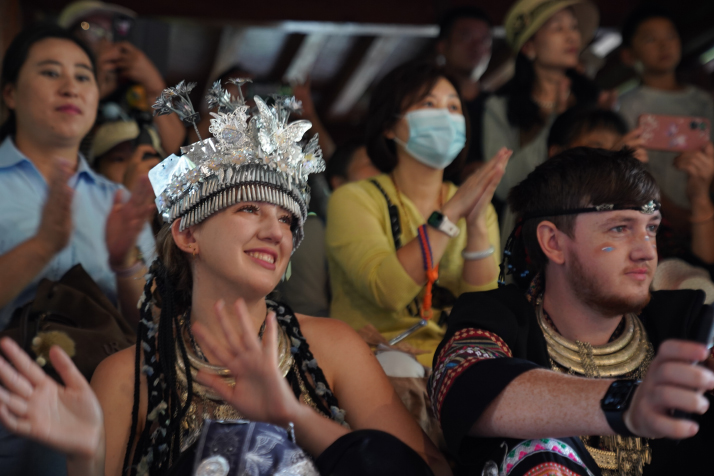 Delegates of the sixth China-America Student Conference watch a performance at Yunnan Ethnic Village in Kunming, Yunnan Province, on July 16 (ZHANG WEI)
H uali de—a Chinese phrase meaning "splendid" or "grand"—is one that Branson Chi, a 19-year-old American student, only recently acquired, but immediately put to good use. Over the course of July, he used it to describe everything from the huckleberry ice cream he shared with his peers in Montana, the United States, to clouds drifting over the mountains of southwest China, and the conversations with fellow delegates in hotel lounges that stretched late into the night. Chi was one of 22 students from universities in China and the U.S. who took part in this year's Across the Pacific: China-U.S. Youth Dialogue for a Shared Future program. The event, co-hosted by the China International Communications Group (CICG) Center for the Americas and the International Student Conferences (ISC), was designed to foster closer ties between young people from the two countries. This year's program also included the sixth China-America Student Conference, or ChASC6, a student-led initiative organized under the ISC. Unlike previous editions, which were held in either the U.S. or China, this year's conference was the first in its history to take place in both countries. Between July 3 and 23, the participants traveled from Washington, D.C., and Montana in the U.S. to Yunnan Province and Beijing in China. Along the way, they visited universities, museums, rural communities and businesses, engaging in discussions on topics ranging from climate change to AI—issues of growing importance at a time of uncertainty in China-U.S. relations. "There is tension in the relationship, but there is also a pretty strong magnetic force between our societies, our economies and our governments," Kurt Tong, former U.S. ambassador for the Asia-Pacific Economic Cooperation (APEC), managing partner at the Asia Group and chair of the Executive Committee of the ISC Board, said at the opening ceremony of ChASC6. "Global peace and security, climate change, how to structure the global economy… All of these issues actually bring the two countries together." And that is where young people come into play. By learning from one another through programs like ChASC, they can strengthen mutual understanding and help keep channels open across the Pacific, he said.
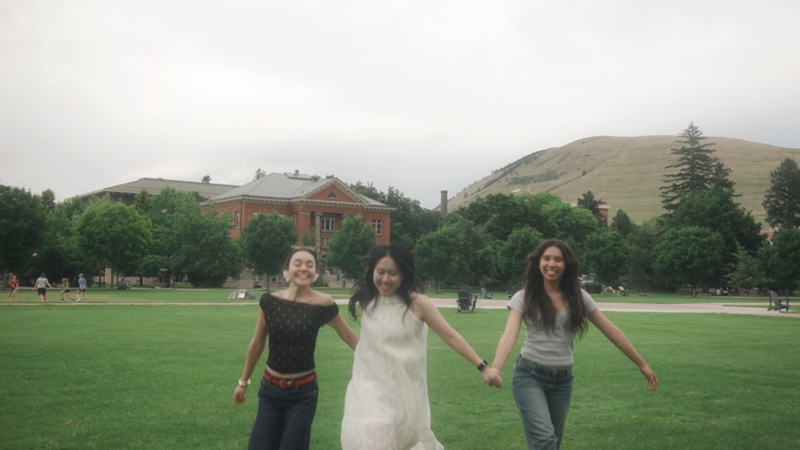
Chinese and U.S. delegates visit the University of Montana in Missoula, Montana, the United States, on July 12 (WU ZIYU) A tale of two countrysides This was American student Lily Berry's second time participating in the program. A delegate last year, she returned as a member of its student executive committee (EC). What made this year's program unique, for her, was the attention it paid to the rural side of both countries. "As an agriculture major, it was really fun to experience the countryside and learn more about the daily routines of local rural communities," she told Beijing Review. In Montana, they discussed rural development and sustainability with students at the University of Montana; heard from Indigenous representatives about the history and modern life of tribal communities; visited a bison reserve to learn about the conservation of prairie ecosystems and wildlife; and explored how local farms and farmers' markets practice organic farming and community-supported agriculture. For Wu Ziyu, an English major at Xiamen University in Fujian Province, southeast China, a lecture on environmental conservation at the Flathead Lake Biological Station became one of the most memorable parts of her first-ever visit to the U.S. She was struck by the droves of tourists traveling to the Glacier and Yellowstone national parks in summer—and by how their spending has made tourism a major engine of the local economy. "My time in Montana offered a glimpse of how tourism can support local development without compromising the natural environment—and how nature itself can become a source of social and economic growth," she told Beijing Review. That theme carried into the Yunnan leg of the tour. In Haiyan Village, a 600-year-old fishing settlement on the shore of Dianchi Lake, the delegates saw how a once-quiet village had reinvented itself as a popular tourist destination without completely shedding its fishing heritage. In Xizhou Ancient Town, they wandered through neighborhoods where traditional homes stood alongside cafés and craft workshops. At the Dounan Flower Market, Asia's largest hub for trading fresh-cut flowers, they learned how Yunnan had turned one of its greatest natural assets, flowers, into a vast industry. The itinerary also offered a window into Yunnan's rich ethnic diversity. At Yunnan Ethnic Village, a cultural park showcasing the customs and architectures of 26 local ethnic groups, delegates tried on traditional clothing and watched performances depicting aspects of everyday community life. In addition to their visits to the countryside, delegates also took part in a dialogue on rural development at Yunnan University, where they discussed sustainable growth, environmental protection and tourism with local students. "These issues concern us all, wherever we come from," Liu Yajing, a Chinese delegate who graduated from the university six years earlier, said. "It was not a formal discussion. We were simply sharing stories, but those personal accounts helped break down barriers and turn the room into a global village." 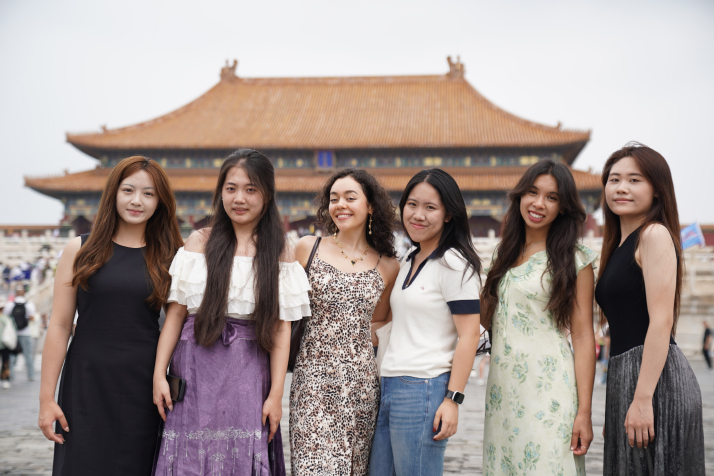 Chinese and U.S. delegates visit the Forbidden City in Beijing on July 21 (ZHANG WEI)
Presence and perspective For Liu and her fellow delegates, whether exchanging ideas at Yunnan University, dancing in traditional ethnic dress or simply talking about Yunnan's local mushroom season over a meal, it all boiled down to the same thing: immersive experience. Before joining the program, Dominique Addison was no stranger to Chinese culture. For nearly eight years, her family has hosted Chinese exchange students, and sharing a home with them has shaped much of her knowledge of the country. China also featured prominently in her studies at Syracuse University in the heart of New York State, where she recently completed dual master's degrees in public administration and international affairs. "This, however, was on an entirely different level," she said. Seeing China firsthand and fully immersing herself in the experience had given her a fuller and more nuanced understanding of the country. The program took the delegates not only to institutions at the heart of China-U.S. relations—including the Chinese embassy in Washington, the American embassy in Beijing and a press briefing in the Blue Hall of China's Ministry of Foreign Affairs, but also to cultural and business spaces that offered a broader perspective on the many forces that have shaped, and will continue to shape both countries. "I think it's very important to see each country's perspective firsthand," Tyler Smith, a history and international studies major at the University of Tampa, Florida, said, adding that the program had allowed him to encounter two distinct vantage points on how the past is remembered. In Yunnanyi Village, he learned how the village had once served as an important hub on the Tea Horse Road, an ancient network of trade routes through which tea from Sichuan and Yunnan was transported to Xizang. During World War II (WWII), the village also became a transit point of the Hump, the perilous trans-Himalayan air route that carried supplies into China and became a lifeline keeping the country connected to the outside world and helping its resistance against Japanese invaders. "It is a very underappreciated part of WWII history," Smith said, noting that the American education system tends to focus more on the war's European Theater. "There are many stories that are not widely told. That is why visiting these museums matters. They show how different countries, despite their cultural differences, worked together." The program looked not only at the past but also toward the future. At Robot World in Beijing E-Town, a hi-tech and innovation hub, delegates got a close look at China's rapidly evolving robotics industry. At the Chongyang Institute for Financial Studies at Renmin University of China, they discussed with experts the promise and risks of emerging technologies, AI governance and the part young people can play in advancing China-U.S. technological cooperation. "Youth and technology are inseparable. We were born into a technological age, have lived through its transformations and have taken part in shaping it," Chi said. "It is therefore up to young people to confront the challenges we share and help build a better world." What they carried home With all its engagement with issues that matter to young people, from rural development to technological innovation, many delegates said what they would remember most were the connections forged along the way. Asked to name his fondest memories of the trip, Erik Larson, the American chair of this year's EC, listed many, none of them grand: games in the dorms, boating in Montana and impromptu sing-alongs on the bus. These seemingly trivial moments mattered, Larson noted, because they gave the abstraction of bilateral relations a human scale. "The China-U.S. relationship is so important to the future of our world, yet there is so much misinformation," he told Beijing Review. "I think bringing students together through programs like this, and allowing these small moments to accumulate, is a really effective way of bridging that divide." "Young people are the future of China-U.S. relations and a vital force in expanding exchange, deepening mutual understanding, breaking down prejudice and building consensus," Yu Tao, Vice President of CICG, said at the closing ceremony. Xin Feng, President of the CICG Center for Americas, urged the delegates to carry that work beyond the program. "By building bridges of understanding and reaching out to one another, you can encourage more people to connect, communicate and collaborate." The conclusion of this year's edition of the program marked not an ending, but the beginning of stories yet to be written. María Paula Mora said she plans to start searching for research opportunities in China after the journey. She had long wanted to study the Global South but had struggled to narrow it down to a specific focus. The program, she said, gave her a fresh perspective, a clearer sense of direction and a newfound interest in learning Chinese. What Sriya Rama Uppalapati gained was less a fixed career plan than a new sense of possibility. "Up till now I was quite unsure on my future, but now I know there are so many things out there," she said. "The world is so wide open, and this program just exposed me to a lot of opportunities." For Chi, the three-week journey was profoundly transformative. "The program allowed me to understand how people's backgrounds and experiences shape their perspectives and to see a side of life I might not otherwise have encountered," he said. "Despite our differences, we share our emotions and empathy for each other in a universal way that goes beyond the Pacific and reaches across the globe," he said. "And that, to me, is huali de." BR (Dai Yingzhu, Li Xiaoyang and Tao Xing also contributed to this article) Copyedited by Elsbeth van Paridon Comments to pengjiawei@cicgamericas.com |
|
||||||||||||||||||||||||||||
|