
|
| China |
| The green path forward | |
|
|
 The Shankou Mangrove National Nature Reserve in Beihai City, Guangxi Zhuang Autonomous Region, on July 24 (XINHUA)
On July 29, China released the 15th Five-Year National Climate Change Response Plan (2026-30), outlining key climate goals for the period and laying a roadmap for achieving them. The plan sets a new 2030 goal of reducing carbon dioxide emissions per unit of GDP by 17 percent over 2025 levels, while reaffirming the existing goals of peaking carbon emissions before 2030 and achieving carbon neutrality before 2060. Jointly issued by departments including the Ministry of Ecology and Environment (MEE), the Ministry of Foreign Affairs and the National Development and Reform Commission, the blueprint lays out a broad strategy for addressing climate change. Measures stipulated by the plan include expanding carbon markets, accelerating renewable energy deployment, strengthening climate resilience, improving the protection of ecosystems and driving the low-carbon transition. China will also seek to build a transparent and international voluntary greenhouse gas emission reduction trading market and has largely completed a product carbon footprint management system by 2030, according to the plan. The country will also strengthen monitoring and control of non-carbon dioxide greenhouse gases, and develop the capacity to reduce emissions by 30 million tons of carbon dioxide equivalent by 2030. Aiming to cut emissions in key sectors, China will implement a dual-control system for both total carbon emissions and carbon intensity (a measure of how much carbon dioxide emissions are produced per unit of GDP), accelerate the development of a new energy system, expand non-fossil energy use and promote the peaking of coal and oil consumption. To enhance climate resilience, the plan calls for climate risk assessments and stronger responses to extreme weather and climate events. These measures will target natural ecosystems, agricultural production, economic activity and vulnerable regions, according to the plan. According to the MEE Department of Climate Change, the plan has aligned policies with market mechanisms as well as the carbon peaking targets. This plan represents China's first full-sector, integrated climate action system developed at the national Five-Year Plan level. New measures A major focus of the plan is the expansion of China's carbon market, a key tool for reducing emissions while maintaining economic growth. The plan states that the government will increase the number of industries and greenhouse gases covered by the national emissions trading system and will introduce more sophisticated quota management mechanisms. Chai Qimin, Director for Strategy and Planning, National Center for Climate Change Strategy and International Cooperation, told news portal China.org.cn that the dual-control system aims to strike a balance between emission control and high-quality development. Previously, the energy consumption dual control system, which covered both fossil and non-fossil energy, imposed constraints on local development. "Under the new framework, localities can develop new energy to meet additional demand, which both drives new industries and keeps emissions low," Chai said, adding that the new approach gives localities more flexibility to align development with emission goals. While emission reduction remains at the center of China's climate strategy, the new plan places increased attention on adapting to climate impacts and preparing societies for climate-related disruption. The Chinese authorities on August 4 further unveiled another five-year action plan to bolster geological disaster prevention across the country from 2026 to 2030, which also has a focus on strengthening climate resilience and enhancing grassroots response capabilities. China remains highly prone to geological disasters because of its complex terrain, diverse geological conditions, active tectonic movements and growing frequency of extreme weather events. The plan calls for more risk surveys, monitoring and early warning systems in response to climate change, and stresses the need to study disaster mechanisms triggered by extreme rainfall, rapid weather swings and abrupt drought-flood alternations. Over the coming five years, China plans to build an integrated national geological disaster information platform and improve coordination between national and provincial systems based on big data and AI. 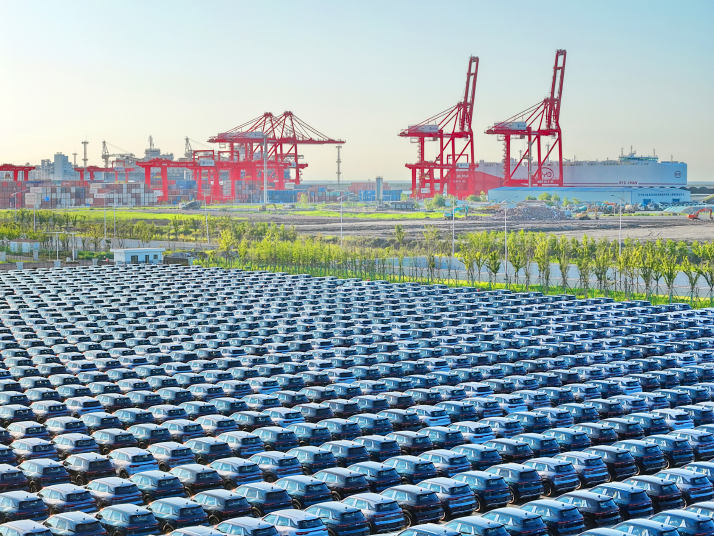 New-energy vehicles staged for shipment at a railway logistics center in Nantong, Jiangsu Province, on May 29 (XINHUA)
Green blueprint Renewable energy is moving toward the center alongside China's broader push to reshape its energy system. During the previous five-year period, renewable energy expansion focused largely on scaling up capacity. The new phase aims to build a more integrated energy system in which renewable sources play a central role in meeting future demand. China aims to raise the share of non-fossil energy in total energy consumption to 25 percent by 2030, according to the 15th Five-Year Carbon Peaking Action Plan, released in July. Under the plan, wind and solar power are expected to become the dominant sources of new electricity capacity, accounting for more than half of installed power capacity. Non-fossil energy generation is also expected to exceed half of total electricity production by 2030. China will enable the high-level integration of more than 2.8 billion kilowatts (kw) of new-energy capacity into the power grid and build a charging infrastructure network capable of supporting over 110 million electric vehicles by 2030. To achieve these goals, the authorities have outlined priorities including expanding green and low-carbon power supplies, enhancing the power system's flexibility and security, advancing market-oriented power sector reforms and promoting international cooperation. The plan calls for balancing the development of renewable energy with grid integration, advancing conventional hydropower projects in an evidence-based manner, promoting the safe and orderly development of nuclear power, encouraging diversified development of non-fossil energy sources and improving the efficiency and carbon performance of coal-fired power generation. By 2030, China plans to increase installed conventional hydropower capacity to around 410 million kw, nuclear power capacity to about 110 million kw, and combined installed capacity of biomass, solar thermal, geothermal and ocean energy to roughly 65 million kw. New energy push China remains the world's largest energy consumer. In recent years, the country has accelerated the expansion of renewable energy, with wind and solar power capacity rising as it enhances investment into clean energy manufacturing, grid infrastructure and energy storage. The transition has strengthened China's position across key clean energy supply chains, including solar panels, wind turbines and electric vehicles. Coal-fired power accounted for 49.7 percent of China's total electricity output in the first half of 2026 (H1), the first time its share had fallen below 50 percent, the National Energy Administration of China said. Zhou Hongchun, a researcher at the Development Research Center of the State Council, told newspaper China Economic Times that China's energy transition is entering a more difficult and complex phase, as the country moves beyond simply expanding renewable capacity toward building a more stable and integrated new energy system. "From energy structure adjustment to the formation of a new energy system, China's energy transition is entering the critical 'hard nut to crack' phase," Zhou said. Rather than a rapid exit from fossil fuels, Zhou said China's approach would focus on improving the efficiency of existing energy sources and reducing their carbon intensity. Coal and oil will continue to serve as the "ballast stones" of China's energy security. "This transition will allow conventional energy sources and emerging clean energy systems to support each other, reducing the risk of regional or temporary power shortages caused by fluctuations in renewable energy output," he said. China's new-energy industries are gaining strong momentum. Its annual exports of new-energy vehicles (NEVs), lithium-ion batteries and solar cells have exceeded 1 trillion yuan ($147 billion) for three consecutive years, according to the General Administration of Customs. China's NEV sector reported continued growth in H1, with output and sales both exceeding 7 million units during the period, according to the China Association of Automobile Manufacturers. According to the association, NEV output from January to June reached 7.438 million units, while sales stood at 7.446 million units. Pure electric vehicles accounted for 67 percent of total NEV sales during the period. Hainan, China's southern island province, has become the country's first province-level region to set a timetable for ending sales of gasoline-powered cars. The provincial authorities released in early July a plan to steadily phase out the sale of cars powered solely by fossil fuels by 2030. Under the plan, NEVs, including hybrid vehicles, are expected to account for 45 percent of its auto ownership by 2030, up from 23.75 percent in 2025, while gasoline-powered cars already in service will continue to be permitted on the roads. 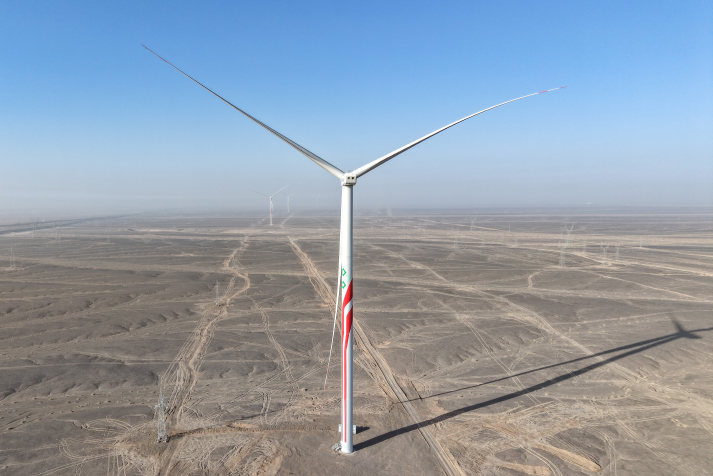 Wind turbines in the Gobi Desert in Guazhou, Gansu Province, on November 19, 2025 (XINHUA)
Gradual transition Reducing emissions while maintaining economic growth and industrial competitiveness remains a challenge. Zhou acknowledged that other challenges remain in the development of renewable energy. The instability of renewable electricity generation, along with difficulties integrating large volumes of clean power into the grid, remain key obstacles. Another challenge is the relatively low utilization rate of renewable electricity in some regions, where insufficient grid capacity and limited demand have contributed to the curtailment of both wind and solar power. To address these issues, Zhou pointed to emerging technologies and market reforms that could improve the flexibility of the energy system. Hydrogen production and virtual power plants could help balance electricity supply and demand, improving the efficiency of renewable energy use, he said. Zhou also highlighted the importance of developing a unified national electricity market. By reducing barriers to inter-provincial power trading, such a system could allow renewable electricity to be allocated more efficiently across a broader geographic area. In China, renewable resources are often concentrated in western regions, where wind and solar potential is abundant but electricity consumption is relatively limited; eastern coastal regions with higher electricity demand generally make more use of traditional power sources. According to Zhou, a combination of a more integrated power market and improved energy technologies could help resolve long-standing challenges in renewable energy transmission and consumption. "The combination of the two could solve the problems of renewable energy grid connection and absorption, allowing green electricity to achieve smooth flow from production to consumption," he said. BR Copyedited by G.P. Wilson Comments to lixiaoyang@cicgamericas.com |
|
||||||||||||||||||||||||||||
|