
|
| China |
| Przewalskii's naked carp: back from the brink | |
|
|
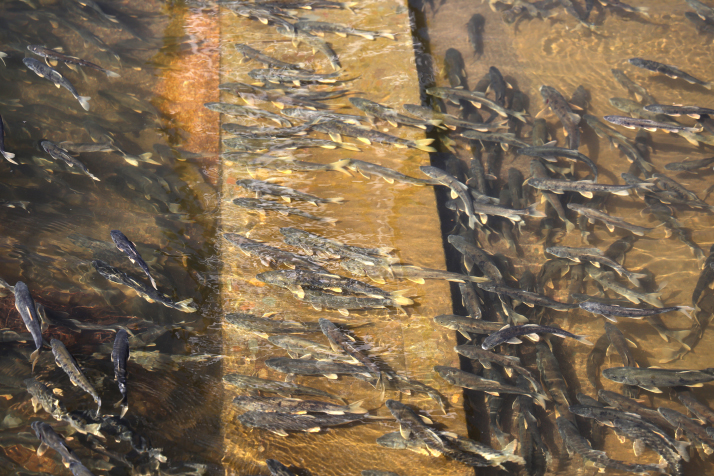 A shoal of Przewalskii’s naked carp embark on their annual mass migration in Gangcha County, Qinghai Province, on July 7 (VCG)
In July, the wind at the northern shore of Qinghai Lake sweeps across the water, weaving intricate patterns of silver ripples. Ascending the fish-viewing platform in Quanji Township, Gangcha County, Qinghai Province, a vivid panorama unfolds: Thousands of golden-brown Przewalskii's naked carp (Gymnocypris przewalskii) surge over the riverbed. They swim against the powerful current, and upon encountering stone barriers, they lash their tails with immense effort, leaping over the obstacles in a display of athleticism.
The Przewalskii's naked carp, known as huangyu locally, is a species endemic to Qinghai Lake. Characterized by their lack of scales and their remarkable ability to withstand extreme cold and high salinity, these fish are a vital link in the lake's ecological chain. Because the water of Qinghai Lake is highly saline, fish eggs cannot hatch naturally within the lake itself. Consequently, every year between June and August, mature huangyu leave the lake and swim upstream along major inflowing rivers to reach the freshwater spawning grounds in the upper reaches of the Qinghai Lake Basin. This upstream migration on a massive scale, worthy of constructing viewing platforms, is not merely a natural wonder; it is a hard-won victory of ecological restoration. 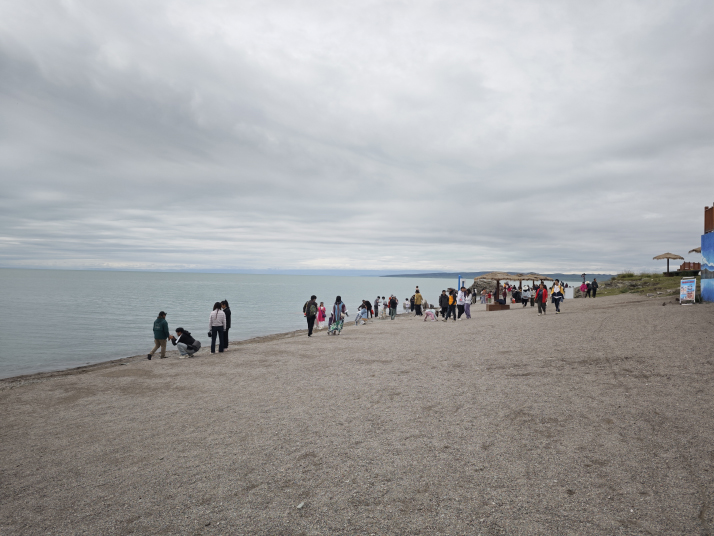 The lakeshore at the Shengquanwan Ecological Experience Zone in Gangcha on July 24, 2025 (JI JING)
A crisis overcome During the 1950s, the huangyu were abundant in the Qinghai Lake Basin. However, a combination of prolonged droughts, dropping water levels and rampant overfishing pushed this species to the brink of extinction. Official data show that the biomass of the huangyu plummeted from approximately 320,000 tons in the 1950s to a mere 2,592 tons in 2002. The collapse of the fish population sent shockwaves through the entire ecosystem. "At that time, Qinghai Lake's ecological chain was flashing red warnings. Migratory birds faced severe food shortages due to the lack of fish," Yan Yinli, Deputy Director of the Gangcha County Ecology and Environment Bureau, told news portal Chengdu.cn. Understanding the critical importance of the huangyu to the ecological integrity of Qinghai Lake, local and provincial authorities launched a systemic conservation campaign in 2002. The province implemented six consecutive rounds of fishing moratoriums, effectively halting the exploitation that had nearly destroyed the species. Simultaneously, they institutionalized a program of artificial propagation and stocking, consistently releasing fry back into the wild to bolster the population. To safeguard the migration routes of the huangyu, Gangcha pioneered a "human-plus-technology" management model. On the human front, the county maintains round-the-clock river patrols to strictly combat poaching, ensuring that the migration path remains a sanctuary. On the technological side, high-definition surveillance cameras and drone patrols have been deployed to ensure full coverage of even the most remote river sections. Researchers have also pushed the boundaries of aquatic science by using PIT (Passive Integrated Transponder) tags. By implanting microchips into approximately 180,000 Przewalskii's naked carp, scientists can now monitor individual migration patterns with precision, determining exactly where fish spawn and how they navigate specific, challenging river segments. Furthermore, state-of-the-art sonar systems have replaced traditional guesswork, allowing research teams to scan the 4,650-square-km lake and estimate the huangyu population size at a staggering 533 million as of 2025. This rigorous protection strategy has effectively closed the loopholes that once invited exploitation. Furthermore, the authorities have adopted a zero-tolerance approach toward crime, investigating 29 administrative and 17 criminal cases related to illegal fishing and seizing over 6,000 kg of illicit catch since 2023. The ecological dividend The return of the fish has also brought about the return of other life. The number of waterbirds, once starving, surged from 218,000 in 2007 to 606,000. For the local community, the "ecological dividend" has become a tangible reality, shifting the economic model of the region. The annual migration has turned into a major tourism draw, allowing the region to rebrand itself from an extractive economy to one centered on sustainability. By developing eco-friendly tourism projects, such as the Shengquanwan Ecological Experience Zone, local residents are trading their fishing nets for sustainable careers in hospitality. The Shengquanwan zone serves as the centerpiece of this transition, promoting a deep integration of ecology and cultural tourism. Capitalizing on its diverse seasonal landscapes, the zone has become a year-round destination. In summer, visitors come to witness the breathtaking scene of migrating carp coexisting with flocks of waterbirds; in winter, they encounter graceful migratory whooper swans. Lu Yan, a tourist from Anhui Province, was unable to hide her excitement as she watched the huangyu leaping through the torrents during the migration in Gangcha: "The majestic power of the huangyu swimming against the current fills me with a sense of awe for the endless cycle of life in nature," she told China Report magazine in July. Since opening its doors in 2023, the zone has achieved high-quality, rapid growth. By July 2025, the site had hosted a cumulative total of over 633,000 visitors, generating 18.4 million yuan ($2.7 million) in revenue. This economic success is directly linked to the wellbeing of the local population. The tourist zone provides diverse jobs for villagers, including roles as cleaners, security guards, drivers, ticket sellers and chefs, ensuring them long-term, stable incomes. Moreover, the project actively supports villagers in launching their own micro-enterprises, encouraging local herdsmen to leverage the influx of tourists to provide unique services such as guided horseback rides, yak-riding experiences, lakeside convenience stores and homestays. The huangyu, leaping time and again through the rushing waters of the plateau, create a harmonious scene alongside the grasslands, rivers and birdlife. This journey serves as a poignant reminder that no species exists in isolation; rather, all are part of an interconnected community of life. From the brink of extinction to a flourishing population, the dramatic turn in the fate of the huangyu is a testament to China's progress in building an ecological civilization on the Qinghai-Xizang Plateau. Copyedited by G.P. Wilson Comments to jijing@cicgamericas.com |
|
||||||||||||||||||||||||||||||
|