
|
| China |
| Beyond Prescriptions | |
|
|
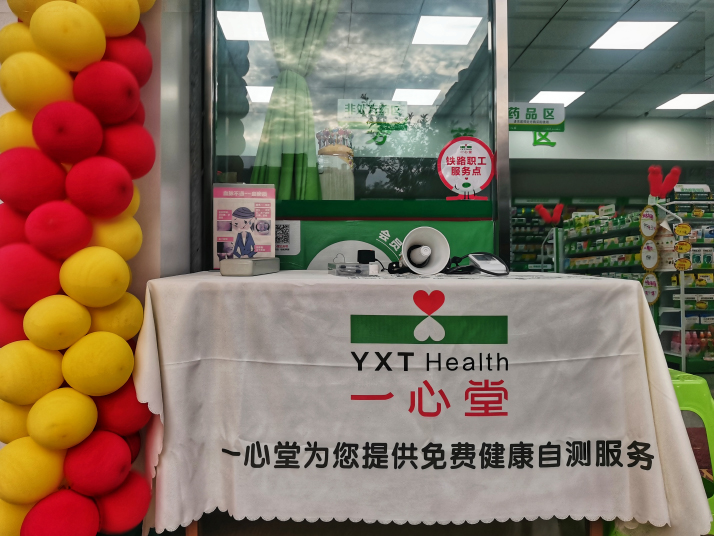 A free self-service health screening station outside a Yixintang pharmacy in Changning, Yunnan Province, on August 17, 2024, offering local residents convenient access to basic health checks
Every morning after buying groceries, 68-year-old Auntie Wang stops at the same neighborhood pharmacy in Beijing's Xicheng District before heading home. She isn't there to buy medicine. Instead, she walks to a blood pressure monitor near the entrance, slips the cuff over her arm and waits for the familiar beep with the help of a pharmacist. "Your blood pressure is looking stable today," the pharmacist said. Wang thanks her, folds the printout into her shopping bag and leaves. "If I have questions about my medicine or don't feel quite right, I come here first," Wang told Beijing Review. "Sometimes I just want someone to tell me that everything is normal." For Wang, the pharmacy has become as much a part of her weekly routine as the nearby market. She is far from alone. The pharmacy downstairs According to pharmacist Xiao Cai, people stop by every day to check their blood pressure, ask about possible side effects or simply seek advice before deciding whether a trip to the hospital is necessary. Many of them are older residents managing chronic illnesses, while others are young office workers or parents with children. "Some people don't buy anything at all, they just want answers or reassurance," Xiao told Beijing Review. "Over time, I came to know the names of many customers, and even the names of their family members." For years, these conversations have quietly become part of everyday life in many Chinese communities. Behind the medicine shelves, neighborhood pharmacies have gradually taken on another role—not replacing hospitals, but offering residents an accessible place to seek basic healthcare advice close to home. More than medicine Across China, many of the country's major pharmacy chains, including Yifeng Pharmacy, Dashenlin Pharmacy, Yixintang Pharmaceutical Group and Shu Yu Civilian Pharmacy, have expanded their neighborhood stores to offer services beyond medicine sales. Today, it is increasingly common for customers to have their blood pressure or blood sugar levels checked, receive medication consultations, have traditional Chinese medicine prescriptions prepared or seek advice on managing chronic conditions. Some of them also offer first aid for minor cuts and burns, seasonal healthcare education and other basic community health services, sometimes even inviting certified physicians to provide consultations. Some pharmacies are experimenting in smaller, but equally practical ways. Outside one store, a sign offers seasonal wellness tips based on China's 24 Solar Terms, recommending foods and simple lifestyle adjustments as the weather changes. At another, loudspeakers broadcast reminders to stay hydrated during heatwaves or protect against seasonal illnesses, turning an ordinary walk past the pharmacy into a gentle nudge toward healthier living. The exact services vary from one neighborhood to another, but the overarching direction is the same: Making basic healthcare more accessible where people live. 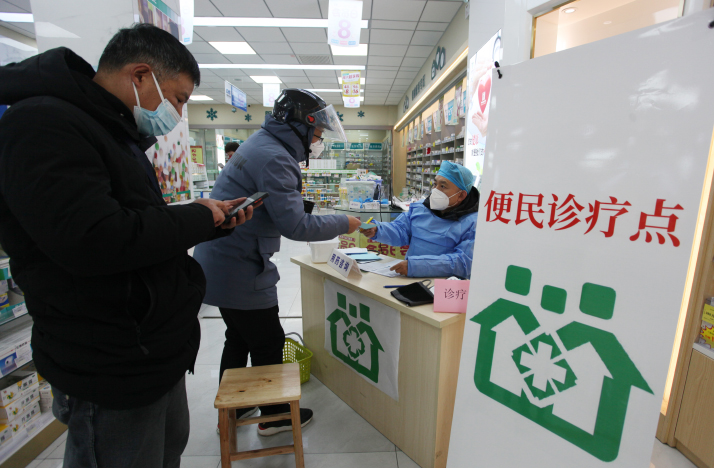 A licensed physician offers medical consultations at a neighborhood pharmacy in Yangzhou, Jiangsu Province, on December 23, 2022
A win-win transformation The growing focus on healthcare services is reshaping the business of pharmacies. For years, China's retail pharmacies competed much like other retailers, through better locations, bigger inventories and frequent discounts. While online pharmacies and instant delivery has made it easy for customers to get the medication they need, they also make drug prices more transparent and easier to compare. Price competition has become increasingly fierce, squeezing the profit margins of brick-and-mortar stores. Providing services that cannot be delivered through a smartphone has become a new way forward. "The old model of relying on product line expansion, promotions and customer traffic is becoming increasingly difficult to sustain," Ruan Hongxian, Chairman of Yixintang Pharmaceutical Group, told Xinhua News Agency. Instead, he argued, pharmacies need to build their competitiveness around professional healthcare services rather than simply selling more products. That shift is creating benefits on both sides of the counter. Residents gain easier access to health advice close to home, often avoiding unnecessary trips to crowded hospitals. Pharmacies, meanwhile, are building stronger relationships with their communities and finding new ways to stand out in an increasingly digital marketplace. Rather than competing over who can sell medicine at a lower price, many pharmacies are beginning to compete over who can provide better healthcare. From experiment to strategy As these practices spread, policymakers are seeking to turn scattered experiments into a more consistent model. Earlier this year, China released guidelines encouraging pharmacies to transform from medicine retailers into community "health stations." The policy calls for pharmacies to strengthen services such as medication consultation, health promotion, chronic disease management and emergency support. The emphasis is not on turning pharmacies into miniature hospitals. Instead, it aims to make better use of an existing network of neighborhood stores, turning these into "store pharmacies" by allowing them to handle routine healthcare needs while leaving more specialized care to hospitals. In June, the China Association of Medical Commerce joined hands with leading pharmacy chains and pharmaceutical companies to launch the drafting of an industry standard for community "health stations" at store pharmacies. The move is widely seen as a sign that the concept is entering a new phase—from individual experiments by pharmacy chains to a more standardized and scalable model. The proposed standards are expected to cover key areas such as service procedures, pharmacist training, chronic disease management and digital record-keeping, helping ensure that community health services are delivered more consistently across different regions. For pharmacies, the goal is to make the transition more sustainable. For residents, it means that the quality of services may become more reliable, regardless of which store they walk into. China's Healthy China Initiative promotes a broad vision of improving public health, not only by strengthening medical services, but also by encouraging healthier lifestyles, better health awareness and greater emphasis on prevention. As neighborhood pharmacies evolve alongside that vision, everyday healthcare is becoming easier to reach and easier to understand. A quick blood pressure check, a conversation with a pharmacist or timely advice on medication may seem like small moments, but together they are helping more people take a more active role in managing their own health. Health, after all, is built not only in hospitals, but also in the small choices people make every day. Copyedited by Elsbeth van Paridon Comments to kangcaiqi@cicgamericas.com |
|
||||||||||||||||||||||||||||||
|