
|
| China |
| Efforts to build world-class destinations for the digital age pay off | |
|
|
 Visitors film a Unitree humanoid robot at the Wensan Digital Life Block in Hangzhou, Zhejiang Province, on April 18 (YIN KANG)
For centuries, Hangzhou in Zhejiang Province has been famous for producing China's highest quality silk and tea, but in recent years, increasing numbers of tourists have visited in search of something else: robots. Once the site of an electronics street, the Wensan Digital Life Block is a digital lifestyle and innovation district that allows visitors to experience and engage with the city's latest technologies. At its main venue, Wensan Future Science and Technology Experience Center, which opened in April 2025, visitors can try on intelligent exoskeletons, interact with lifelike robotic cats, and explore technologies including AI, robotics and brain-computer interfaces. "I came here to experience hi-tech products made in Hangzhou," Ahmed Moustafa, an Egyptian economist and Director of the Asia Center for Studies and Translation, told Beijing Review. Hangzhou's changing tourism landscape is part of a broader transformation taking place across China. As visa-free access expands and services for international visitors improve, more travelers are arriving not only to see the country's traditional landmarks, but also to experience its contemporary urban life, technology and consumer culture. The trend is reshaping both where foreign tourists go and what they expect from a trip to China. The nationwide inbound boom China's inbound tourism market has continued to expand in 2026. In the first half of the year, China welcomed 22.91 million international arrivals, up 20.4 percent year on year, according to the National Immigration Administration. Of them, 17.82 million entered visa-free, up 30.6 percent and accounting for 77.7 percent of all international arrivals. Statistics by online travel booking platform Trip.com show the number of purchases on the platform by European tourists traveling to China surged by 275 percent this summer over the previous year. The platform has also observed visitors traveling beyond traditional gateways such as Beijing and Shanghai to destinations including Zhangjiajie in Hunan Province, and Lijiang and Dali in Yunnan Province, while longer and more in-depth stays are becoming more common. 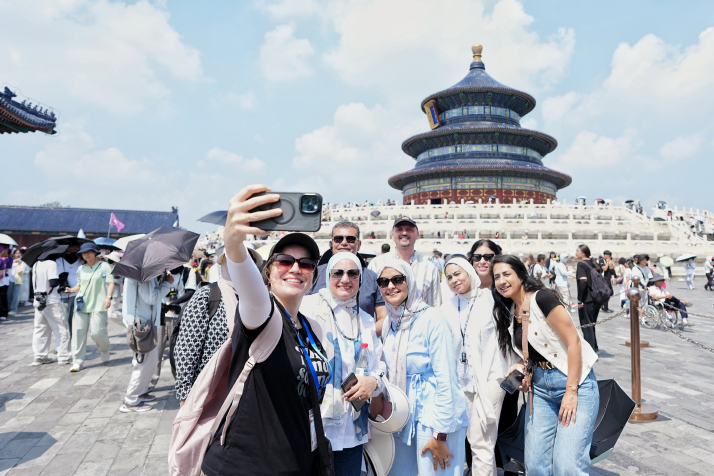 Tourists from Egypt take selfies in front of the Hall of Prayer for Good Harvests at the Temple of Heaven Park in Beijing on July 28 (XINHUA)
This growth in inbound tourism is being facilitated by a nationwide push to make entering and traveling in China easier. In March, nine government departments, including the Ministry of Commerce and the Ministry of Culture and Tourism, introduced 16 measures to promote inbound consumption. The measures call for expanding visa-free access, improving payment and telecommunications services, providing more multilingual services and further streamlining departure tax refunds. Visa-free entry has been a major driver of growth. According to Trip.com's 2026 China inbound tourism annual report, released in June, China now grants visa-free entry to nationals of nearly 80 countries, and inbound tourism from visa-free countries is growing faster than that from countries whose citizens still require visas. Departure tax refunds are another measure aimed at encouraging consumption by visitors. By July, China had more than 15,000 tax-refund stores, while the number of overseas visitors applying for refunds in the first half of 2026 was about four times higher than a year earlier. A new attraction Against this national backdrop, Chinese cities are finding new ways to distinguish themselves, both by finding new ways to share local history and culture, and by introducing technology and innovation to enhance the experience of visitors. As inbound tourism has increased, Hangzhou has emerged as one of the fastest-growing destinations for international visitors. Famed for centuries in China as a paradise on Earth, the city's location just 45 minutes by high-speed rail from Shanghai and its tourist-friendly strategies are helping it share its many charms with a global audience. In the first five months of 2026, the city received 761,000 overnight visitors from overseas, up 51.8 percent year on year, while revenue from international tourists rose 60.1 percent to $781.33 million. Now, the city is aiming not only to bring in more visitors, but also to change their reasons for visiting. For centuries, Hangzhou has had the attributes necessary to attract visitors with scenery, culture, lifestyle and cuisine, but since the early 2000s, the city has also been laying the foundations to attract tourists with technology. Back then, giants such as e-commerce and cloud computing giant Alibaba were just setting up shop in the city, but more recently, AI developer DeepSeek, humanoid and quadruped robot maker Unitree Robotics, video game developer Game Science, embodied AI pioneer DEEP Robotics, brain-computer interface company BrainCo and spatial intelligence service provider Manycore Tech have continued to build Hangzhou's reputation as a major innovation hub. At the same time, social media have helped turn Chinese technology itself into a tourist attraction. During his China tour beginning in March 2025, U.S. streamer IShowSpeed livestreamed experiences involving Chinese electric vehicles and other technologies to tens of millions of viewers, prompting widespread overseas interest in China's futuristic technologies and urban life. Hangzhou has since begun turning that curiosity into organized tourism products. In June 2025, the city unveiled its first 10 Tech Tourism Sights, 10 related routes and a technology-tourism map, covering AI, virtual reality, low-altitude aviation (below 1,000 meters), aerospace and robotics. Destinations range from Alibaba's global headquarters and AI campus to the Wensan Digital Life Block, AI Town and industrial robot testing facilities. This year, the concept has expanded from simply seeing technology to experiencing and consuming it. On July 30, Hangzhou launched its 2026 "Tour the Future, Take Tech Home" initiative, releasing 10 recommended "new tech specialties," 20 additional shortlisted products, 20 technology-tourism attractions and a series of themed study-tour routes. At the newly opened AI Hangzhou City Lounge in the Wensan Digital Life Block, visitors can interact with AI in multiple applications and scenarios, including smart offices, education, art, daily life, mobility and health. Travel agencies are following the trend. Routes combining the Wensan Digital Life Block, Alibaba and other technology sites are increasingly offered alongside Hangzhou's traditional cultural attractions. Rather than simply photographing the headquarters of a famous technology company, visitors can increasingly touch, wear and buy the products they encounter. Hangzhou's technology tourism is therefore more about experiencing how technology is becoming part of everyday urban life. "We visited the headquarters ecosystem of Ant Group, the Hangzhou-based fintech company behind digital payment platform Alipay and a longtime partner of Alibaba, witnessing firsthand how digital finance has reshaped daily commerce and global fintech standards," Moustafa said. Michael Dunford, an emeritus professor at the School of Global Studies at the University of Sussex in the United Kingdom, linked Hangzhou's technology development to a broader topic: what technology is used for. "If you produce things that are useful, if you invest, if you create the capabilities to produce things that are useful and improve the quality of people's lives, you're moving in a progressive direction," Dunford told Beijing Review. He added that Hangzhou offers a clear example of this approach. "You see extraordinary technological progress, the application of technology to useful things, to the care of the elderly, to healthcare," he said. Technology has also been woven into other tourist attractions across the city. For example, at the Archaeological Ruins of Liangzhu City, a UNESCO World Heritage-listed Neolithic site, visitors can put on virtual reality headsets and step into a 35-minute digitally reconstructed journey through the ancient city, with palaces, waterways and settlements reappearing around them. "It made me realize that what we call 'modern civilization' didn't just appear suddenly. It has very deep roots here," Hedi Hariz, Assistant Editor in Chief of the Social Affairs Department at Tunis Afrique Presse, told Beijing Review.  Tourists from Israel make rubbings using traditional techniques in Eryuan County of Dali Bai Autonomous Prefecture, Yunnan Province, on July 28 (XINHUA)
Making travel easier For international visitors, a satisfying trip is shaped not only by museum tours and corporate visits, but also by practical, everyday considerations: Can I pay conveniently? Is the hotel easy to reach? Can I get assistance in my native language? Hangzhou has been trying to answer those questions as part of its development of international tourism, aiming to improve related products, services and systems. Hangzhou is enhancing convenience across all fronts for inbound tourists. For example, at Hangzhou Xiaoshan International Airport, an international service center provides integrated assistance in finance, telecommunications, transport, tourism and information. Visitors can also access SIM card services offline and eSIM services online. China's mobile payment system has also become easier to access for international visitors, with Alipay now allowing overseas users to link international bank cards to the app before arriving in China and then to pay for goods and services by scanning QR codes after arrival. Through Alipay+, visitors can use more than 30 overseas e-wallets from 13 countries and regions at merchants across China. In 2025, more than 10 million inbound travelers used Alipay+ or Alipay's international card-binding service, while transactions made through overseas e-wallets in China surged 160 percent year on year. On August 29, 2025, the city piloted what it described as China's first one-click tax refund service for international tourists at a store of Wensli, a Hangzhou-based silk brand, cutting processing time from about 20 minutes earlier in the year to within two minutes. It has also distributed maps of tax refund stores to hundreds of locations in China and abroad. Hangzhou has also launched an English version of a tourism AI agent known as Hang Xiaoyi. The agent integrates DeepSeek's AI model to answer questions, recommend routes and handle travel inquiries. Its knowledge base now covers 383 scenic areas and cultural venues, 318 hotels and homestays, and 3,548 performances and exhibitions. Hang Xiaoyi and other cutting-edge technologies are not only assisting visitors and enhancing existing attractions, they are also themselves becoming attractions, adding to the blend of scenery, culture and innovation that make Hangzhou one of China's fastest growing, most engaging and easiest to navigate destinations for tourists. (Print Edition Title: Tech, Tourism and Transformation) Copyedited by G.P. Wilson Comments to liwenhan@cicgamericas.com |
|
||
|
||||||||||||||||||||||||||||
|