
|
| China |
| Should celebrities be allowed to have privacy? | |
|
|
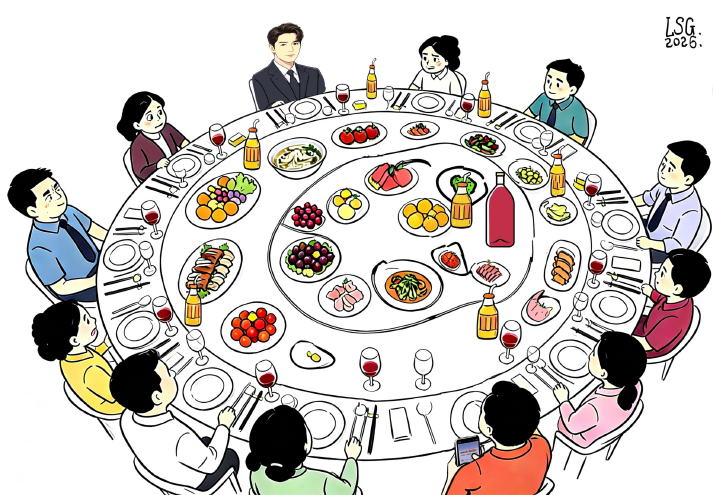 (CARTOON BY LI SHIGONG)
Comedian Jia Bing's private reunion with old friends in a private room at a restaurant in early August became a public scandal after a so-called friend secretly recorded him and posted edited clips online in which he sometimes talks dirty. This was no paparazzi ambush; it was a breach of trust by a trusted friend within a closed space in which privacy could reasonably be expected. The incident is reportedly an example of the quest for short-video traffic motivating breaches of trust. It has sparked debate over privacy, betrayal and the ethics of exploiting personal moments for short-video views. He Jiahui (Rednet.cn): The virality of the footage online has prompted legal experts to remind us that celebrities, too, enjoy legally protected privacy. The incident is a reminder of a troubling reality: the relentless chase for clicks can make us forget where public curiosity ends and personal space begins. The public has not turned against Jia; it has turned against the betrayer. Yet the blame does not rest solely on the betrayer. The platforms that allowed the video to spread before belatedly removing it and the unregulated ecosystem of freelance "private paparazzi" who treat celebrities as prey are equally complicit. Restaurants, hotels and even residential areas are becoming hunting grounds, with no clear rules governing what may be filmed or shared. The damage, however, is not merely legal—it is existential. For every artist, the fear that a casual remark, an unguarded gesture or a tearful toast to a faraway friend might become tomorrow's headline erodes the very possibility of normal life. Public figures owe their audiences their craft, not their private hours. If the entertainment industry is to thrive, it must be built on mutual respect. Regulation must step in, not to stifle coverage, but to distinguish legitimate reporting from invasive exploitation. Platforms must implement proactive content reviews, not reactive takedowns. A healthy media ecosystem is one in which artists can perform freely on stage and rest peacefully off it, and that begins with honoring the simplest of boundaries: the closed door of a private room. Huang Jing (Chengdu.cn): It is not Jia Bing who has crumbled after being secretly filmed at a private dinner; it's something far more consequential: social trust itself. The public is standing with him not out of celebrity sympathy, but because this violation hits home for every one of us. We all fear being the next person recorded without consent in what we believed was a safe space. The betrayer in this case operated with chilling calculation: first gaining entry as a "friend," then exploiting the very trust that allowed Jia to relax and finally weaponizing that relaxed moment to create viral content. This chain—trust exchanged for access, access for unguardedness and unguardedness for clicks—represents a profound moral failure. And the cost? Nearly zero. Unless the victim pursues legal action, the betrayer walks away with online traffic, while society pays the price in eroded confidence. Copyedited by G.P. Wilson Comments to yanwei@cicgamericas.com |
|
||||||||||||||||||||||||||||||
|