




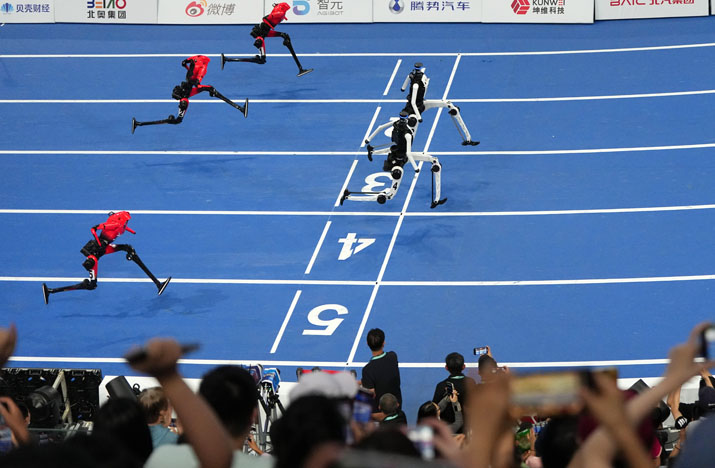
Robots compete in the large robot category of the 100-meter race at the Second World Humanoid Robot Games in Beijing on August 26 (XINHUA)
Usain Bolt's legendary 100-meter record didn't fall to any other human athlete. It has instead been beaten by a fleet of humanoid robots.
In the 100-meter final at the Second World Humanoid Robot Games in Beijing on August 26, all five finalists crossed the line in under 9.58 seconds—faster than any human in history. The winner clocked a staggering 8.64 seconds.
Their performance has improved at a breathtaking speed. Just a day earlier in the semifinals, all five qualifying bots ran sub-Bolt times.
The progress looks even more staggering when compared with last year's inaugural edition, where the champion lumbered in at 21.50 seconds, nearly 13 seconds slower.
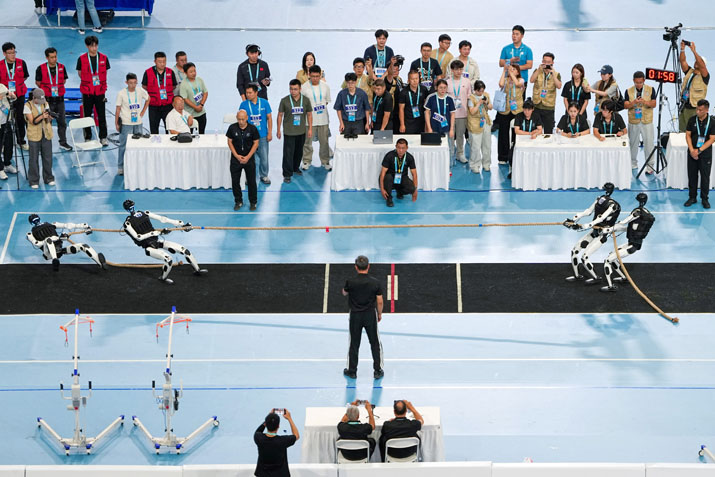
Robots compete in the heavyweight division of the Tug of War competition at the Second World Humanoid Robot Games in Beijing on August 25 (XINHUA)
Faster and smarter
The 100-meter dash was merely a preview of what unfolded at this year's Games. Across five days of competition on August 22-26, 2,056 robots from 666 teams across 16 countries went head-to-head in 51 events, shattering human athletic benchmarks right and left.
In the 400-meter event, the winning bot clocked an astounding 38.15 seconds. That doesn't just obliterate the human world record of 43.03 seconds; like in the 100-meter race, it shaves over 50 percent off last year's inaugural winning time of 1:28.03.
The 1,500-meter proved just as jaw-dropping. The champion crossed the line in 2:21.64, leaving humanity's 3:26 mark in the dust while taking more than four full minutes off last year's winning pace of 6:34.40.
Then came the standing high jump, where a bot cleared 3.4 meters, comfortably eclipsing the long-standing human record of 2.45 meters. For context: Last year's apex was a modest 0.95 meters, meaning performance effectively tripled in just 12 months.
In just one year, the World Humanoid Robot Games have evolved from clumsy machines stumbling across the finish line into a masterclass in raw mechanical speed.
Driving this leap is Tiangong Ultra, a model tailored specifically for track events. The Beijing Humanoid Robot Innovation Center told the Global Times newspaper that the bot underwent sweeping hardware and software upgrades for this year's competition, now featuring enhanced joints, a lighter frame and a streamlined body optimized for high-speed running.
On the software side, developers upgraded its motion control and shifted from basic lane-following to map-based positioning, allowing Tiangong Ultra to sprint at full speed without relying on track lines.
Beyond pushing the boundaries of mechanical performance and hardware reliability, the center emphasized its goal of balancing raw speed with natural human posture and stability. The race-tested tech is ultimately meant to pave the way for real-world deployments, including long-distance inspections, logistics and emergency response in complex environments.
Alongside returning events, this year's lineup also debuted several new disciplines, including weightlifting, table tennis and a 2v2 tug-of-war. The latter proved to be far more than a brute-force contest.
According to Gong Xiao, an organizing committee member and Deputy Director of the China Software Testing Center, the event tested real-time balance and dynamic control. "It's about whether a bot can stand its ground and pull continuously—skills directly transferable to real-world tasks like pulling and carrying," Gong said at an August 25 press conference.
The lightweight (under-40kg) tug-of-war title went to Shandong's Yobotics Team. Algorithm engineer Kong Deran explained that their bots emulated human leverage to read opponent force patterns and adjust stance on the fly.
The team also adopted a clever over-under handgrip—one palm up, one down—to prevent rope slippage. For Kong, the competition is a proving ground for practical home robotics, where reliable, high-tension gripping is essential for daily household tasks.
Grip and grit
Liu Weiliang, Deputy Director of the Beijing Municipal Bureau of Economy and Information Technology, noted that this year's World Humanoid Robot Games featured 51 events, including 21 scenario-based challenges across nine real-world applications, from household chores and fire rescue to retail assistance and book sorting.
A major crowd-pleaser was the Dexterous Hand Challenge, where bots tackled eight high-precision tasks, including weighing powder, fastening nails, opening caps and lids, and picking up beans with tweezers.
"The dexterity of these robotic hands comes down to one core factor: degrees of freedom," Chen Zhang, head of dexterous hand technology at Hangzhou-based startup Xynova, told Beijing Daily. "Every independently controlled joint adds another degree of freedom. Precise actions like handling chopsticks, opening a folding fan or gripping irregular objects all rely on having enough degrees of freedom to back them up."
Several next-generation robotic hands made an impression at this year's event with their remarkably refined builds. Now roughly the size of an adult male palm, the lightest models weigh under 500 grams. Yet even as their form factor shrinks, their load capacity keeps climbing.
Chen emphasized that the core components for these hands are now mass-produced using domestically developed tech with a fully localized supply chain. This shift to scaled manufacturing has slashed costs, laying a firm foundation for the commercial rollout of humanoid robots.
Young developers emerged as a standout force at this year's Games. In the newly introduced 3v3 U19 soccer division, every team was made up entirely of developers aged 19 and under.
Mei Jiawei, a student at Beijing No. 4 High School, rallied his classmates to form a team after learning about the new youth division.
"Most of us had a background in informatics competitions and a passion for robotics," Mei told China National Radio. "It's exciting to see these high-level opportunities opening up to younger students."
The U19 soccer event enforced strict full-autonomy rules: Once the whistle blew, any remote control or manual override was strictly forbidden. The bots had to rely exclusively on onboard vision systems and local algorithms to handle every play—from dribbling and tactical positioning to taking shots on goal.
Zhang Shiwu, Deputy Dean of the School of Engineering Science and Deputy Director of the Humanoid Robotics Institute at the University of Science and Technology of China, told China National Radio that introducing high-stakes competitions to primary and secondary school students builds a crucial talent pipeline for the industry.
"Humanoid robotics is advancing at breakneck speed, creating an enormous demand for talent, especially interdisciplinary specialists," Zhang said. "Getting younger students involved turns them from passive observers into hands-on builders. They gain real-world exposure to hardware architecture, algorithm optimization and real-time tactical processing long before entering the workforce."



