
|
| China |
| Who runs the block? The battle over community trust and the bottom line | |
|
|
 LI SHIGONG
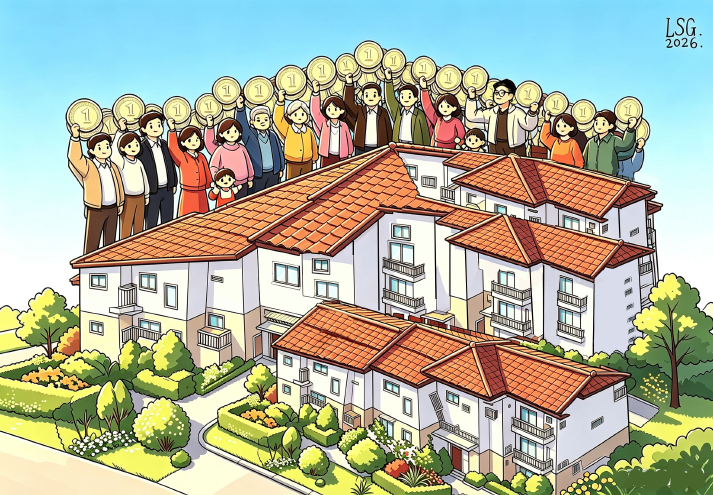
The recent withdrawal of property management firms from residential complexes has sparked public debate, with the companies citing financial pressures and difficulties in collecting management fees. In some communities, these departures have disrupted services such as waste collection, security and elevator maintenance. The situation raises questions about whether the traditional property management model needs reform and, more importantly, how communities can break the cycle of declining service quality, withheld payments and eventual withdrawal. Zhou Lifang (China Comment): The current deadlock requires two-way standardization. Property companies must deliver exactly what their contracts promise, i.e., adequate staffing for cleaning, security and maintenance, while opening their books to homeowners' scrutiny. Transparency is non-negotiable. Regular public reporting of all income (including advertising and parking) and expenditures must be mandatory. Government bodies, sub-district offices and resident committees must step up as enforcers. They need robust evaluation and exit mechanisms to hold companies accountable, intervening when staffing is short or disclosures are withheld. At the same time, residents must be guided toward rational rights protection and timely payments, with legal consequences for willful defaulters. Zhao Xiaodan (Dzwww.com): Recently, a residential community in Jinan, capital of Shandong Province, abandoned traditional property management in favor of a self-governance model that charges just 1 yuan (about $0.14) per household per day. The results are striking: Fee collection rates have soared from under 10 percent to over 90 percent, and a once-neglected, chaotic neighborhood has been transformed. Other than cutting costs, this is about dismantling the trust deficit that plagues conventional property management. Under the for-profit model, fees based on the size of an apartment often felt arbitrary, service scopes were vague and financial records were shrouded in secrecy. Residents suspected hidden profits, while managers complained of financial strain. This mutual suspicion trapped many communities in an endless loop of "new managers, new conflicts and eventually withdrawal of services." The Jinan model offers a dual breakthrough. First, it replaces complex, area-based fees with a flat daily rate, removing perceived unfairness and lowering psychological resistance to payment. Second, it establishes a co-governance structure involving multiple stakeholders. Issues are addressed weekly—minor ones resolved immediately and major ones debated collectively. Funds are held in a bank account, professionally accounted for and disclosed semi-annually. Revenue from public parking is reinvested into the community, severing any channel for hidden profit. Ultimately, this model proves that neighborhood governance is not a commercial transaction but a civic partnership. While market-driven firms prioritize profit, self-governance returns decision-making and oversight to the people. The 1-yuan fee lowers the barrier to participation, while transparent management rebuilds the foundation of trust. BR Copyedited by Elsbeth van Paridon Comments to yanwei@cicgamericas.com |
|
||||||||||||||||||||||||||||
|