
|
| China |
| New canal project links southwest China more closely with global markets | |
|
|
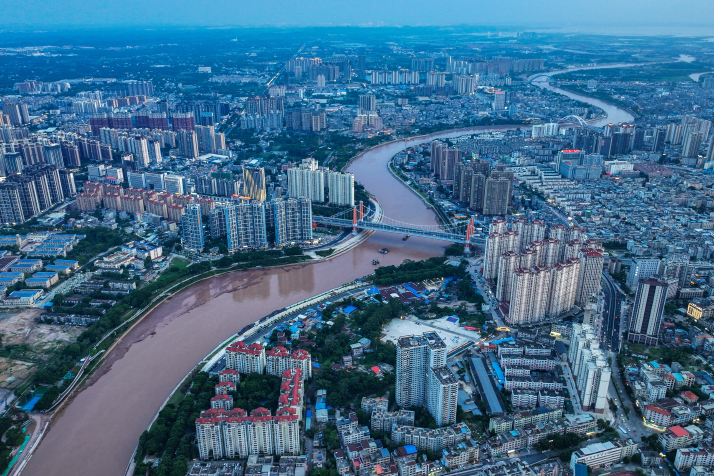 The Pinglu Canal in Qinzhou, Guangxi Zhuang Autonomous Region, on August 19 (XINHUA)
A megaproject four years in the making, the Pinglu Canal officially opened to shipping on September 16. The 134.2-km canal runs from Hengzhou, a county-level city in Guangxi Zhuang Autonomous Region of south China, to the Beibu Gulf, the closest maritime gateway for southwest China. It is the first river-to-sea canal project planned and coordinated at the national level since the founding of the People's Republic of China in 1949. That morning at the Madao Hub, near the upstream end of the canal, a whistle blasted as the first ship eased through the enormous gates. Word soon reached Qinzhou Port on the Beibu Gulf, where Ling Guohua, an operations manager at Beibu Gulf-PSA International Container Terminal Co. Ltd., announced: "The river and the sea are finally connected." The canal's significance goes far beyond simply adding another waterway. It is a strategic upgrade for Guangxi as a whole and for southwest China more broadly.  A visitor at a photo exhibition themed on the Pinglu Canal in Beijing on September 15 (XINHUA)
A strategic upgrade For decades, the Xijiang River, China's second-busiest inland waterway after the Yangtze, and the sea were cut off from each other by a stubborn stretch of land. Goods from southwest China had to sail east along the Xijiang River-Pearl River waterway and make a long detour through the Pearl River Delta, with the inland voyage alone running more than 800 km. The Pinglu Canal changes that. Designed for vessels of up to 5,000 tons, it is the shortest waterway route between southwest China and ASEAN, and forms part of the New International Land-Sea Trade Corridor, a strategic route launched in 2017 to link China's inland regions with ASEAN and other global markets. Now, freighters can turn south onto the Pinglu Canal and head straight to the Beibu Gulf coast, cutting the trip by roughly 560 km. It is expected to reduce overall logistics costs, saving more than 5 billion yuan ($746 million) in transportation costs each year, Zhang Zhiwen, Deputy Secretary General of the Guangxi Zhuang Autonomous Regional Government, told media. Take bulk cargo from Baise in Guangxi as an example: Shipping it out through the Pinglu Canal instead of the traditional Xijiang River-Pearl River route cuts transit time by nearly half. Guangxi Rizon Sion Sci-tech Co. Ltd., a papermaker in Hengzhou, used to send its goods down the Xijiang to Huangpu Port in Guangdong Province for export, about a seven-day trip each way. With the Pinglu Canal, it now reaches open water in roughly one day. That saved time adds up to real money. Zhang said that with the canal's opening, the logistics costs of goods from southwest China reaching the sea will be 18-30 percent lower than by the traditional route. For bulk cargo and containers moving long distances, water transport has clear advantages over road and rail: It carries more, costs less and uses less energy. By one estimate, moving a ton of cargo 1 km by inland waterway costs a quarter of what it does by rail and a fifteenth of transporting it by road. For many local companies, the money saved on logistics will go toward research and development and market expansion, including upgrading production processes, developing higher-value products and strengthening sales channels across southwest China and ASEAN. The project is expected to directly boost GDP by about 180 billion yuan ($27 billion), having created more than 420,000 jobs during construction and supporting 260,000 to 410,000 jobs once in operation. The design team estimates that the canal could add another 130 billion to 200 billion yuan ($19 billion to $30 billion) to GDP along its route each year. Shared opportunities Construction of the Pinglu Canal began in August 2022. The canal has been incorporated into national-level plans including the National Comprehensive Three-Dimensional Transport Network Plan and the Master Plan for the New International Land-Sea Trade Corridor in West China, which aims to connect China's western inland regions with a seaport on the Beibu Gulf, open up a land-sea intermodal corridor, and underpin the opening up and development of the west. The National Development and Reform Commission, the Ministry of Transport, the Ministry of Water Resources and other central government departments have provided support and guidance on multiple fronts for the canal's construction and the integrated development of the canal economic belt. "The Pinglu Canal is turning southwest China from a hinterland in China's opening-up into a frontline facing ASEAN," Liu Yunzhong, a researcher at the Department of Development Strategy and Regional Economy of the Development Research Center of the State Council, told newspaper China Youth Daily. With the canal's low-cost water transport, Guangxi, as well as Yunnan and Guizhou provinces, can build up industries that move large volumes of goods, such as phosphorus chemicals, green new materials, paper, grain and oil, turning minerals and agricultural resources into inputs for ASEAN's manufacturing sector. Liu added that the canal would also support the implementation of rules of the Regional Comprehensive Economic Partnership (RCEP) and the China-ASEAN Free Trade Area 3.0. The zero-tariff benefits of the RCEP can only be fully unlocked with low-cost logistics. "The canal lowers the barrier to cross-border trade in bulk commodities, expands trade between the two sides in agricultural products, resources and basic industrial goods, and will drive a finer division of labor across supply chains while making regional supply chains more resilient," he said. "Benefiting from the canal, ASEAN companies can gain easier access to China's vast inland market and diversify their supply chains," Wilson Lee Flores, a columnist for newspaper The Philippine Star, told Xinhua. He added that the canal also makes investment in areas of inland China more attractive, and for Chinese enterprises, they can deepen their engagement with the dynamic economies of resource-rich Southeast Asia. "Infrastructure such as the Pinglu Canal can turn geographic proximity into practical economic opportunity and inclusive development," Flores said, adding that it should be efficiently operated and complemented by sustainable policies. At the mouth of the Pinglu Canal, the China-Malaysia Qinzhou Industrial Park is reorienting its layout toward ASEAN. According to the park's economic development department, it will continue to upgrade the Two Countries, Twin Parks cooperation, building closer industrial links with the Malaysia-China Kuantan Industrial Park in Malaysia. Leveraging the canal's logistics corridor, the two sides will pursue two-way investment in areas such as auto parts, halal food and palm oil processing. Up until now, 17 Malaysian investment projects have landed in the park. (Print Edition Title: Waterway to the World) Copyedited by G.P. Wilson Comments to luyan@cicgamericas.com |
|
||||||||||||||||||||||||||||||
|








