
|
| China |
| Echoes of the Long March | |
|
|
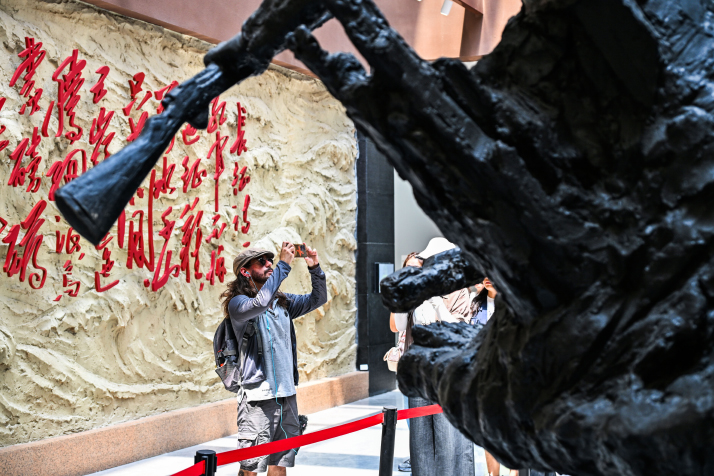 Álvaro Lorite López visits the Luding Bridge Memorial Hall in Luding County, Garze Tibetan Autonomous Prefecture, Sichuan Province, on July 4 (WEI YAO)
Between July 3 and 12, a team of reporters from China International Communications Group outlets, including China Hoy (the Spanish version of China Today) and Beijing Review magazines, took a trip that followed in the footsteps of the Communist Party of China (CPC)-led Red Army during its passage through Sichuan Province in southwest China during the Long March (1934-36). Throughout the journey, one recurring question was: What is the spirit of the epic military maneuver? And what remains of that spirit today, 90 years after its victory? In Red Star Over China, written in 1936 during his travels through what was called Red China, or the CPC revolutionary base area in northwest China, American author Edgar Snow explains how, to a large extent, "class struggle in China could be seen in the conflict between the mintuan (paramilitary armed groups serving the Kuomintang regime) and the CPC-led guerrillas, since these battles were very often a direct armed conflict between landlords and their former tenants and debtors." In other words, much of the popular support the Red Army won along the Long March came from their helping peasants recover ownership of their land. That was one of the main material bases on which the growth of popular support rested. The Battle of Luding Bridge "About 200 km west of the village of Anshun in Sichuan, the gorge through which the Dadu River rushed was very deep and narrow. There was a suspension bridge of metal chains there, the Luding Bridge. It was the last possible crossing of the Dadu River to the east from the Tibetan region. The communists set out for that point, marching barefoot along a path that wound through the gorges, sometimes climbing several hundred meters, sometimes descending again to the level of the swollen stream and wading through mud that reached waist-deep. If they seized the bridge, the entire army could enter central Sichuan. If they failed, they would have to retrace their steps, a detour of more than 500 km from which few men would survive." This is how Snow described the beginning of one of the most epic and decisive battles of the Long March—and the fate of the nation. In May 1935, the Red Army reached the Dadu River, harried by Kuomintang troops. Without resting, the exhausted soldiers covered some 120 km in a single day and night. When they reached the bridge, almost all of the planks had been removed; only the 13 iron chains that made up the bridge's skeleton remained. Although it is difficult to establish precisely what happened, according to testimonies recorded in different historical accounts, a group of 22 brave young men, covered by the fire of their comrades and under enemy fire, began crossing it. Four fell into the raging waters below, but 18 managed to reach the other side, seizing one of the turning points that determined the history of the Long March. Memories of that crossing still live on among the people who inhabit these areas today. "The Red Army arrived in this area and stayed for a while. The area was being exploited by the Kuomintang and it was not a good time for us. The arrival of Comrade Mao Zedong and the CPC meant an improvement, which is why I have his photo on the wall; in this village everyone holds him in deep respect," Sulan Duoji, a young man who runs a specialty coffee shop in a village in Barkam, Aba Tibetan and Qiang Autonomous Prefecture in Sichuan, told us. Deng Anmei, who works at a hotel near the Luding Bridge, also keeps alive the stories of the Red Army's passage. "Locals were very poor at that time. They hardly had any wood, but when they learned the Red Army was coming to help, some used their own doors to make access easier for the troops. It was a spontaneous local organization. Back then this area was a big trench; you couldn't cross by walking—they had to lay down wooden planks. Years later the land was leveled and this part was assigned to my father's household, so I had the honor of being able to work that plot," she explained. In 1984, a memorial for the heroes who died in the battle of the bridge was erected. The courage, determination and resilience of these young people showed their willingness to sacrifice themselves for the common good of the people. They had come from many areas where peasants had been stripped of nearly everything. Perhaps another key to approaching the spirit of the Long March lies in this story: the determination to set and pursue a collective objective and to fight for it—even at the cost of one's own life. A spirit that speaks to the importance of bonds between people. Wide support Leng Li and Chai Fuqin are CPC members in the village of Chuni, Sichuan, where they cultivate fruit trees. They sell their produce in big cities far away thanks to online sales channels. The cherry orchard surrounding the village was one of the places where the exhausted soldiers were able to stop and refuel. "The villagers were surprised that the Red Army troops were not noisy and did not bother the villagers. They did not steal or take anything by force when they passed through here. It was the first army they had seen that dressed as poorly as they did. So it didn't take long for people to do everything they could to support them," they recounted. There were not only epic battles. To win the respect, support and friendship of people of all ethnic groups in the area, the Red Army had to rely on words and negotiation. The rules of conduct required of all soldiers as they passed through villages, namely, prioritizing respect for locals, are well-known and are mentioned in Snow's book. At that time there was no standardized spoken Chinese and most of the population was illiterate. Because of this, the linguistic work of translators was essential to establish alliances and friendships along the way. Snow recounted how, upon reaching the territory of the Lolo tribes (traditionally presented as enemies of the Han ethnic group) north of the Dadu River, the Red Army "managed to win their friendship." Part of this was thanks to the work of senior Red Army commander Liu Bocheng, who went on to become a founding father of the People's Republic of China in 1949. Liu knew those tribes well, including their worldviews and customs. Thanks to his language skills, Liu managed to convey the idea that together they were fighting a common enemy, the warlords, and that the policy of the CPC was to favor the autonomy of China's ethnic minorities. Thus an agreement was reached in which several members of the tribes even joined the vanguard of the Red Army on the Long March. What at first was a strategic retreat gradually transformed into a movement of expansion on the ground, as well as the consolidation of an ever-growing force based on popular, peasant support. BR The author is a Spanish editorial consultant with China Hoy, a Spanish-language sister publication of Beijing Review Copyedited by Elsbeth van Paridon Comments to linan@cicgamericas.com |
|
||||||||||||||||||||||||||||
|








