
|
| China |
| How a remote steppe in Inner Mongolia became the beating heart of China's AI boom | |
|
|
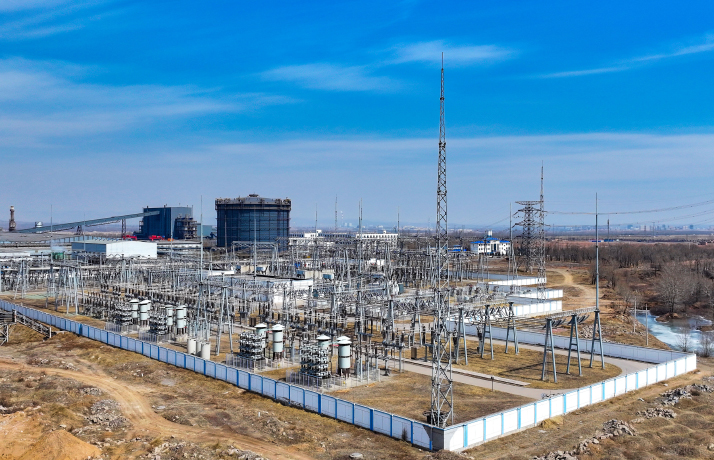 A new-energy substation in Ulanqab, Inner Mongolia Autonomous Region, on March 20
The landlocked territory of Ulanqab, a little-known city in Inner Mongolia Autonomous Region, was once defined by its scarcity. Buffeted by frequent winds and locked in winter for five months each year, the city's only real distinction, if it had one, was as China's "potato capital," producing 4.5 million tons annually—6 percent of the national total. Then came the AI explosion. In a data-hungry era, Ulanqab's historic liabilities transformed into prized assets. Sub-zero air slashes server cooling costs. Biting gales generate cheap, abundant wind energy. Endless, empty steppes provide vast, inexpensive land. A region once left behind now commands precisely what the digital frontier hungers for. When DeepSeek, one of China's premier AI developers, expanded its hiring roster beyond the glass towers of Beijing and Hangzhou, Zhejiang Province, it added a third location: a wind-swept outpost on the northern steppe. The offer was hard to ignore: 15,000 to 30,000 yuan ($2,100 to $4,200) a month for a senior engineer willing to manage server racks on the open grassland. To outsiders, the role sounded like an eccentric hi-tech exile. But in the physical architecture of China's AI boom, the move made perfect sense. The digital turn  Workers sort Blu-ray discs at Zhonghongzijing Intelligent Computing Center in Ulanqab, Inner Mongolia Autonomous Region, on May 12, 2025 XINHUA
Locals like Luo Dongmei and her husband felt the seismic shift long before anyone put a name to it. The couple's small diner sits in Basumu, a quiet village on the outskirts of Ulanqab, just a short distance from the humming server farms of the Chahar High-Tech Development Zone. "Years ago, there was hardly anyone around. On a good day, we brought in 500 yuan ($70)," Luo recalled. "Then the big data hubs arrived. Suddenly, we couldn't keep up with the crowd. Now, we pull in over 2,000 yuan ($280) a day." As technicians arrived to build and tend the server farms, growth came in rapid succession. Luo expanded into a larger building, hired extra hands and eventually opened a modest inn. Across Basumu, the quietness gave way to unexpected hustle. Derelict farmhouses, long left to crumble, were repurposed into lodgings, with a 20-square-meter room now fetching 1,600 yuan ($225) a month. In place of idle fields, a micro-economy of inns and corner markets swiftly took root. For generations, the surrounding township of Bayintala subsisted on a fragile cycle of farming and herding. Opportunities were narrow, and a steady exodus of young people left for distant metropolises. The development of the digital technology has rewired the once sleepy agrarian outpost into a digital infrastructure base, fueling the local economy. Du Xile, a local official, measures the transformation in stark arithmetic: "Before 2023, the entire township had just four places to eat. Today, there are 35, alongside 10 new supermarkets." Yet Ulanqab's viral turn was no happy accident or sudden lucky strike. Over the decade before "AI" became a household term, the city had been laying its digital foundations. Back in 2013, Ulanqab partnered with Huawei, a provider of information and communications technology infrastructure and smart devices, to build its first cloud data center. At the time, the country's cloud market was still in its infancy, and hardly anyone in town could clearly explain what "big data" actually meant. In 2017, the city established its own Big Data Administration, a forward-looking bureau that soon made a decisive gamble: That same year, the city began laying two direct, high-capacity fiber-optic cables connecting straight to Beijing, 240 km away. With very few enterprises in the industrial park at the time, the costly project offered little chance of immediate return. But the technical specs were staggering: With each pair of lanes in the cable carrying 8,000 gigabits of data every second, the delay before information travels to its destination and back—what tech experts call "latency"—fell to just 4.2 milliseconds. That is roughly 50 times faster than the blink of an eye, allowing tech firms in Beijing to run computations on Ulanqab's servers as seamlessly as if they were sitting next door. The investment paid off quickly. In 2018, tech giant Alibaba broke ground on its own cloud base in Ulanqab. Wang Chaoyang, General Manager of Alibaba Cloud's Global Data Center, explained to National Business Daily that for latency-sensitive industries like quantitative trading and online gaming, that fiber-optic cable was a game-changer. Equally vital was physical proximity. "Being a comfortable 100-minute high-speed rail ride from the capital meant Beijing-based engineers could be on-site in Ulanqab the very same day if troubleshooting was needed," Wang said. The silicon prairie A turning point came in February 2022, when China launched its national "east data, west computing" initiative, a sweeping policy to shift computing demand from crowded eastern cities to energy-rich western regions. Ulanqab was designated as one of eight primary national hubs. Still, that policy mainly targeted general data processing. What truly set Ulanqab ablaze was the generative AI wave that followed. Between late 2022 and 2023, Ulanqab executed a critical pivot, upgrading its infrastructure from general CPU (Central Processing Unit) processing to high-performance GPU (Graphics Processing Unit) AI clusters. Investments from tech giants like Huawei, Alibaba and Apple poured in. By 2026, total signed investments in Ulanqab topped 500 billion yuan ($70 billion) across more than 100 major projects. Alibaba alone pledged over 10 billion yuan ($1.4 billion). "When it comes to data center site selection in Ulanqab, the single most critical factor is the price of electricity," Wang said. "Electricity in Ulanqab costs roughly 0.3 yuan ($0.04) per kilowatt-hour. For a massive one-gigawatt facility, running those servers in Ulanqab saves approximately 5 billion yuan ($700 million) a year in power bills alone compared with the developed eastern coast." Foreign institutions also took notice, with Goldman Sachs labeling Ulanqab "one of the largest and fastest-growing AI computing hubs in the Asia-Pacific region." Today, Ulanqab reliably handles 75,000 petaflops of overflow computing demand from Beijing. One petaflop is 1 quadrillion floating-point operations per second. DeepSeek, ByteDance, Alibaba and Baidu all run large language model training inside server halls built on this wind-swept steppe—powering frontier applications from computer vision and autonomous driving to advanced chip design. In 2024, Inner Mongolia took another step forward with the launch of the North Frontier Computing Research Institute at Ulanqab-based Jining Normal University, the autonomous region's first specialized institute dedicated to computing power. The platform gave Ulanqab a home-grown engine for research, technology transfer and workforce development. Local colleges teamed up with industry leaders like Huawei and Lenovo to build practical training bases, turning out more than 2,000 computing professionals each year. Zhao Xin is one of those swept back home by this tide. A native of Ulanqab, Zhao spent years working in the tech sector in Tianjin. Watching his hometown's rapid transformation, he decided to return. "I used to think that real opportunity only existed in big cities," Zhao admitted. "Now, with the local computing industry booming, there are plenty of jobs. I can build a solid career without having to live away from home." Local institutions like Ulanqab Vocational College have partnered with giants like Huawei to run targeted classes in server maintenance and network security, placing over 1,000 graduates into tech roles with employment rates above 90 percent. From research institutes to vocational classrooms, from humming server racks to the desks of young engineers, Ulanqab is translating a massive national strategy, the westward migration of computing power, into the everyday lives and livelihoods of its people. Copyedited by G.P. Wilson Comments to yuanyuan@cicgamericas.com |
|
||||||||||||||||||||||||||||
|