
|
| China |
| Footsteps across time | |
|
|
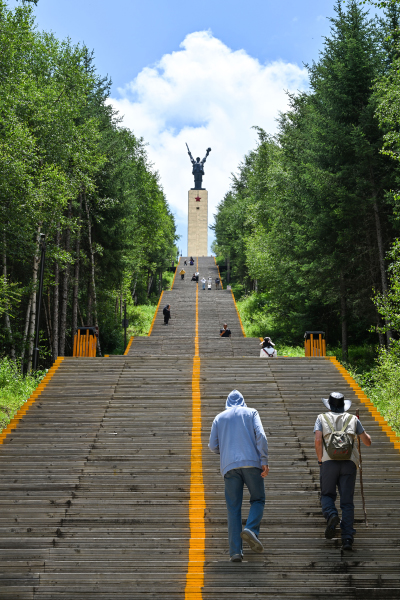 David Ferguson (right) and Iain Inglis climb the steps toward the Red Army Long March Monument in Songpan County, Aba Tibetan and Qiang Autonomous Prefecture, on July 10 (WEI YAO)
When U.S. magazine Life compiled its definitive list of the 100 most important events of the past millennium, it ranked the Long March in China at No. 64. The editors' rationale was uncompromising: The epic journey of the Chinese Workers' and Peasants' Red Army from October 1934 to October 1936 directly paved the way for the founding of the People's Republic of China in 1949. Ninety years after the journey during which tens of thousands of lives were lost to enemy fire, frozen mountain passes and treacherous marshlands, how does this monumental epic translate for a contemporary international audience? Can observers who did not grow up with these stories truly grasp their emotional weight? To find out, three foreign visitors—David Ferguson, a veteran British journalist who has worked in China for over two decades; Zhavier Harris, a communications executive from the U.S. state of Illinois; and Iain Inglis, a long-time British expatriate based in south China—traversed the original route at the invitation of China International Communications Group. Through their cross-cultural observations and personal reflections, the Long March emerges not merely as a chapter in Chinese history, but as a universal story of human endurance, comradeship and unyielding conviction. The calculus of conviction For Ferguson, honorary Chief English Editor of the Foreign Languages Press in Beijing who has closely observed China, understanding the Long March requires stripping away hindsight and confronting the brutal military realities faced by the Red Army in 1934. Reflecting on the early, devastating battle at the Xiangjiang River, where the Red Army lost nearly half its force in a few days, Ferguson noted how the decision to push forward defied conventional military logic. "Now, I don't think there has been another military engagement in modern history where one of the armies lost half its force. I think if there had been, most armies would have given up at that point and said 'we're beaten' and surrendered, but the Red Army didn't do that. They carried on fighting and they carried on the struggle for months—and years," he told Beijing Review. What sustained them through such an immense trial? Ferguson pointed to a genuine belief in their cause: "There are a lot of qualities that contributed to the fact that they kept on going. That fundamental among them must have been a genuine belief in the cause that they were fighting for that no matter of how many of them fell by the wayside, those who were still standing would not give up." For Ferguson, their perseverance inspires a sentiment that crosses national borders. "Everybody admires strength, everybody admires courage, everybody admires comradeship, everybody admires unity," he said. "So what people need to do is find ways of telling that story to people who are receptive to it and make it mean something to them." Cultural empathy While Ferguson provided a structural perspective, Harris, Marketing and Communications Manager for the Springfield Urban League, a community outreach non-profit in Illinois, brought an intimate, cross-cultural empathy to the journey. First retracing the route as a college intern a decade ago, Harris returned for the 90th anniversary to witness how history is being preserved and reinterpreted. Walking across the historic Luding Bridge and gazing at Mount Gongga in Sichuan Province, he described the landscape to his mother during a FaceTime call: "I share with her how we're walking through history... I tell her all the time that everywhere you go in China is living wallpaper," he told Beijing Review. Yet beneath the dramatic scenery lies a deeper human connection. As an African American, Harris views the Red Army's perseverance through the lens of his own community's historic fight against systemic hardship. "Stories of perseverance, stories of overcoming extreme adversity are universal. Every community has struggled with difficulties. As African Americans, we went through 400 years of enslavement, we went through the civil rights movement and we deal with prejudice and racism on a daily basis," he said. "I think that when we talk about everyone having their own Long March, everyone persevering, we can better empathize with each other," he said.  Children cheer as they pose for a group photo at the Qiuji Township Central Kindergarten in Zoige County, Aba Tibetan and Qiang Autonomous Prefecture, Sichuan Province, on July 9. In August 1935, the Red Army fought a two-day and two-night battle in the township, breaking through enemy lines and opening a vital passage to the north (WEI YAO)
Living memory For Inglis, a British linguist and bilingual TV host based in the southernmost Chinese province of Hainan, the Long March offers an existential lesson in human endurance. First introduced to the story as a teenager when his mother read American author Edgar Snow's Red Star Over China, Inglis experienced the reality firsthand while scaling the freezing slopes of Sichuan's Jiajin Mountain, the first snow-capped mountain the Red Army crossed during the Long March, and crossing the treacherous Songpan Marshlands, where roughly 10,000 or more Red Army soldiers are believed to have perished across 1935 and 1936. Pondering how exhausted, ill-equipped soldiers kept moving step by step, Inglis attributed their survival to what he termed "micro-solidarity." "The rank-and-file soldiers, I guess, were kept moving, perhaps one by a sort of solidarity with their comrades, in the ranks of the army, a sort of micro-solidarity," he told Beijing Review. "For example, if I stop moving, then you might stop moving, too. But if you're moving and he's moving, then I have to move too. You're getting your energy from one another," he said. For Inglis, this act of remembering is closely tied to his family life in China. As a father whose daughter is a member of the Chinese Young Pioneers (a school-based organization of children aged 6 to 14), learning this history is both a mark of respect for his adopted home and a personal duty: "The first reason is: China is my home now. It's important as a mark of respect to China to try to learn about its history." Why is China the way it is today? According to Inglis, the reason is in part the Long March. BR Copyedited by Elsbeth van Paridon Comments to taozihui@cicgamericas.com |
|
||||||||||||||||||||||||||||
|