
|
| China |
| Leftover spaces are becoming some of the city's most useful corners | |
|
|
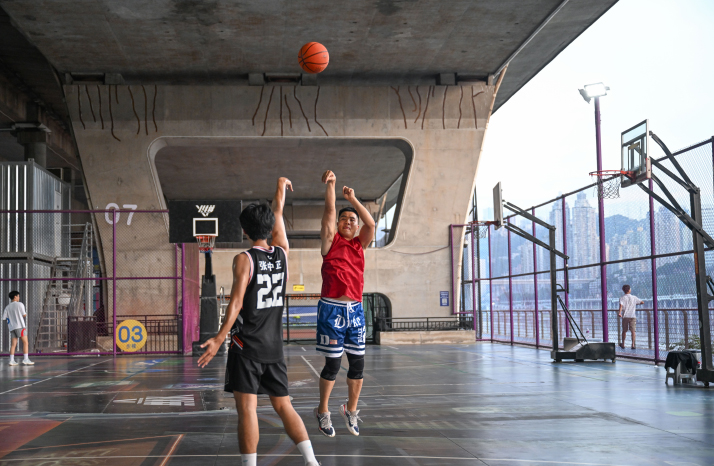 Residents play basketball under a bridge in Chongqing Municipality on August 10 (KANG CAIQI)
Dawn has barely broken, yet an open lot in an old residential compound in Changchun, Jilin Province, is already bustling with activity. Senior residents sit chatting on benches, taijiquan (tai chi) practitioners move in graceful motions and children run around playing. "Just a year ago, everyone avoided this several-hundred-square-meter spot," Wang Yongjun, a local retiree, told Beijing Review. He remembered that weeds grew tall and rubbish was scattered everywhere. Many dumped old furniture and waste here, while some even fenced off small patches of land without permission to use as private storage spaces. Whenever it rained, water pooled all over the place, bringing swarms of mosquitoes and bugs. Anyone passing by wanted to hurry away. With the support of the local government, today, this once neglected eyesore has turned into a small community park for nearby residents to relax in. Transformations like this are taking place in alleyways across many cities in China. Such small-scale urban renewal is no longer about tearing down and rebuilding whole neighborhoods. Instead, it focuses on those tiny, overlooked pockets of vacant urban land: corners of residential compounds, areas under viaducts, abandoned small yards and neglected strips beside boundary walls. Rather than carrying out massive demolition or pouring in enormous funds, it relies on incremental, small upgrades. These forgotten nooks are transformed into local public spaces where ordinary people can stop to rest and engage in leisure activities close to where they live. In May, the State Council, the highest state administrative organ, issued an urban renewal plan for the 15th Five-Year Plan period (2026-30), which outlines goals to improve the quality of urban public services and make full use of existing vacant buildings and underutilized land, prioritizing efforts to shore up weaknesses in public service facilities related to people's wellbeing. From forgotten to useful Abandoned corners of cities are each forgotten in their own way. Some sit beneath elevated highways, empty for years or cluttered with junk. Some are weathered factory buildings left behind after companies moved out, lying quietly in some corners of the urban landscape. Others are odd scraps of land between neighborhoods that no one pays attention to, overgrown with weeds and strewn with trash. What they have in common: They're scattered, small and hard to develop as one piece, long overlooked in the way cities are run. And yet these very "forgotten corners" hold huge potential for making cities better places to live. A circular on national fitness during the 15th Five-Year Plan period released by the State Council on July 23 called for making the most of the city's leftover nooks and crannies. In Yunlong District, Xuzhou, Jiangsu Province, a 3,800-square-meter plot beside an arterial road had been sitting idle since an old shirt factory was torn down there. Rather than leveling the site, designers worked with the natural slope to create a terraced garden. One side has an open plaza with rows of trees, a spot for morning workouts and a children's playground. The other side winds along as a quiet garden path for those who just want to sit down and relax for a bit. A covered walkway connects the two, keeping the lively and quiet areas separate so they don't disturb each other. In the Xiaoliujiawan Residential Community in Wuhan, Hubei Province, residents were asked what they wanted through online and offline surveys before the makeover of an abandoned space. Today, plants they planted themselves dot the space. Unexpected sports space 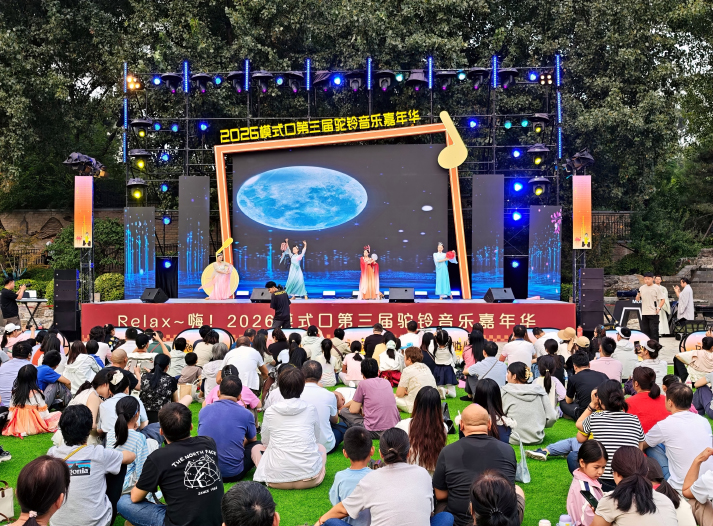 A themed event is underway during the Mid-Autumn Festival holiday at a pocket park in Beijing on September 25 (LU YAN)
One of the most obvious changes these micro-makeovers have brought is new places for sports. Dongxiaokou Town, in Beijing's Changping District, once featured the biggest scrap-recycling market in north China. After the site was cleared and the soil cleaned up, the land wasn't just planted over with grass. Instead, it became Changping's first air-supported sports hall, with four standard tennis courts, smart temperature control, glare-free lighting and a fresh-air system. The hall sits under a giant air-supported membrane structure, which is why it can be built quickly and cheaply on sites like this. It uses over 30 percent less energy than a regular building and stays open all year, rain or shine. Beijing isn't the only city finding room to play in unexpected places. In Hangzhou, Zhejiang Province, under the Shangtang elevated highway in Gongshu District, a stretch of idle, overgrown space is now the district's first large outdoor pickleball spot. Other spots have become daily fixtures for their neighborhoods. The multi-purpose sports ground under the Wangmei Overpass in Linping, Hangzhou, is free and open to the public every day from 7 a.m. to 10 p.m., and has drawn close to 500 visitors a day on average since it opened four years ago. Li Guie, 72, has already walked countless laps on the path under the bridge. "A few of us old sisters come walk here every day now, at least an hour each time. This used to be wasteland. If we wanted to go for a stroll, we had to go way out east to a riverbank. Now the air's good here, and it's safe and convenient," she told Guangming Daily newspaper. Making it last Fixing up a neglected space is only the beginning. Who runs it afterward and where the money comes from are questions every one of these projects has to answer. In Wuhu, Anhui Province, the Yangtze River Third Bridge Sports Park settled on a model of "low fees plus smart operations." The basketball, table tennis, gate ball and badminton courts charge by time slot: free in the morning, and low fees in the afternoon and evening. Online booking and dynamic (time-based) pricing help raise usage rates. This keeps public resources accessible while also letting the project sustain itself. Wuhan's Weishan No.66 Park has gone one step further on the operations side. According to the Hubei Architectural Design Institute, which led the renovation of this old residential compound into a park-style community, the project was designed with commercial operations in mind from the get-go, rather than building first and figuring out the business later. It also avoids heavy upfront spending on buildings and equipment. The project brings in small businesses such as a flower-and-dessert shop and a woodworking workshop, with individual spaces ranging from 27 to 108 square meters. Unfortunately, not every project manages to find its answer. Keeping a small space alive takes more than a one-off investment: Maintenance, staffing and programming all cost money, and many neighborhoods lack the resources to cover them. Ji Ye, a senior engineer at the China Academy of Urban Planning and Design, describes urban renewal as a long-term project that must continuously adapt to residents' needs and local conditions. "Every city has its own history and resources," Ji told People's Daily newspaper. "Only by tailoring micro-renewal to local conditions can a city keep both its vitality and its everyday warmth." For many neighborhoods, that answer is still a work in progress. Copyedited by Elsbeth van Paridon Comments to luyan@cicgamericas.com |
|
||||||||||||||||||||||||||||||
|