
|
| China |
| Tesla's roadster takes flight: Innovation or just hot air? | |
|
|
 (LI SHIGONG)
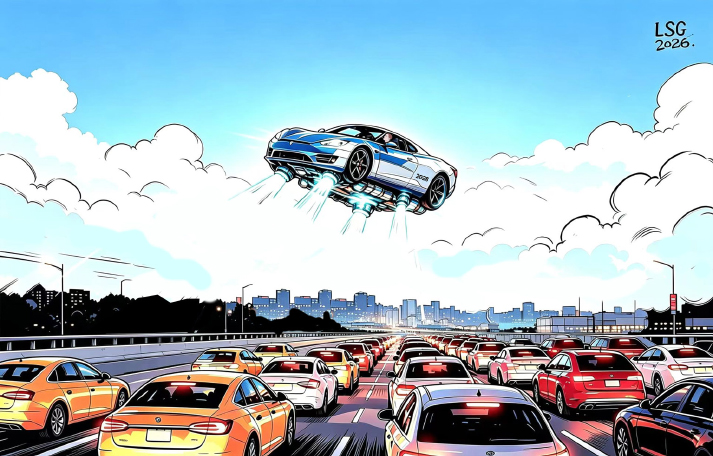
American car manufacturer Tesla unveiled its next-generation Roadster at the test site of billionaire Elon Musk's SpaceX aerospace company in McGregor, Texas, on October 15. The Roadster traveled up a huge curved ramp, and then flew and flipped in the air before landing safely. This model relies on SpaceX technologies including cold gas thrusters to hover. Musk claimed "flying cars are real" when this new sports car was shown off via livestream. Tesla's "flying car" has once again refreshed people's understanding and imagination of what cars can do and where their boundaries lie. Some in the industry worry that as cars begin to break free from the constraints of the ground, the dimension of competition in the automotive industry will rise to a higher, perhaps mostly unattainable level. Others believe Tesla's move carries an obvious experimental and marketing flavor. Whether it is a concept demonstration or a technology that can be put into practical application remains to be seen. Liu Yuanju (The Beijing News): The Roadster can certainly become a toy for the wealthy, but its flying function is clearly not something you can use to overtake the car ahead when stuck in traffic. Even as an emergency evasion feature, a flying car would not find it easy to land safely. If someone driving the car encounters danger, how can they accurately judge in a critical moment whether and how to use the Roadster's flying function? As human society moved from walking to horse-drawn carriages and automobiles, energy levels rose step by step, rules became more refined and regulatory systems grew more complex. Undoubtedly, a flying car represents a higher energy level, and the spatial dimension it occupies is more complicated, involving three-dimensional low-altitude space, where any mishap could trigger cascading risks. Therefore, for a flying car to land safely, refined management is especially necessary—for example, real-time trajectory monitoring, automatic avoidance and fault warnings. In this sense, neither urban space management nor flying car technology itself can be considered mature. Although Chinese peers have been generous in their praise, the Roadster's large-scale rollout may not come until 2028 at the earliest. This is also part of the reason Tesla's stock price rose and then fell after the Roadster's release. The flying Tesla has arrived, but for a true flying car to land safely, there is still a long road ahead. Wang Bin (Tide News): The flying Tesla has amazed the entire world, prompting some to ask whether Chinese domestic automakers should feel ashamed. There is no need to praise one and bury the other. China's auto industry has made achievements plain for all to see. Tesla's innovation deserves respect, but China's complete supply chain, strong industrial and product innovation, and battery breakthroughs are also sources of pride. However, we can't deny that quality control and safety problems, such as "rushed cars," a term used in Chinese to refer to vehicles that automakers push to market hastily by excessively compressing development and testing cycles, often cutting corners on essential validation steps, have surfaced. This must be faced, not evaded. Tesla's Roadster is a reminder and a spur: To talk about competitiveness, first master the basics. Tesla's innovation deserves applause, but blindly chasing it while ignoring the practical stage of China's auto industry, technological foundation and cost constraints is unwise. On October 20, China's Xpeng AeroHT, a flying-car manufacturer, unveiled the Land Aircraft Carrier in Guangzhou, a model set to become the first flying car in a United Arab Emirates low-altitude flight supervision and demonstration zone. As a result, for most Chinese automakers, the right way forward is making breakthroughs through trial and error and taking responsibility for quality and safety. Pursuing innovation and marketing while disregarding quality and safety is to put the cart before the horse. Of course, this does not mean abandoning the courage to pursue high-end technological advances—otherwise, they will fall behind in the next round of competition. Copyedited by Elsbeth van Paridon Comments to yanwei@cicgamericas.com |
|
||||||||||||||||||||||||||||||
|