
|
| China |
| Visiting legislators exchange governance experience and explore China's development in Tianjin | |
|
|
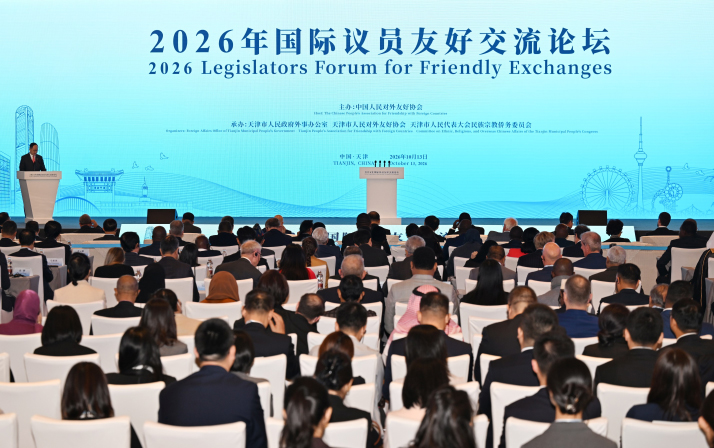 The opening ceremony of the 2026 Legislators Forum for Friendly Exchanges in Tianjin on October 13 (XINHUA)
Sixty-six legislators and former legislators from 52 countries, regions and international organizations gathered in Tianjin Municipality on October 13 for the 2026 Legislators Forum for Friendly Exchanges. During the forum, participants exchanged governance experience, explored opportunities for economic cooperation and discussed how dialogue can help manage international differences. At Tianjin Port, Roger Goodman, Member of the Washington House of Representatives in the U.S., was struck by the scale of the automated container terminal. But another stop on his visit to the northern Chinese city left him with more questions about how China works: A demonstration of how ordinary citizens can participate in the country's legislative process. Organized by the Chinese People's Association for Friendship with Foreign Countries, the forum also provided a platform to discuss economic development, grassroots governance, technological innovation and international cooperation. This year's theme was Sharing High-Quality Growth for a Sustainable Future. The gathering featured two specific dialogues for European legislators and representatives from the Global South. This year was the fourth edition of the forum, following previous meetings in Shenzhen in Guangdong Province, Shanghai and Urumqi in Xinjiang Uygur Autonomous Region. Channels of cooperation In addition to the two dialogues, the forum featured four other parallel sessions covering grassroots governance and social resilience, industry-education integration and new quality productive forces, cultural heritage and urban renewal, and green development and regional coordination. Peng Qinghua, Vice Chairman of the National People's Congress Standing Committee, delivered a keynote speech at the opening ceremony. He said China's 15th Five-Year Plan (2026-30) was both a blueprint for the country's development and a list of opportunities for international cooperation. He called for closer exchange between legislative bodies to advance the UN 2030 Agenda for Sustainable Development. Kenyan National Assembly Speaker Moses Wetang'ula, Provisional Argentine Senate President Bartolomé Abdala and Serbian National Assembly Deputy Speaker Edin Đerlek were among the parliamentary leaders who addressed the opening ceremony. The Tianjin Declaration, released on October 14, summarized participants' views on strengthening exchange between legislative bodies, sharing governance experiences and promoting sustainable development. It also highlighted cooperation in green development, particularly the Beijing-Tianjin-Hebei region's experience in coordinated environmental governance, and encouraged countries to explore approaches to social governance suited to their national circumstances. For legislators like Goodman and former British Member of Parliament Mark Logan, the exchanges in Tianjin also provided an opportunity to discuss how they could maintain dialogue across national borders despite differences in political systems and international relations. Logan said the exchanges among European and Chinese legislators demonstrated an interest in finding new ways to work together. "There is definitely a real appetite among all the countries that were present here today to find a new way to collaborate together," he noted. He recalled a representative's remarks about the importance of institutions in maintaining international peace. Good intentions alone, Logan said, would not be sufficient without mechanisms that allow countries to communicate and address disagreements. "We need new institutions. We need to work on reforming the institutions that we already have," he said. A closer look at Tianjin During their stay, participants visited a range of sites showcasing Tianjin's industrial development, technological innovation, cultural heritage and urban renewal. These included technology enterprises, educational institutions, the city's Ancient Culture Street and urban redevelopment projects. Goodman singled out Tianjin Port, where automated equipment and green technologies are being incorporated into port operations. "I was very impressed, almost left speechless, by the port that is green and smart and carbon-free, and was built in about one year," Goodman told Beijing Review. "It's just impossible to imagine that accomplishment. And it's a symbol, really, of China's rapid development in technology." Tianjin Port is one of north China's major international shipping hubs and an important gateway for the Beijing-Tianjin-Hebei region. Its development is part of efforts to improve logistics efficiency and introduce low-carbon technologies into port operations. Logan also referred to the port when discussing opportunities for cooperation between China and Europe. "With such a large market in Europe and such a large and innovative market as well in China, as we saw yesterday at the port in Tianjin, [there are] so many opportunities for us to work together," he said. Logan's connection with China goes back two decades. He first arrived in October 2006 and later spent nearly 10 years living and working in the country, including in Shanghai. He also studied Chinese and has become known for speaking the language fluently. Logan was also enthusiastic about Tianjin itself. Having visited the city about 10 years earlier, he said he hoped his next trip would come much sooner. He praised its cleanliness, public facilities and sports grounds, and suggested that visitors should take a boat trip along the Haihe River flowing through Tianjin's urban area. His remarks reflected a personal familiarity with China that differed from the experience of some first-time visitors. Logan said his years in the country had challenged expectations he formed before arriving, particularly those shaped by English-language media coverage. "Before I came here, I had all sorts of prejudices and expectations about maybe the bad things or bad sides of China," he said. "And those are things that I actually, myself, have never really seen... in the way that they were projected, at least in English-language media." Legislative lessons Goodman said the most intriguing part of his visit concerned public participation in lawmaking. During an exchange on China's legislative consultation practices, he learned about mechanisms through which residents can offer suggestions on legislation and raise concerns about issues affecting their communities. "More than anything, though, I was very intrigued by the legislative consultation process, where citizens are able to voice their concerns, sit around the table and [contribute to] changes in law in this country," he said. China has established grassroots legislative outreach offices to collect public opinions on draft laws. These offices provide channels for residents, community organizations and other groups to submit suggestions during the legislative process. Goodman said the exchange challenged some of his previous assumptions about China's governance system. He pointed to transportation, elderly care and education as examples of matters on which residents could contribute their views. Goodman said as a state legislator in the U.S., listening to constituents was central to his own responsibilities. He represents Washington's 45th Legislative District and chairs the state House Community Safety Committee. "I am a lawmaker, and yet I cannot do it in a vacuum," Goodman said. "I have to listen to the people every day on a very wide range of topics." For Goodman, the local level was particularly important. "That's really where the resilience of a society comes from—government at the most local level possible," he said. Grassroots governance and social resilience were among the forum's principal discussion topics, alongside industry-education integration, cultural preservation, urban renewal and green development. Such exchanges could help legislators learn from both the achievements and difficulties experienced by other countries, Goodman said. (Print Edition Title: New Links Between Lawmakers) (Reporting from Tianjin) Copyedited by G.P. Wilson Comments to liwenhan@cicgamericas.com |
|
||
|
||||||||||||||||||||||||||||
|