
|
| China |
| Inside the multi-million-yuan campaign to restock China's coastal waters | |
|
|
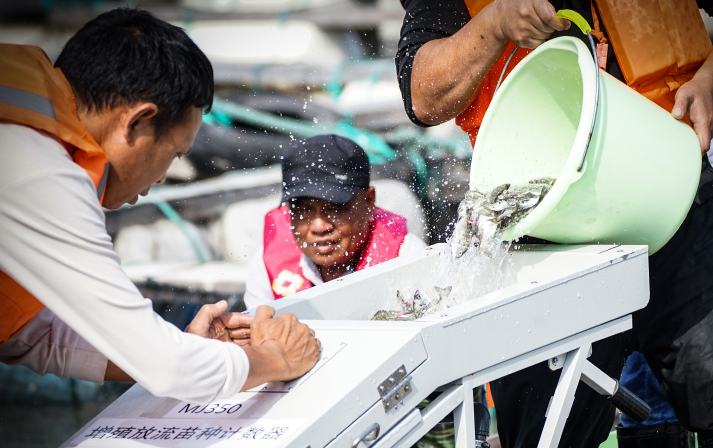 Staff count the juvenile fish being released during a fish release event in Ningbo, Zhejiang Province on October 28 (XINHUA)
Sunlight bathed the harbor at Qiangjiao Wharf in Ningbo, Zhejiang Province, on the morning of October 28. It glinted off a sea that was startlingly still—a calm no one expected just days after a typhoon had swept through the region.
A live-fish transport vessel listed gently at the wharf as deckhands lugged buckets of seawater to a counting ramp. Inside, thousands of fingerlings—each just a bit longer than a human finger—created frantic silver ripples in the sunlight. A technician tipped a bin, spilling the water down a slick ramp. As the fish slid downward, they crossed an optical infrared sensor that chimed in rapid, electric clicks, counting each fish as it passed. Each one bore a tiny, bright-pink plastic anchor tag inserted near its dorsal fin, stamped with a microscopic tracking code. Before the batch was released, a researcher measured a dozen specimens against a ruler, while a colleague logged the data in a notebook. Then, 168,000 tagged juvenile yellow croakers, yellow drums and blackhead seabreams tumbled over the gunwale and vanished into the East China Sea. 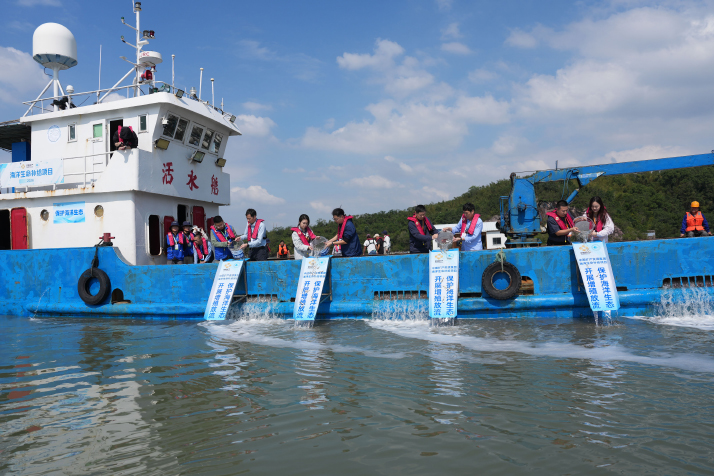 Tagged juvenile fish are released into the sea in Ningbo on October 28 (XINHUA) Investing in the deep This was the 43rd such restocking exercise conducted by China Mineral Resources Group Zhoushan Development Co. Ltd. since it launched its ocean protection initiative in 2024. In partnership with the East China Sea Fisheries Research Institute and the Zhejiang Mariculture Research Institute, the company has committed 107 million yuan ($15 million) to a restoration program scheduled to run through 2028. The effort forms part of the enterprise's broader, targeted biological restoration strategy, which includes stock enhancement, habitat-specific releases and high-stakes aquaculture research aimed at reviving species that once defined the region's marine heritage. Standing near the pier was Wu Bing, a 43-year-old whose sun-weathered skin betrays a life spent on the water. Born inland in Xuzhou, Jiangsu Province, Wu moved to the coast decades ago. Today, as head of the Safety and Environmental Protection Department at China Mineral Resources Group Zhoushan Development Co. Ltd., he oversees the logistics for the entire coastal replenishment operation. Working across the Zhoushan Archipelago near Ningbo has given Wu a deep, pragmatic respect for the East China Sea's volatility. Sudden coastal storms are an occupational hazard; on some field assignments, he has found himself marooned on remote outposts for several days when violent typhoons severed ferry routes to the mainland. As the project lead, Wu has directed over 54 million yuan ($8 million) into marine restoration since 2024. Across offshore operations, his team has released approximately 792 million juvenile marine animals into the waters around Shengsi and Daishan, including Daiqu yellow croakers, swimming crabs, cuttlefish, jellyfish, blackhead seabreams and yellow drums. An hour's drive south along the jagged Zhejiang coast, the East China Sea Fisheries Research Institute's experimental base is located in a village in Ninghai. There, marine scientific inquiry drops down to the unglamorous floor of the intertidal ecosystem. Tang Baojun, a lead researcher at the facility, oversees specialized ecological compensation projects funded by China Mineral Resources Group, including 1.3 million yuan ($180,000) dedicated to the spiny rock shell (Thais clavigera) and 1.1 million yuan ($164,924) for the equilateral surf clam (Gomphina aequilatera). The spiny rock shell is a predatory sea snail prized in coastal Zhejiang for its fiery, distinct flavor. Its wild populations have dropped drastically over recent decades due to overharvesting and other environmental pressures. Breeding the gastropods under indoor, controlled conditions was long considered a huge challenge in Chinese marine biology. Tang's team gathered wild adults from the Zhoushan Archipelago, conducting months of laboratory trials to maximize egg deposition. Getting fragile young snails into the wild coastal environment created another hurdle. Dropping them directly onto bare wave-battered rocks left them vulnerable to heavy ocean swells and hungry predators. To improve their chances, Tang's team engineered white, mesh cylindrical plastic buffer cages. Scientists pack the juvenile snails inside the submerged cages, providing a safe buffer that allows them to gradually acclimate before crawling out on their own to inhabit the rocky crevices. In neighboring tanks, microscopic equilateral surf clams undergo a parallel process. Tang's team conditions wild adult clams with high-nutrition diets, achieving full reproductive maturity within two weeks before initiating artificial spawning and larval rearing. While the surf clam holds clear commercial value as a seafood staple, scientists also view it as an environmental custodian. As a filter feeder, the bivalve cleans coastal waters, reduces excess nutrient runoff and locks away carbon within its shell—making it a key candidate for China's expanding push toward "carbon-sink fisheries." From lab to deck Over a two-hour drive to the east, across the bay on Xishan Island in Zhoushan, translucent clusters of dark, gel-like spheres sway in the aerated tanks of the Zhejiang Mariculture Research Institute—the fertilized egg masses of Sepiella maindroni, the ink-spitting cuttlefish. Shi Huilai, a senior researcher, reached into a tank and lifted a wet mass of black cuttlefish eggs onto his palm. Each year, the facility incubates and releases up to 50 million fertilized eggs directly into nearby bays. The cuttlefish project is widely considered one of the great success stories of Chinese marine conservation. Once one of the legendary Four Major Catches of the East China Sea, wild cuttlefish stocks suffered a catastrophic collapse beginning in the 1990s from relentless industrial trawling. Through years of persistent research into artificial breeding, customized egg-holding cages and artificial reef construction, the institute helped pull the species back from local extinction. In an adjacent tank, scientists are pushing into far more precarious biological territory: the largehead hairtail, or cutlassfish (Trichiurus lepturus). Coveted by seafood lovers across China, the long, ribbon-like predator has historically defied captive breeding. For decades, fishermen and scientists lived by a grim rule: The fish dies the moment it leaves the water, succumbing almost instantly to pressure shock and stress. Chai Xuejun, who has led the institute's cutlassfish research since 2013, began running domestication trials in 2014. By designing low-stress transport systems and specialized round holding tanks, his team achieved what was once thought impossible: maintaining live, wild-caught adult cutlassfish in land-based facilities for long-term study. Yet commercial aquaculture remains out of reach. Extracting viable eggs from stressed wild females remains exceptionally rare, leaving large-scale hatchery releases as a distant goal. The ultimate measure of these laboratory milestones and corporate compensation budgets does not reside in academic papers, but along the timber decks of the local fishing fleet. "Some years ago, there were seasons when you could barely find a cuttlefish out there," Captain Wang Bo, a 40-year veteran of the East China Sea, told Beijing Review. "Now, the cuttlefish have come back in numbers you can actually count on. When we bring a haul to the dock, they fetch seven or 8 yuan a catty (around $2 per kg)." As academic labs and corporate funds intersect along the Zhejiang coast, the East China Sea is steadily turning a corner, proving that decades of ecological decline can be reversed to bring real life back to the water. (Print Edition Title: Blueprint for a Blue Revival) (Reporting from Ningbo, Zhejiang Province) Copyedited by G.P. Wilson Comments to yuanyuan@cicgamericas.com |
|
||||||||||||||||||||||||||||||
|