
|
| Lifestyle |
| How one film festival captures cinema breaking free of the traditional screen | |
|
|
 A conceptual visualization of the four-dimensional space in virtual reality (VR) film Red Coast Echo (THREE BODY UNIVERSE)
When Shuishui, who prefers to be known by her nickname only, turned 31 on February 18, the Beijing-based video editor skipped the usual birthday rituals. Instead, she chose a more unusual way to celebrate: a journey back to 1995, the year she was born. Opening her eyes, she found herself in Shanghai. Metro Line 1, the city's first subway line, had only just opened in full. The city was still buzzing over Shanghai Shenhua soccer club's first-ever professional league title. She wandered through crowded lilongs, the lane-house neighborhoods unique to the city; rode a creaking lift to the top of a construction site to watch the night sky; and floated across the newly completed Oriental Pearl Tower, then the highest structure in China at 468 meters, holding an umbrella, Mary Poppins-style. This was no daydream, but an episode of Rock-a-Bye, Shanghai 1995, a virtual-reality (VR) fantasy musical film Shuishui watched—or rather, experienced—at this year's Beijing International Film Festival (BJIFF), held from April 16 to 25. The film was one of more than 50 domestic and international works featured in Boundless ∞ Immersive, a section of the festival that explores how VR, augmented reality (AR), mixed reality (MR) and other technologies are pushing cinema beyond the confines of the traditional big screen. For Shuishui, an enthusiastic VR fan who has followed the medium for almost a decade, the section is a measure of how far immersive cinema has come. When BJIFF first introduced a VR section in 2018, she recalled, the medium was still largely associated with space-capsule-like pods in shopping malls, where people paid 9.9 yuan ($1.45) for a few minutes of novelty. In the years that followed, the section expanded to include extended reality (XR) and, later, other forms of immersive storytelling. "Now, immersive cinema is no longer seen as a gimmicky add-on to traditional film, but as an art form important enough to warrant its own exhibition space," she told Beijing Review. "It opens up all kinds of possibilities—not just for how stories are told, but how they are lived." Stories that surround Story, indeed, lies at the heart of this year's selections. "Earlier VR works were often more concerned with chasing technological spectacle than with telling a compelling story," wrote an anonymous reviewer on Yuanlishe, a Chinese online community focused on AI, the metaverse and other tech developments. "This year's entries, however, point to a broader shift: VR is no longer the point, but a vessel for narrative and emotion." Perhaps the work that carries the greatest emotional force in this year's lineup is A Long Goodbye, a VR film directed by Kate Voet and Victor Maes, which won the Immersive Achievement Prize at the 2025 Venice Film Festival. Rendered in a hand-painted watercolor style, the VR film draws viewers into the fading world of Ida, a 72-year-old pianist living with dementia, as she waits for her husband, Daniel, to return home. Little by little, through scattered notes and old tape recordings, both Ida and the viewer come to piece together a heartbreaking truth. "When you put on the VR set, you ask yourself two questions: Who am I and where am I, and this very much resembles the experience of living with dementia," Voet said during the Venice Film Festival. 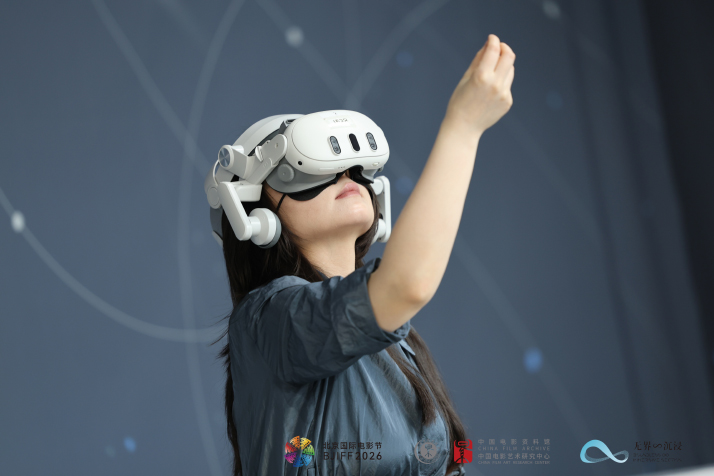 A viewer reaches for a note pasted onto a virtual wall when watching VR film A Long Goodbye at the 16th BJIFF on April 17 (COURTESY PHOTO)
Where A Long Goodbye uses VR to place viewers inside a woman's fading consciousness, Fillos Do Vento: A Rapa, another work in the section, uses a three-wall projection to plunge viewers into the raw physicality of the natural world. Set in the rolling hills of Galicia in northwest Spain, the film tells the story of how local communities strive to preserve Rapa das Bestas, a five-century-old tradition in which villagers wrestle with wild horses to shear their manes and rid them of parasites. Conceived as a traditional feature documentary, the work was made over seven years, with all the patience and painstaking effort the form demands. According to Brais Revaldería, the director, the event takes place for only one week each year, capturing the moments needed to tell the story required years of waiting. But even with years of material in hand, he felt dissatisfied. "The ritual had already been documented many times," he told Beijing Review. "The challenge was how to further narrow the distance between contemporary audiences and an ancient tradition, and that was why we decided to pivot." Adapting a traditional documentary to an immersive form, however, was far from straightforward, and sound effects posed a particular challenge. To build a fully enveloping soundscape, the team recorded each sound separately—the pounding of hooves, the whistle of wind and the rustle of leaves—and only later layered them into a final composition. Smell, too, was central to the film's sensory experience. Upon entering the cave-like screening space at the festival, viewers were immediately met by the mingled scents of grass, mud and salty sea breeze. "Smell can be the most powerful trigger of memories and emotions," Revaldería said, recalling how each time he returns to Galicia, his hometown, the scent of the forest conjures the place before it even comes into view. For him, the 270-degree projection, layered sound and recreated scents of Galicia were there not merely to present the tension between tradition and modernity, but to place viewers in the middle of it. "Documentaries are special because they tell real stories, and that allows people to connect on a deeper, more human level," he said. "There will be endless possibilities for immersive storytelling—whether through VR or any other cutting-edge technology—but in the end, it all comes down to the human connection." A language of its own Beyond the international titles, many of which have already made their mark at leading film festivals abroad, this year's BJIFF also showed how immersive filmmaking in China is beginning to develop a language of its own. That shift was reflected in the festival's decision to introduce, for the first time in its 16-year history, and in the history of major Chinese film festivals more broadly, a competition unit dedicated specifically to VR titles. "The aim is to identify domestic works that can serve as benchmarks for the industry, not only for their technological sophistication but also for their examination of social themes and their search for a distinctly Chinese mode of storytelling," Jin Lina, head and curator of the Boundless ∞ Immersive section and an associate research fellow at the China Film Archive, told Beijing Review. This new section did not emerge in a vacuum. It came a year after the China Film Administration (CFA), the top industry regulator, issued a notice on advancing the development of VR films. For the first time, the medium (AR and MR included) was officially recognized as a new cinematic form and incorporated into the country's box office system. The domestic titles selected this year show how quickly this sector is evolving, taking in a wide variety of forms and drawing on everything from historical events to major contemporary franchises. Xuanzang and the Kucha Kingdom in the Tang Dynasty, for instance, brings to life an episode from the fabled westward journey of the seventh-century Buddhist monk Xuanzang—a historic pilgrimage that later inspired the 16th-century novel Journey to the West. Donning a VR headset and seated in a chair that turns automatically, the viewer is cast as the monk and transported back to Kucha, an ancient kingdom in what is now China's Xinjiang Uygur Autonomous Region. 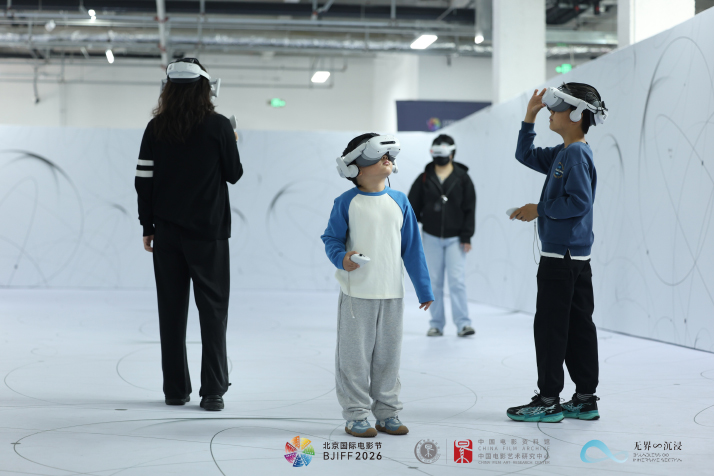 Visitors to the 16th Beijing International Film Festival (BJIFF) step into the world of Candle in the Tomb XR on April 18 (COURTESY PHOTO)
Another selected work, Candle in the Tomb XR, demands a more active kind of participation. Drawn from one of China's most successful adventure franchises, which has expanded across novels, films, TV dramas and video games, it plunges participants into a tomb-raiding expedition that requires them to walk through a specially designed space and use controllers to pick up objects and shoot at attacking monsters. Pushing that sense of immersion even further is Red Coast Echo, which was adapted from The Three-Body Problem, Liu Cixin's acclaimed sci-fi trilogy about humanity bracing itself for an imminent alien invasion. Traditional cinema usually unfolds along a single narrative arc, with a beginning, development, climax and ending. Red Coast Echo, by contrast, breaks apart that linear structure. Participants must choose between two opposing camps: the ETO, a human organization committed to aiding the alien invasion, and the PDC, which was created to protect the planet. From there, the story splits into two parallel paths, each testing different relationships, decisions and moral positions. "Unlike conventional VR experiences, where users do little more than walk around and look, this work turns movement and choice into methods of shaping the narrative," a representative of Three Body Universe, the company behind the project, told Beijing Review. "In that sense, players are not merely watching a film, but creating one." For Revaldería, a film festival veteran, it was precisely the diversity and novelty of such works that make the section stand out. "Immersive media is still trying to find its place within the film industry," he said. "People are not always sure how to categorize it, and at some international film festivals I have felt like an outsider. But here it was given real visibility, and I felt genuinely welcomed." 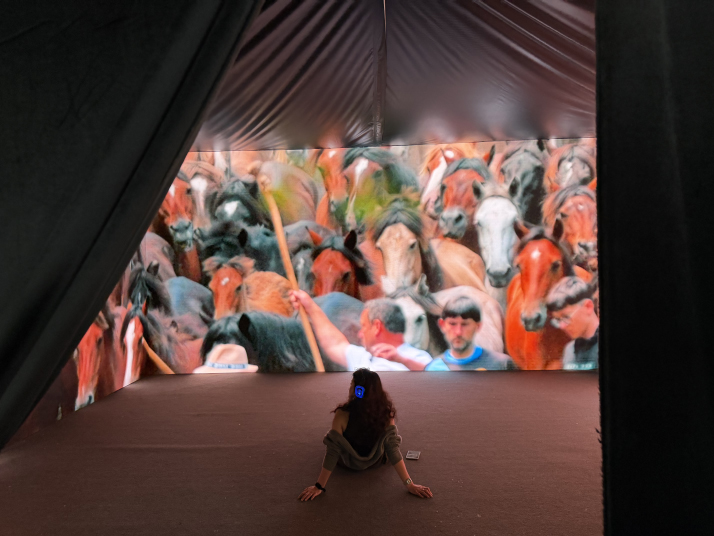 A viewer watches immersive documentary Fillos Do Vento: A Rapa at the 16th BJIFF on April 18 (COURTESY PHOTO)
The festival, however, is only the most visible part of a broader ecosystem expanding across the country. Rock-a-Bye, Shanghai 1995, the VR film Shuishui experienced at BJIFF, is now on show at Zhangyuan, a historic cultural quarter in Shanghai built around a lilong complex, in an apt fusion of heritage tourism and immersive cinema. Red Coast Echo, meanwhile, is due to be available to audiences from May 1 at two Three-Body-themed VR venues in Beijing and Shenzhen, where immersive experiences sit alongside gift shops and themed exhibitions. And in Xi'an, Shaanxi Province, visitors can experience Xuanzang and the Kucha Kingdom in the Tang Dynasty at the world's first XR cinema, where headsets and rotating chairs take the place of the traditional screen and seats. Yet for all these signs of a fast-expanding industry, immersive cinema remains a fledgling art form with plenty of practical limitations. VR headsets can be heavy, and some viewers report dizziness after prolonged use. The illusion of immersion is also easily broken. At a Q&A session at the BJIFF, one audience member noted that a nearby viewer's perfume had disrupted Fillos Do Vento: A Rapa's carefully crafted scent experience, while people talking and moving in and out of the venue further broke the spell.
There are broader concerns, too. For some critics, the rise of immersive entertainment devices may further hasten the decline of traditional cinema, at a time when people around the world are already going to the movies less often. Revaldería, however, is convinced that cinema will live on, albeit in a different form. In his view, part of the emotional power of moviegoing lies in the peculiar joy of being alone together—an experience that is at once deeply personal and profoundly communal. Immersive cinema, he argued, can evoke that same feeling in its own way, and he sees its rise not as a rupture but as part of movie's natural evolution as the medium adapts to changing times. Hopefully, one day, when people fully accept it as a new form of cinema, it will be granted the same respect—and come to develop its own etiquette—as traditional film, he concluded. (Print edition title: Films Without Frames) Copyedited by G.P. Wilson Comments to pengjiawei@cicgamericas.com |
|
||||||||||||||||||||||||||||||
|