
|
| Lifestyle |
| A confluence of cultures | |
|
|
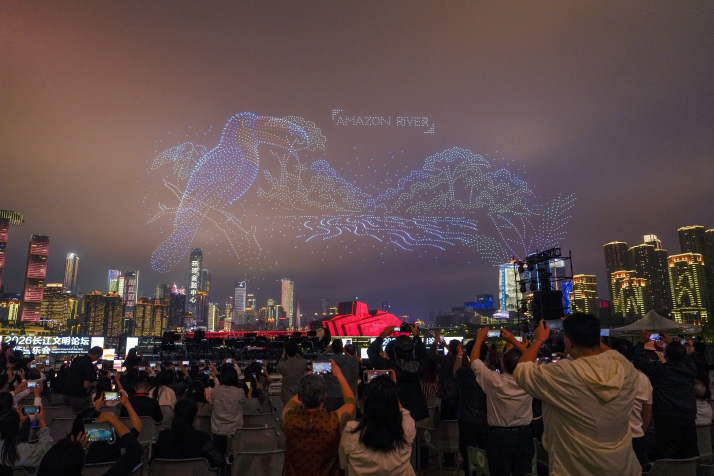 A drone show themed on exchanges among great river civilizations in Chongqing on September 14 (COURTESY PHOTO)
Rivers around the world have long been the muses for poets, threading their way through verse. In China, the waters of the Three Gorges have been inspiring poetry for almost 3,000 years. On September 14-18, Chongqing, located at the upstream end of the Three Gorges, hosted the 2026 World Great Rivers Poetry Festival and the 10th Baidicheng International Poetry Festival, with the aim of connecting the poetic traditions of the Yangtze River with literary cultures from other major river basins. The Kuizhou Poetry Recital, held on September 18 at the Peak of the Three Gorges Scenic Area in Chongqing, was part of these two festivals. During the recital, more than 300 poets, scholars, cultural practitioners and poetry enthusiasts from around the world gathered to look out over the Yangtze River as it passed between the cliffs of Qutang Gorge. Together, they recited verses and shared literary sentiments, reviving the age-old poetic tradition nurtured by the Three Gorges landscape. The recital brought participants close to the scenery that inspired generations of writers, including Tang Dynasty (618-907) poets Li Bai (701-762) and Du Fu (712-770). As verses from Li Bai's Leaving the White Emperor Town at Dawn and Du Fu's On the Height echoed across the gorge, the recital illustrated the enduring relationship between the landscape and its literary heritage. Poetry without borders The two festivals were jointly held with the theme of Gathering by the Yangtze, Dialogues Between Civilizations. Li Peng, Executive Deputy Director of the Publicity Department of the Communist Party of China Chongqing Municipal Committee, said at the opening ceremony that the festival linked literature associated with the Yangtze with writing from the world's other major river basins. Through reading, translation and cross-linguistic appreciation, he added, writers could deepen mutual understanding and seek common ground. Over the following days, participants traveled along the Yangtze in Chongqing, attending discussions, recitals and cultural events. The itinerary combined literary exchange with visits to urban and rural locations, allowing guests to experience the region's history, landscapes and contemporary life. For Pulitzer Prize-winning U.S. poet Gregory Pardlo, rivers offer an apt metaphor for the movement of literature across borders. "Poetry, like a river, resists containment," he said. "The songs composed along the banks of the Yangtze centuries ago—the verses of Li Bai or Du Fu—did not remain inland. They moved downstream, boarded ships, crossed oceans, and found new life in the lexicons of writers along the Hudson (River in the United States) and across the Gulf." Pardlo also linked literary creation to ecological responsibility. "Water reminds us that culture is fluid, always borrowing, always bound to its sources," he said. "For a writer, environmental concern isn't an added subject matter; it is an act of ethical self-preservation. To protect the river is to preserve the condition for song." His remarks expanded the festival's concept of dialogue beyond exchange between literary traditions. They also drew attention to the natural environments from which river cultures emerge and on which they continue to depend. A landscape of verse Qutang Gorge is the shortest and most picturesque of the Three Gorges. Fengjie County, where Qutang Gorge begins, has long been associated with classical Chinese poetry. Historically known as Kuizhou, the area was both a strategic military location and a source of literary inspiration. Its mountains, waterways and dramatic gorges feature in many well-known works. The Kuizhou Poetry Recital translated that literary history into a contemporary cultural experience. In addition to readings, performers portrayed figures including Li Bai, Du Fu and another Tang poet Liu Yuxi (772-842), combining theatrical interpretation with the natural setting. For international participants, the event provided a direct encounter with a landscape previously known to many through literature. Alaa El Menshawy, a visiting scholar from Egypt at the Chinese Academy of Social Sciences, noted the close connection between the region's geography and its historical legacy. Russian violinist Anna Ganin, who has long been interested in Tang poetry, described visiting the places associated with Li Bai and Du Fu as an emotional experience. "The view is absolutely gorgeous," she told Beijing Review. "I would never have thought that I would come here, walk this path like Du Fu and Li Bai, and see the same views they did." For Ganin, the continuing appeal of poetry lies in its ability to preserve human experience across generations. Scientific and social progress may transform everyday life, she said, but poetry, feeling and music remain part of civilizations' cultural memory. Mexican poet Dulce Chiang, who traveled to Fengjie by cruise ship along the Yangtze, said the journey had provided material for her own work. "It's been such an enriching experience," she told Beijing Review. "I think it will enrich my poetry, and I'll write about this." Their responses showed how physical places can serve as points of entry into another culture. Rather than presenting classical verse solely as an object of historical study, the recital connected texts, landscapes and individual experience. Ancient verse, new questions While the recital focused on poetry's relationship with place and memory, another festival event examined its relevance amid rapid technological change. On September 15, Fengjie hosted an exchange involving former contestants from the Chinese Poetry Competition, a television program combining knowledge contests with the appreciation of classical Chinese poetry. Award-winning contestants joined cultural and historical content creators, teachers, students and local poetry enthusiasts for discussions outside the program's usual studio setting. Chen Geng, the competition's 2019 champion and a four-time participant, addressed the value of poetry in the age of AI. She argued that easy access to information does not replace the long process through which individuals develop cultural literacy, emotional awareness and judgment. "It is in such an era that poetry becomes increasingly essential," Chen said. "Cultural literacy and personal cultivation require long-term accumulation, and human emotion is the most precious part of life." Her comments highlighted a distinction between retrieving information and developing understanding. AI systems can process and generate language at speed, but the reading of poetry involves personal memory, cultural context and emotional interpretation. Chen cited Song Dynasty (960-1279) poet Li Qingzhao (1084-1155) and Tang poet Li Shangyin (813-858) to illustrate how classical verse conveys subtle states of mind that resist purely rational explanation. Such works, she said, allow modern readers to enter the inner worlds of earlier writers and find echoes of their own hesitation, confusion and hopes. "Everyone struggles with unspoken hesitation, confusion and dilemmas in life," she told Beijing Review. "Yet the scenery, stories and emotions depicted in classic poems can bring us peace, strength and hope." Poetry's role in China has historically extended beyond individual expression. It was used in education, philosophical debate, social communication and the articulation of personal ideals. Over time, it became closely integrated with both elite and popular culture. Its influence has also traveled beyond China. Chen pointed to Austrian composer Gustav Mahler's symphonic song cycle Das Lied von der Erde (The Song of the Earth), which drew inspiration from German adaptations of classical Chinese poetry, including works associated with the Tang Dynasty. Such examples show how poems can acquire new forms and meanings as they move between languages and artistic traditions. "Alongside tea, porcelain and silk, poetry serves as another iconic cultural symbol of China on the global stage," Chen told Beijing Review. "It enables international audiences to understand the spiritual pursuits, inner affections and core values of the Chinese people." BR Copyedited by G.P. Wilson Comments to xubei@cicgamericas.com |
|
||||||||||||||||||||||||||||||
|