
|
| Opinion |
| Building the Industries of Tomorrow | |
|
|
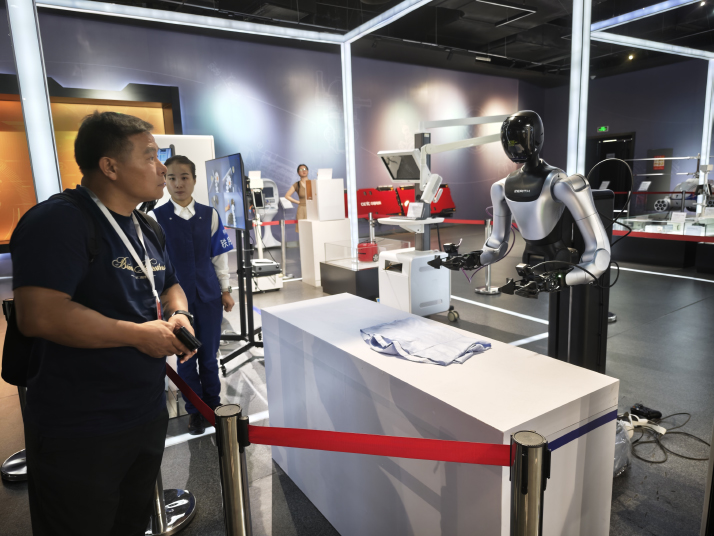 A housekeeping robot at the Anhui Innovation Pavilion in Hefei, Anhui Province, on August 3
Cultivating industries of the future has become a key priority in China's economic development, driving technological innovation and industrial transformation. How is China advancing this transformation, and what does it mean for global technological cooperation? Beijing Review recently spoke with Ding Minglei, a researcher at the New Quality Productive Forces Promotion Center of the Ministry of Science and Technology, about the strategic thinking behind future industries, innovation practices and the changing landscape of international technological cooperation. Edited excerpts of the interview follow: Beijing Review: In the context of global technological competition and industrial transformation, why has China chosen to focus on developing new quality productive forces? What does this term mean? Ding Minglei: Allow me to zoom out first. We are standing at what future historians may call a "watershed era." AI, quantum technology, synthetic biology, nuclear fusion and brain-computer interfaces—these technologies are not advancing in isolation. They are intersecting and amplifying one another in a kind of "tech Cambrian explosion." What is being reshaped is not a single industry but the entire foundation of civilization: energy, materials, life itself and even our reach into space. Whoever seizes this moment will define the productive forces of the next era; whoever misses it may be left behind at a historic turning point. Let me explain in plain language. What we call "new quality productive forces" is advanced productivity driven primarily by scientific and technological innovation—especially disruptive and frontier technologies. It is not a matter of tightening a few more screws on an old machine; it is about replacing the engine entirely. "Industries of the future" are the new industries this engine is birthing, including AI, quantum, humanoid robots, the low-altitude economy (airborne economic activities below 1,000 meters), commercial spaceflight, biomanufacturing, green hydrogen and nuclear fusion. They may look like saplings today, but they may grow into the industrial forests that shade the world 10 or 20 years from now. Why is China making such a determined effort at this moment? I see three layers of logic. First, it is a civilizational imperative to ride the tide of history. Industries of the future are, in essence, "industries of time": We reap what we sow. Every major economy is laying out its bets, and this is a race no one can afford to sit out. But this is not a zero-sum game. Much of this territory is uncharted. There is no map, no ready-made answer. Every country's exploration expands the frontier of human knowledge. China is not trying to outrun others on a track someone else drew; we want to help draw a new map together, across unknown terrain. Second, it is essential to China's high-quality development. Our economy must shift from high-speed growth to high-quality growth. The old inputs—labor, land, resources and the environment—are reaching their limits. The only way forward is to shift onto an innovation-driven track and raise total factor productivity. Let me be equally clear: Developing new quality productive forces is not about abandoning traditional industries. China is the only country in the world with all industrial categories listed in the United Nations industrial classification. Steel, chemicals and textiles are being re-armed by AI and green technology, becoming smarter and cleaner. Combined with our enormous market and the world's richest application scenarios, frontier technologies here can complete the leap from prototype to product to commodity faster than anywhere else. Third, and this is often missed, China hopes to offer certainty in a highly uncertain world. In early 2024, seven government departments jointly issued guidelines spanning six broad directions: future manufacturing, information, materials, energy, space and health. The 15th Five-Year Plan (2026-30) has laid out a blueprint for quantum, biomanufacturing, hydrogen and fusion, brain-computer interfaces, embodied intelligence and 6G. I want to be precise about the government's role: We are not "picking winners." We are cultivating a rainforest—nurturing industries in stages, tolerating failure, letting different technical routes compete in the market, while balancing development with security and innovation with governance. To use a metaphor: Government is shifting from a gardener who chooses which seedling survives to the architect of an ecosystem who tends to the soil, sunlight and the rain. Some international observers often misinterpret technological self-reliance as closed-door development. How would you characterize the relationship between self-reliance and high-level opening up? This is the misunderstanding I hear most often abroad. Let me answer with complete candor: Technological self-reliance is not reinventing the wheel behind closed doors, still less is it deglobalization. Chinese leaders have put it powerfully: Indigenous innovation is innovation pursued in an open environment; it must never be done with the door shut. This is not diplomatic rhetoric. It is a judgment backed by hard facts. For example, China has forged science and technology partnerships with over 160 countries and regions, signed around 120 intergovernmental agreements, and participated in more than 60 major international cooperation programs ranging from the International Thermonuclear Experimental Reactor, which aims at creating energy through a fusion process similar to that of the sun, to the Square Kilometer Array, a large multi-radio telescope project spread out over two sites that will be located in Australia and South Africa. In space, China's Tiangong space station is open to scientists worldwide: The first selected experiments came from 23 institutions in 17 countries, and a Pakistani astronaut will become the station's first international visitor. The Chang'e-6 lunar probe mission carried payloads from the European Space Agency, France and Italy; the Chang'e-7 mission will carry payloads from six countries including Egypt, Thailand and Switzerland; and together with 17 countries and international organizations, we are building the International Lunar Research Station. In AI, Chinese labs such as DeepSeek chose to open-source their model weights and training logs, allowing researchers in other countries to reproduce and build on the work with just a few dozen dollars of computing power, a vivid example of technology democratizing itself. Multinational companies are voting with their feet: Their research and development (R&D) centers in China are shifting from "innovating for China" to "innovating in China, for the world," and foreign investment in scientific research and technical services rose for the seventh consecutive year in 2025. Historically, China's technological progress was achieved through openness; closure has no way out. By their nature, future industries demand cooperation: The more frontier the field, the greater the need. Nuclear fusion, quantum, brain-computer interfaces, 6G and AI all require enormous investment, carry extreme risk and raise some of the hardest ethical questions. No single country can handle these alone; they are humankind's shared challenges. Most fundamentally, self-reliance and opening up are two sides of one coin. Mastering core technologies is not about decoupling from others, but about avoiding being forced into decoupling when someone else cuts off supply. Only when you stand on your own feet is a handshake between equals possible—not a begging hand, but a steady one. China explicitly opposes attempts to politicize and overstretch the concept of national security on science and technology issues. We do not build "small yards with high fences," and we do not join exclusive blocs. With nearly 50 countries we have built over 70 Belt and Road joint laboratories; juncao, a hybrid grass developed by Chinese scientists, has taken root in more than 100 countries and regions. (The Belt and Road Initiative is a China-proposed framework that boosts connectivity along and beyond the ancient Silk Road routes—Ed.) We are working to build an open, shared global innovation network; not a parallel system behind a new wall, but a more resilient and inclusive one. China's choice has always been consistent: strengthening our own capacity through openness and sharing opportunities through cooperation. That has not changed, and will not change. Looking ahead, what new opportunities and value will China's new quality productive forces and industries of the future bring to global industrial innovation and international collaboration? Let me offer three points from the perspective of global value. First, China is becoming an important testing ground for frontier technologies and an engine that drives costs down. To turn a laboratory prototype into an affordable product, a technology must cross the "valley of death"—engineering, pilot scale-up and mass production. China's complete supply chain and vast market allow technologies to move quickly down the learning curve. Over the past decade, the costs of solar panels, lithium-ion batteries and electric vehicles (EVs) have fallen sharply, significantly accelerating the global energy transition—a major contribution of Chinese manufacturing to the world. China supplies over 80 percent of the world's solar panels, and in 2025 exports of the "new three," namely, EVs, lithium-ion batteries and solar panels, approached 1.3 trillion yuan ($195 billion). Seen from a wider lens, China is doing something for all humankind: turning clean energy from a luxury available to a few wealthy nations into an affordable necessity in developing countries. Humanoid robots, green hydrogen and biomanufacturing may well tell the same story, becoming affordable first in China and then available to the world. Second, China is steering its industries of the future toward challenges common to all humanity, such as climate change, aging populations, food security and major disease. Brain-computer interfaces are helping people with paralysis control wheelchairs and robotic arms with their minds. AI-assisted diagnosis has already reached more than 800 counties across China and is extending to other developing countries through cooperation. Biomanufacturing makes chemical production less resource-intensive and cleaner. One telling detail: China's low-altitude economy solutions are helping African countries bypass the old path of "building highways first, then cars," using drones today for medical deliveries, crop spraying and logistics in remote areas. This is technology democratizing itself in the most concrete way. The more frontier the technology, the more it must remain affordable and useful to ordinary people—that is the benchmark China keeps in mind. Third, China works for more inclusive, more human-centered global governance of innovation. The rules for technologies like AI and data cannot be written in closed rooms by a handful of countries. China put forward the Global AI Governance Initiative, supported the establishment of the World AI Cooperation Organization in Shanghai and stands for open source and AI for good. In March, the World Data Organization was launched in Beijing. Most recently, together with 20 countries, we established the World Organization for Science Literacy. Through Belt and Road joint laboratories and South-South cooperation, we are helping more developing countries cross the digital divide. Because we believe the power of technology deserves to be called human progress only when it is shared by the greatest number of people. Copyedited by Elsbeth van Paridon Comments to luyan@cicgamericas.com |
|
||||||||||||||||||||||||||||||
|