|
| Voice |
| The Art of Strategic Engagement | |
|
|
|
Summit-level engagement reflects a deeply held conviction that major-power stability begins at the apex of political authority. Direct communication between national leaders, such as the recently concluded summit between Chinese President Xi Jinping and U.S. President Donald Trump in Beijing on May 13-15, carried a weight that routine bureaucratic exchange cannot replicate. This principle, often expressed through the concept of “grasping the nettle from the top,” acknowledges that only principals possess the political capital to make consequential trade-offs and override institutional resistance. Head-of-state diplomacy serves multiple functions. First, it establishes clear red lines that lower-level officials cannot independently test or transgress. When leaders meet face-to-face, they communicate thresholds of tolerance that, once understood, reduce the risk of miscalculation. Second, summits provide opportunities for strategic reassurance, including signals that, despite profound disagreements, neither party seeks systemic collapse or direct military confrontation. Third, and perhaps most importantly, leadership engagement allows to practice an asymmetric strategy of leveraging patience and procedural discipline against kinetic-conflict-driven competitors facing shorter political cycles and more volatile domestic constraints. Summits also carry symbolic significance. These encounters not merely for their transactional potential but for their performative dimension.
Chinese AI startup DeepSeek releases the preview version of its latest model, DeepSeek-V4, which added support for domestically developed chips, including Huawei's Ascend processors, on April 24 (VCG)
Engaging strategic competitors China’s willingness to engage adversaries who have aggressed against its interests and those of its partners reflects a pragmatic realism rooted in historical experience. The ancient strategist Sun Tzu’s admonition to “know yourself and know your enemy” remains operative: Engagement provides intelligence, reveals intentions and prevents the kind of mutual ignorance that transforms manageable competition into existential conflict. Several structural factors compel this approach. Economic interdependence, despite accelerating decoupling in sensitive sectors, continues to bind the two major economies in ways that discourage abrupt severance, including war. Furthermore, engaging competitors like the United States serves China’s broader diplomatic positioning. By maintaining dialogue under adverse conditions, Beijing demonstrates what it terms “strategic composure,” or the capacity to pursue long-term objectives without being diverted by immediate provocations. This posture resonates with developing nations wary of great-power confrontation and reinforces China’s narrative as a responsible stakeholder in international order. Engagement also allows China to probe for divisions within the American political system, as well as between the U.S. and its allies. The visible requirement that an American president travel to Beijing to seek stabilization, even as his administration projects narratives of restored dominance, generates cognitive dissonance that Chinese diplomacy can exploit. By appearing reasonable and open to dialogue while Washington appears simultaneously aggressive and supplicant, Beijing demonstrates the relative decline of American hegemony and soft power. The likely trajectory The trajectory of U.S.-China relations following the May 13-15 summit is unlikely to diverge sharply from the framework that has characterized the relationship for nearly a decade. However, several emergent factors significantly complicate the strategic landscape and merit careful incorporation into any realistic assessment. Simultaneously, technological competition is undergoing a structural shift that challenges foundational American assumptions. The emergence of advanced Chinese AI models, such as recent DeepSeek iterations powered by Huawei Ascend chips rather than restricted NVIDIA hardware, demonstrates that US export controls have not arrested Chinese progress but rather catalyzed indigenous innovation. “When the old man lost his horse, how could he know it was not a blessing?” aptly describes Beijing’s trajectory: the very sanctions intended to constrain development have forced consolidation around sovereign technology stacks, reducing long-term dependence on foreign supply chains. For Washington, this presents a dual dilemma. The American AI sector, characterized by enormous capital expenditures and speculative valuation premised on perpetual frontier access, faces increasing vulnerability to a correction if Chinese alternatives demonstrate comparable capability at fractionally lower cost. The “AI bubble” risk, where military applications, consumer platforms, and financial markets have all priced in American technological supremacy, creates systemic exposure that Chinese strategists can exploit through calibrated demonstrations of parity. Furthermore, the currently energy denial strategy underlying US military operations against Venezuela and Iran introduces another critical concern. These strikes cannot be understood solely through the lens of regional objectives or alliance management; they represent preemptive preparation for potential confrontation with China. By constricting Chinese access to diverse energy supplies ahead of possible hostilities, whether trade or kinetic, Washington attempts to offset Beijing’s demonstrated capacity to impose asymmetric risk through rare earth export controls. The logic is compensatory: If China can throttle American advanced manufacturing through mineral restrictions, America can reciprocate by threatening Chinese industrial viability through energy strangulation, and likewise create the sort of energy denial that is often a prelude to war. China’s concept of “you have your policy, I have mine” captures this mutual holding of economic hostages. Yet this strategy assumes Chinese energy vulnerability is acute and irremediable, a questionable premise given Beijing’s strategic petroleum reserves, pipeline infrastructure with Russia and Central Asia, and accelerating renewable energy deployment. The energy crisis may thus prove less effective as leverage than Washington anticipated.
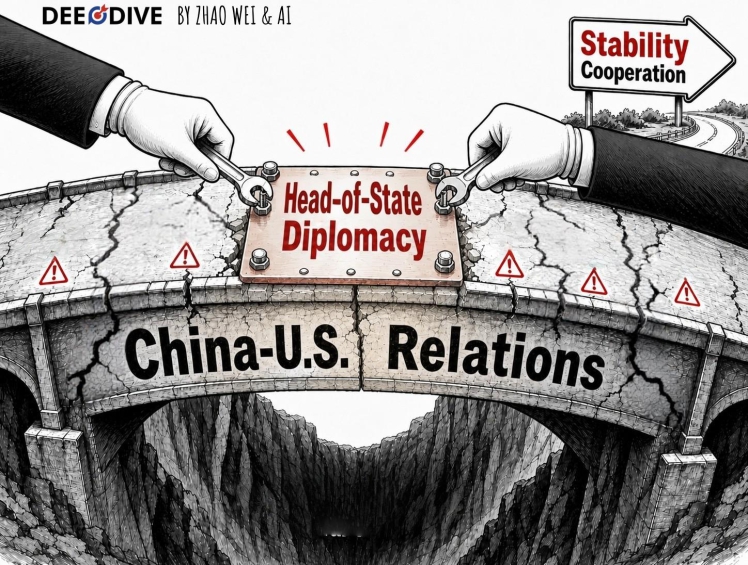
China-U.S. relations are not built overnight, and they should not be damaged casually. When cracks appear, head-of-state diplomacy is the repair work that keeps the bridge standing (ZHAO WEI&AI)
Most fundamentally, Washington confronts an accelerating challenge to the dollar’s structural role in international trade and reserves. China’s promotion of bilateral currency swaps and, for example, the pricing of commodity contracts in non-dollar denominations are not merely tactical irritations but systemic threats to the exorbitant privilege that has financed American deficit spending and military primacy for decades. De-dollarization, once a marginal concern, has acquired strategic momentum as sanctions overuse demonstrates to third parties the political risk of dollar dependence. For Beijing, this is killing two birds with one stone: reducing vulnerability to American financial coercion while simultaneously eroding the economic foundation that sustains American military capacity. The May summit occurred within this context of contested monetary order, with Washington likely to demand Chinese restraint in alternative financial architecture even as its own energy denial strategy pushes Beijing further toward sovereign alternatives.
The apparent positioning by both parties for potential conflict must be understood within this compressed technological and economic window. If American strategists assess that hypersonic deployment creates temporary escalation dominance, and Chinese strategists assess that AI parity, energy resilience and monetary alternatives create long-term structural advantage, both sides face incentives to either exploit a closing window or prevent its opening. The energy crisis, rather than incentivizing cooperation, becomes a mechanism to test which economy can absorb greater pain, a contest of “who can endure the bitterest.” Yet absolute conflict remains avoidable, though the margin for error narrows. Nuclear deterrence continues to impose a floor on escalation, but hypersonic compression of decision timelines degrades the stability that traditional deterrence assumes. The economic costs of full decoupling remain prohibitive, but AI-driven automation and alternative trade settlement systems may reduce the political salience of those costs over time. More likely is a protracted period of “fighting without breaking,” characterized by proxy competition, economic warfare through intermediaries, technological demonstration projects designed to signal capability, and episodic summitry that produces tactical pauses without strategic resolution. For China, the operative principle remains “hide brightness, nourish obscurity,” not in the sense of indefinite strategic patience, but of calibrated timing. Beijing likely assesses that demographic transitions, debt accumulation, technological bubble vulnerability and now monetary system fragility in the U.S. will compound over the coming decade, while China’s own military modernization, energy diversification, sovereign technology construction, and financial architecture development proceed apace. The DeepSeek-Ascend achievement symbolizes this trajectory: not merely catching up but establishing parallel ecosystems that reduce leverage points for American coercion. The American political cycle introduces additional uncertainty. Should the 2026 midterms produce substantial Republican losses, the administration may face pressure to either escalate further, to demonstrate resolve, or to seek more substantive accommodation. Conversely, a strengthened position might embolden confrontational policies that eliminate the limited cooperation zones currently preserved. Chinese planners must prepare for both contingencies while avoiding commitments that foreclose future flexibility. The author is a professor of politics and international relations and director of the Center for Ecological Civilization at East China Normal University in Shanghai. He is also a senior research fellow with the Institute for the Development of Socialism with Chinese Characteristics at Southeast University in Nanjing Copyedited by Elsbeth van Paridon Comments to dingying@cicgamericas.com |
|
||
|
||||||||||||||||||||||||||||
|