
|
| Voice |
| Putin's Visit to China: Much Remains to Be Done | |
|
|
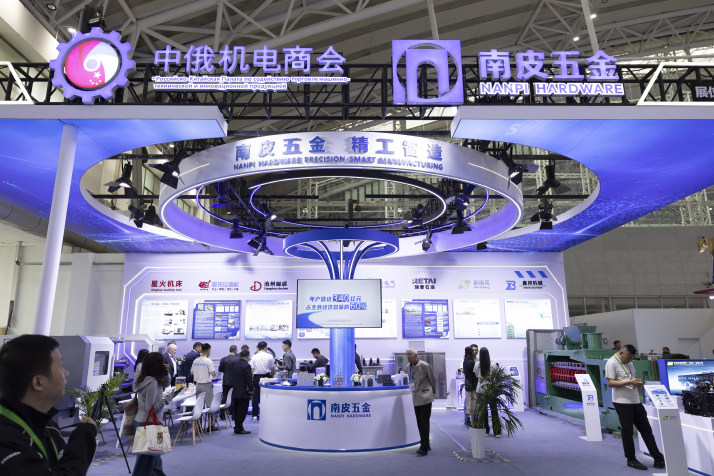 A booth at the 10th China-Russia Expo in Harbin, Heilongjiang Province, on May 17 (XINHUA)
U.S. President Donald Trump's visit to Beijing, which took place in mid-May, has sparked heated discussions worldwide, not least in Russia. Russian experts on international affairs have closely followed and examined every detail of the visit: from the handshake between President Xi Jinping and President Trump, to Defense Secretary Pete Hegseth taking the initiative to communicate with Chinese military officials at the welcome ceremony, and even to Secretary of State Marco Rubio, one of the toughest China hawks in the Trump administration, wandering aimlessly in the hall with no one willing to talk to him. Beyond these details, Russian experts have also made extensive comments on the outcomes of President Trump's visit. They have reached a core consensus that China has long been committed to normalizing economic and trade ties with the United States. In this regard, China has issued clear goodwill gestures and refrained from playing all the political cards available to it. But whether China-U.S. relations can improve remains to be seen, as it is widely known that pledges made by the sitting U.S. president are often short-lived. Russian President Vladimir Putin's visit to China on May 19-20 equally commanded global attention. It was President Putin's 25th trip to China, coinciding with the 30th anniversary of the establishment of the China-Russia strategic partnership of coordination and the 25th anniversary of the signing of the Treaty of Good-Neighborliness and Friendly Cooperation Between the People's Republic of China and the Russian Federation. Mutual trust In Russia, one school of thought argues that a key purpose of President Putin's visit to China was to learn what decisions the United States and China had reached regarding Russia, especially concerning the Russia-Ukraine conflict. Such speculation stems from the fact that President Putin could have arrived in Beijing before Trump's visit, to once again clarify Russia's position on relevant issues to China, and thereby enlist China to persuade the United States to end its aid to Ukraine—yet Moscow chose not to do so. In my opinion, however, such arguments do not hold water. After all, President Putin's visit was planned well in advance, with its schedule fixed long ago and entirely unrelated to Trump's trip. Moreover, the United States made multiple changes to the dates of Trump's China visit. President Trump may have hoped to walk into his meeting with President Xi holding a political trump card—such as an easy victory over Iran—but Iran has handed him no such card. Furthermore, there is no need for President Putin to repeatedly explain to the Chinese leadership and people why Russia launched the "special military operation" against Ukraine. After all, had NATO not continued its eastward expansion through Ukraine, creating a pervasive sense of existential threat for Russia, President Putin would never have initiated the operation. And were it not for the vehement opposition from the United States and Europe, Russia would likely have concluded its conflict with Ukraine long ago. President Putin has no reason whatsoever to worry that China and the U.S. might accidentally form an anti-Russia alliance and build a new Sino-U.S. co-governance order. It is utterly unrealistic for China to reach solid agreements with a hegemonic power that regards it as its primary rival. Currently, only the close economic, trade and financial ties binding China and the U.S. can hold back the direct military aggression of this hegemonic power. Meanwhile, Washington continuously uses Taiwan as a pawn to contain China and hinder its development. More efforts needed I am highly optimistic about the prospects of China-Russia cooperation. I sincerely hope that President Putin's visit will steadily elevate bilateral relations to new heights. Still, more efforts need to be made on Russia's part in relevant fields. First, I hope that a joint working group composed of experts and scholars from both countries can be established to formulate action plans for China and Russia to implement the vision of building a community with a shared future for humankind. Some may argue that such a vision is unrealistic and overly idealistic at a time when certain Western countries are deliberately disrupting the global political order. On the contrary, by stirring up global unrest, Western forces aim precisely to stop China and Russia from leading people across the world toward progress, peace and a bright future under the guidance of this vision. Their scheme has already shown initial results. Through public opinion manipulation and values infiltration, the West has fostered morally degraded groups who lack cultural refinement, historical awareness and national faith. Regrettably, the negative impact of ideological erosion has spread to Russia, where agents of external forces once carried out rampant activities. To create favorable conditions for putting the vision into practice, China and Russia must not only safeguard security along their common borders, but also extend security influence to broader regions, including Central Asia, South Asia, Iran, the Strait of Hormuz, the Arctic shipping routes and Eastern Europe. Establishing a Eurasian security belt benefiting all peoples across the Eurasian continent represents the shared aspiration of billions of people living here. Second, let us turn to bilateral relations between Russia and China. I hope the upcoming China-Russia Years of Education will prioritize people-to-people diplomacy. It is through such exchanges that mutual trust between the two peoples can be steadily strengthened, enabling them to seek common ground and expand interactions continuously. Youth exchanges stand out as a top priority, since the awareness of respecting neighboring countries' cultures and histories takes root among the younger generation. In this regard, I have previously suggested that the Russian Government offer strong support for youth exchanges between west Russia and China. People in these regions still view China as somewhat mysterious, and some even harbor misgivings about China's rapid technological advancement. Only through on-the-spot visits can young people there truly understand that China is a peace-loving major country as well as a reliable neighbor and partner of Russia. Governments should provide financial subsidies to boost youth exchange and deliver tangible outcomes in people-to-people diplomacy, rather than merely making empty pledges. Neglecting people-to-people ties will eventually give rise to profound hidden dangers, a fact sufficiently evidenced by the current situation in Ukraine and other post-Soviet states. Finally, I sincerely hope that Russia and China will continue to jointly safeguard the victorious outcomes of the World Anti-Fascist War. One highly feasible initiative is the erection of a monument to General Tang Duo. Tang was one of the founding fathers of the Chinese People's Liberation Army Air Force. A graduate of Soviet aviation schools and the Zhukovsky Air Force Academy, he joined the Soviet Air Force during World War II, not only training flight crews and planning air combat operations against the fascists, but also personally piloting missions over East Prussia and Poland. In May 2015, President Xi published an article in the Russian newspaper Rossiyskaya Gazeta, commemorating this hero. Erecting a monument to Tang in Kaliningrad, where he fought the Nazis, would not only honor the shared history of Russia and China fighting side by side against Nazi Germany and Japanese militarism, but also represent a highly significant symbolic gesture of friendship from Russia to China. It is precisely through such symbolic acts commemorating our shared combat history that mutual respect between the two countries is continuously consolidated, while strongly countering attempts to falsify the history of World War II. When it comes to matters of historical symbolism and national friendship, no effort should be spared. The author is editor in chief of Russia and China magazine Copyedited by G.P. Wilson Comments to dingying@cicgamericas.com |
|
||
|
||||||||||||||||||||||||||||
|