
|
| Voice |
| Toward 'constructive strategic stability' | |
|
|
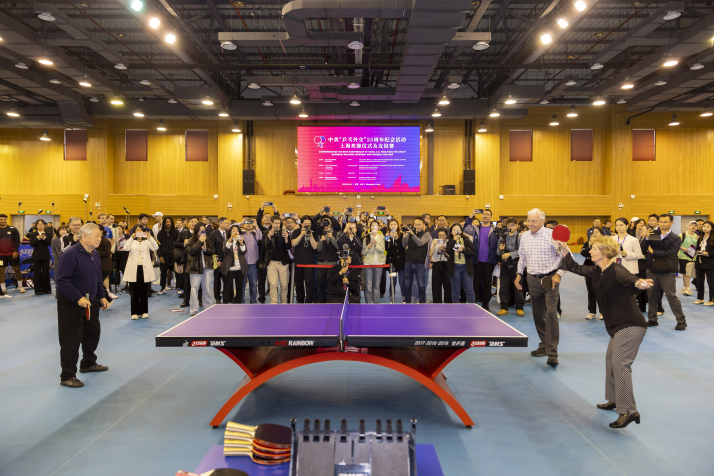 A friendly table tennis match between representatives from China and the United States at Shanghai University of Sport in Shanghai on April 13 (XINHUA)
Following U.S. President Donald Trump's visit to China on May 13-15, bilateral ties entered another closely watched phase. Chinese Foreign Minister Wang Yi later described the meeting between Chinese President Xi Jinping and Trump as "historic," adding that both sides agreed to explore the correct way for the two major countries to get along. Against that backdrop, two separate events held in Beijing on May 25 offered a rare glimpse into how some American scholars are interpreting the current trajectory of the relationship. At the Chongyang Institute for Financial Studies, Renmin University of China, and the Center for China and Globalization, former U.S. ambassador to Russia and Stanford professor Michael McFaul and George Washington University professor David Shambaugh respectively reflected on the post-summit geopolitical landscape. The two scholars emphasized a similar point: China and the United States are unlikely to stop competing, but both governments increasingly appear to recognize the importance of managing that competition rather than allowing it to spiral into confrontation. A new framework Shambaugh argued that the greatest significance of Trump's visit was not necessarily any single agreement reached during the summit, but the fact that the summit happened at all. After several years of instability in China-U.S. relations, he said, the meeting succeeded in "putting a floor" under the relationship and establishing "guardrails and boundaries" capable of preventing further deterioration. He described "constructive strategic stability" as an important new official narrative shaping bilateral relations, with "strategic stability" in Beijing referring to "predictability in competition." In his view, such narratives matter because policies often derive from them and because they provide governments with a broader strategic framework. Shambaugh noted that the summit created a new framework capable of restraining points of friction while keeping tensions within manageable boundaries. He stressed that "stability" should not be understood as something static or permanent. Borrowing from earlier discussions among Chinese and American scholars about "dynamic stability," Shambaugh argued that relationships between major powers inevitably evolve and fluctuate. The real challenge is creating a framework flexible enough to accommodate change while still maintaining basic equilibrium. He also devoted considerable attention to the meaning of "competition." For years, Shambaugh observed, Chinese officials tended to reject the American concept of competition because the word competition itself was often associated with hostility and adversarial politics. But he said Wang's recent remarks suggest a noticeable evolution in Chinese thinking. According to his May 15 press briefing, Wang said competition should be "kept within proper limits and is not turned into a zero-sum game. Major-country competition is nothing new, but China-U.S. relations should not be defined by competition. When competition does happen, it must be a healthy one where we learn from each other, pursue excellence together and compete fairly in compliance with rules. The purpose of competition should be to outdo oneself, so that both sides become better." McFaul similarly viewed the phrase "constructive strategic stability" as a notable development. For years, China and the U.S. have often relied on different narratives and vocabularies to define their bilateral relationship. Trump's willingness to publicly accept Chinese terminology, McFaul argued, sends an important signal domestically and internationally, particularly given how controversial such language could be in U.S. politics. But he noted that the phrase must eventually acquire real substance through concrete cooperation. Both scholars argued that if the current easing of tensions is to endure, China and the U.S. must considerably expand their areas of cooperation. To make "constructive strategic stability" meaningful, McFaul said, both countries need practical cooperative mechanisms. AI emerged repeatedly in his remarks as one possible starting point. He warned that AI technologies could create enormous risks if obtained by rogue actors or terrorist organizations, especially in fields such as biotechnology and weapons development. Preventing such dangerous scenarios is a clear shared interest for both Beijing and Washington. Climate cooperation and trade stabilization also featured prominently in his discussion. McFaul described China's agreement to purchase Boeing aircraft as a "win-win" example of practical cooperation, though he acknowledged that broader investment ties remain politically difficult in both countries. He specifically referenced the challenges faced by global leader in innovative technologies CATL's investment efforts in the U.S. as evidence of the obstacles that still exist. Rebuilding mutual understanding Both scholars also placed strong emphasis on people-to-people exchange. Shambaugh reflected at length on his own experience studying at Peking University in the 1980s, where he became the first foreign student permitted by China's Ministry of Education to study in the school's international relations department. He recalled researching Chinese perceptions of the U.S. and noted that mutual perceptions remain one of the most important factors shaping bilateral relations, often more important than trade balances or other functional disputes. "Language means different things to different people," he observed, warning against assuming that others automatically interpret policies or rhetoric in the same way. Sustained dialogue, therefore, is essential. Without it, misunderstanding and misperception inevitably deepen. He expressed concern that exchange between the two societies has "atrophied badly" since the COVID-19 pandemic and urged both governments to rebuild them on a reciprocal basis. While praising Xi's November 2023 announcement to invite 50,000 young Americans to China on exchange and study programs over the course of five years, Shambaugh stressed that scholarly exchange deserves equal attention. Researchers, he said, want access to Chinese archives, factories, laboratories and rural communities because there is intense global curiosity about China's ongoing transformation. McFaul echoed that sentiment. He criticized America's recent cuts to overseas exchange programs, and noted that such policies ultimately weaken U.S. national interests. "I think that's a real tragedy for my country. I want America and all American institutions to understand China. And you can't understand China if you don't interact with it, if you don't travel here," he noted. China's multilateralism Another aspect of McFaul's remarks was his praise for China's investment in soft power instruments and multilateralism. He described himself as "very impressed" by China's investments in soft power and multilateral institutions. In his analysis, China has pursued a "two-pronged strategy": strengthening its influence within existing institutions such as the United Nations, World Bank and World Trade Organization, while simultaneously creating new platforms including BRICS (the acronym for an emerging-market cooperative mechanism that initially comprised Brazil, Russia, India, China and South Africa), the Shanghai Cooperation Organization, the Asian Infrastructure Investment Bank and the Belt and Road Initiative (a China-proposed initiative to boost connectivity along and beyond the ancient Silk Road routes). Far from viewing these efforts as threatening, McFaul described them as logical outcomes of China's growing power and influence. In fact, he lamented that the United States is no longer pursuing similar strategies itself. He criticized Washington for withdrawing from or weakening institutions it once helped create, including the Trans-Pacific Partnership and the Iran nuclear agreement. Leaving institutions such as UN organizations, he argued, makes little strategic sense: "It's like you build a house and then you leave." McFaul also argued that the U.S. should spend less energy trying to contain China's growing global influence and focus more on strengthening its own global leadership programs. "The world's big enough for two great powers," he said. Taken together, the remarks by Shambaugh and McFaul suggest that some American scholars increasingly see stable coexistence as the more realistic path for China-U.S. relations. Neither scholar minimized the depth of structural competition between the two countries. But both appeared to share the view that competition itself need not define the entirety of the relationship. Copyedited by Elsbeth van Paridon Comments to liwenhan@cicgamericas.com |
|
||
|
||||||||||||||||||||||||||||
|