
|
| Voice |
| Shanghai: The new capital of Global South AI | |
|
|
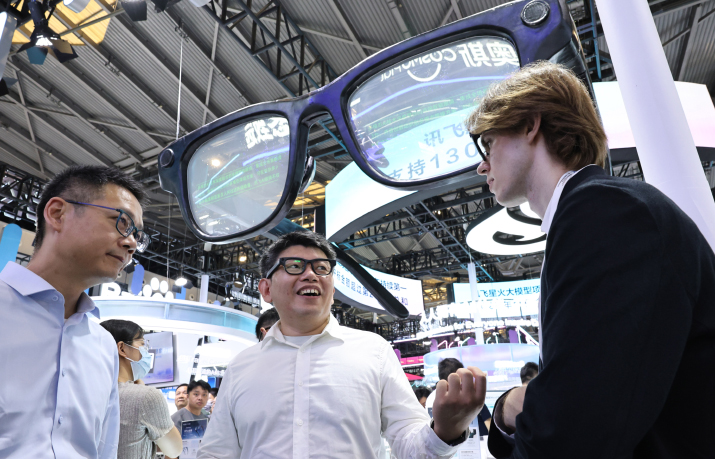 A member of staff (center) introduces intelligent glasses with real-time translation functionality at the Shanghai World Expo Exhibition and Convention Center in Shanghai on July 17
What an honor it was to be part of the historic 2026 World AI Conference (WAIC) and its embedded Win-Win BRICS Forum right here in Shanghai. As someone who's spent over 25 years living and working in China, watching this city transform from a manufacturing powerhouse into the undeniable epicenter of the multipolar AI future hit different. This wasn't just another tech expo. This was an epic strategic move to institutionalize a real alternative AI governance and development ecosystem outside the Western-led order. China didn't just talk about doing so. They built the stage, invited the players and started delivering on the vision. From declarations to tangible action BRICS (a group of emerging economies that cooperate to promote and pursue the interests of the Global South—Ed.) has been evolving fast. The original group expanded in 2024 to include Saudi Arabia, the UAE, Iran, Egypt and others, key Global South heavyweights with capital, energy, markets and strategic weight. What started with the 2023 BRICS AI study group and the 2024 cooperation framework has now moved from well-intentioned joint declarations into real practice. At this year's WAIC, the Win-Win BRICS Forum showcased that shift. We're talking joint computing clouds, shared open-source foundation models tailored for diverse languages and needs across BRICS nations, and cross-border data sandboxes that respect sovereignty while enabling collaboration. This is the kind of practical infrastructure that actually moves the needle for countries that have been locked out or overcharged by the U.S.-EU monopoly system. President Xi Jinping's keynote speech, his first at WAIC, drove this point home. China committed to providing 5,000 AI training and seminar opportunities for developing countries over the next five years and pledged to set up AI application cooperation centers with BRICS, the Association of Southeast Asian Nations, the African Union and others. He framed AI as something that should serve all humanity. The new World AI Cooperation Organization (WAICO), launched with 29 founding countries and headquartered in Shanghai, institutionalizes this approach. Shanghai is now officially the Capital of Global South AI. No debate. Countering the Western monopoly playbook The tagline "Making AI an International Public Good for the Benefit of All Humanity" isn't just rhetoric. It's a different narrative to the U.S.-EU model, which gets sold as "democratic AI" but feels too much like monopoly control dressed up in fancy language. Think about it: U.S. chip export controls and the CHIPS Act were supposed to kneecap China's AI progress. Instead, they accelerated China's push for indigenous alternatives like Huawei's Ascend chips and a thriving open-source ecosystem. The EU AI Act reaches far beyond Europe with its extraterritorial rules. Big Tech (Nvidia, OpenAI, Google, Microsoft) dominates the stack, sets the prices and often comes with political strings or data demands that many sovereign nations find unacceptable. China is offering something different: AI as a utility. Non-coercive. Sovereignty-respecting. Affordable. Open enough that countries can adapt it to their own languages, cultures, industries and values. That message is landing hard with nations tired of being told they have to choose between expensive, sanctioned Western tech or nothing. Holding the forum inside WAIC in Shanghai was brilliant. Delegates got an up-close look at Chinese AI hardware and software, including Huawei clusters, new foundation models and embodied AI applications, while coordinating real ways to share compute, talent pipelines and manufacturing capacity. This matters especially for sanctioned members like Russia and Iran, and for China itself facing ongoing U.S. restrictions. It's building resilience into the system. Soft decoupling and digital sovereignty One of the most striking things I noticed was the push to pool sovereign wealth, especially from the Gulf, and technical talent from India, Russia, Brazil and across the expanded BRICS into Chinese-led mega-projects. This isn't accidental. It redirects capital that might otherwise flow into Silicon Valley or get tangled in U.S. investment screening regimes. China is creating a parallel AI stack: from chips (Huawei's Ascend ecosystem) to models [open-source Chinese-led large language models (LLMs)] to infrastructure (shared clouds and data frameworks). Countries can plug in without having to swallow the full Western package or risk secondary sanctions. Analysts I've been following closely, like Ben Norton, who I had the chance to meet recently after his powerful lecture at Fudan University, have been calling this for a while. Western tech giants built on hype, closed ecosystems and massive valuations are vulnerable once real open-source competition from China scales. The bubble isn't just possible—it's looking increasingly likely as the rest of the world builds alternatives that don't require begging for GPUs or complying with extraterritorial rules. George Galloway and other sharp geopolitical voices have long pointed out that power shifts when the majority of humanity stops playing by rules written in Washington or Brussels. We're seeing that play out in real time in AI. The bigger, multipolar picture We are moving forward in this new era toward a genuinely multipolar world. Western hegemony in tech—and the broader global order—is cooked. The U.S. AI tech bubble, inflated by hype, sanctions that backfired and an inability to protect its supposed technological superiority, is heading for a reckoning. If American tech was so far ahead and untouchable, why has China been able to replicate, improve and scale alternatives so effectively? Why are more and more nations choosing the latter's path? My best advice to any friends and loved ones who have heavily invested in Western AI stocks and companies—Nvidia, the big cloud providers, the closed-model players: GET OUT! FAST! The smart money is already repositioning toward the Global South and the emerging multipolar order. Focus on BRICS-related opportunities, Chinese open-source ecosystems, Gulf and emerging market infrastructure plays, and projects that actually deliver usable AI to billions of people who were previously priced out or politically excluded. This isn't about picking sides in some childish binary. It's about recognizing reality. The majority of humanity has moved on. They want AI that works for their development goals, respects their sovereignty and doesn't come with lectures or hidden costs. China and its BRICS partners are delivering that framework—pragmatically, at scale, and with a "win-win" philosophy that actually means something on the ground. Shanghai didn't just host a conference. It hosted the birth of a new AI order. One in which the Global South isn't a passive market or a source of cheap data—it's a co-creator and co-owner. The wave is here. Catch it. The author is founder of the Iron Mic, and Dana Culture Media Co. He lives in Shanghai and is active in the China is Not Our Enemy campaign Copyedited by G.P. Wilson Comments to dingying@cicgamericas.com |
|
||
|
||||||||||||||||||||||||||||
|