




The Nepal Police said on September 3 that the death toll from the mudslide had risen to 1,290. On the Chinese side, 21 people had been confirmed dead and more than 500 listed as missing as of September 3, according to official statistics.
While monitoring and evaluating the emergency response to the tragedy, it is also important to scrutinize the response from the global media.
Fiction outran the science
The rumors arrived before the floodwaters receded. Within hours, posts on X claimed that a Chinese hydropower dam had collapsed and that Chinese construction was to blame. Some attached dramatic footage of missiles striking a dam. Fact-checkers at AFP, Lead Stories and the Philippines-based Vera Files established the clips were AI-generated, some circulating since May 2026 with watermarks intact. One widely shared “explainer” video passed off footage of a glacier calving into the sea as the Himalayan disaster, gathering more than 800,000 views before Community Notes, X’s crowdsourced fact-checking feature, flagged it. The Chinese Embassy in Nepal has also refuted the false allegations, stressing that “accusation helps nothing, cooperation saves lives.”
The science, meanwhile, was never ambiguous—it was simply slow. The U.S. Geological Survey first logged what appeared to be a 4.4-magnitude earthquake near the border, then concluded that the shaking had been generated by the collapse itself, an event equivalent to an earthquake of roughly 5.2 magnitude. Science coverage by Reuters, The New York Times and the BBC traced the flood to a natural glacial collapse in Nepal, not to any dam or construction project. Chinese institutions working on the same question converged on the same picture: A high-altitude collapse of ice and rock that scoured some 22 km of gully in roughly 7 minutes, melting and gathering mass as it fell. This process was detailed by the Institute of Tibetan Plateau Research in the Science Bulletin of the Chinese Academy of Sciences on September 1. Two scientific communities, shared conclusion, reached through complementary methods over days, not minutes.
None of this stopped “China’s dam burst” from outperforming the science on the platforms where millions now get their news. The reason is structural: Explanatory content must wait for satellite passes, data and peer review; a viral clip needs only to be uploaded. In my own sampling of X that week, the best science posts topped out in the hundreds of thousands of views, while shock videos and blame narratives—despite being entirely false—ran into the millions. Science wins the archive; the first week belongs to whoever posts first and baits the most clicks.
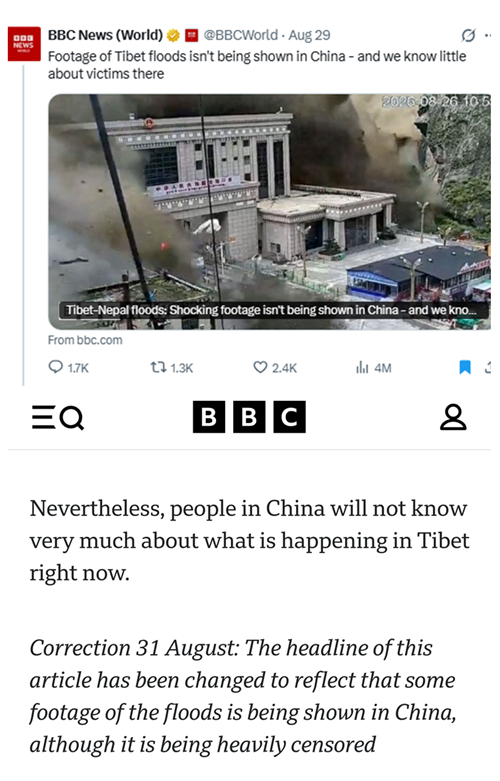
Screenshots show the BBC's revised August 31 headline on a report about information released by China
Drifting from the tragedy
Then came the framing. One of the BBC’s reports, published under the headline Footage of Tibet floods isn’t being shown in China..., rested on two observations that a few minutes of searching would have complicated: The border-crossing surveillance video that circled the globe was hard to find on Chinese platforms, and foreign correspondents cannot enter Xizang without official permission. The packaging delivered a blunter message—media blackout—but on August 31 the BBC amended the headline to acknowledge that some footage was being shown.
By then, The Telegraph’s amplification of the censorship frame had drawn more than a million views, and The Wall Street Journal had run an opinion piece, China Muddies the Flood Waters in Nepal, that wondered whether construction at the Gyirong Port had aggravated the flood—a question the scientific record had already answered—before signing off: “Nothing bad ever happens in China or because of China. So whatever you hear, it’s probably a lie.”
Read that sequence again, because it is the real story: Within a week, coverage of a disaster that had claimed about 1,000 lives drifted until it was no longer about the disaster. It was about China. The victims, Chinese, Nepalese and citizens of other nations alike, became supporting characters in stories more about politics than the pursuit of truth.
The pushback, and an audit by machine
The pushback came from several directions. The Global Times accused the BBC of manufacturing a “secondary disaster” at a moment when lives hung in the balance; China Daily released a plain-language explainer on why every major disaster seems to unleash a fresh batch of anti-China rumors. Netizens posted clips of the round-the-clock coverage on Chinese television, noted that even the BBC was citing Chinese reporting, and minted a mocking nickname: “BBC impartial.” “People are clear on the level of disinformation we’re dealing with here in the WSJ (The Wall Street Journal),” influential French entrepreneur and writer Arnaud Bertrand said on his X account the same day the article was published. Chinese authorities also punished 10 people for spreading disaster-related falsehoods, including one case involving an inaccurate casualty figure. Rumor, it turns out, is an equal-opportunity pathogen.
The most instructive rebuttal came from an unlikely quarter: AI. Grok, the chatbot built into X, audited the platform’s discourse with journalistic ethics as its yardstick—an audit I had requested. Its value lay not in authority—it is, after all, owned by the platform it was auditing—but in its discipline of categories: verified facts (the glacial collapse, the AI-generated fakes); legitimate questions without public answers (the minute-by-minute record of cross-border early warnings); and outright fabrication (the dam collapse, the missile videos). By that standard, both extremes fail. Declaring every inconvenient question a “rumor” is overreach. Presenting unverified accusations of deliberate malice as established fact—in a headline, before an audience of millions—is worse.
The stress test
A natural disaster is journalism’s ultimate stress test, because the audience is not an abstraction. It includes families searching for the missing, villages downstream of an unstable barrier lake and officials making life-or-death calls. In that environment, information is infrastructure.
None of this places transparency off-limits: the fate of the missing and the mechanics of early warning between two neighbors sharing the world’s most fragile watershed deserve patient, evidence-driven reporting. I covered the 7.0-magnitude earthquake that struck Lushan County in Ya’an, Sichuan Province, in 2013, and saw what a national press corps does to a disaster zone: The burden of receiving them is real, and survivors, acutely traumatized, are fragile. A journalistic deadline should never outrank their recovery. That is one reason Chinese disaster coverage has long shown restraint in consideration of victims—a practice older, and less sinister, than “blackout” headlines imply.
There is a difference between holding power accountable with verifiable facts and converting tragedy into a referendum on a country one has already decided to condemn. The first is journalism. The second is content.
And the platforms cannot shrug off the responsibility. My corrective comment under the BBC’s report drew more than 1,000 likes, yet under “most liked” sorting, the absolutist conclusions still ranked above it. Explanatory content suffers the same demotion: It corrects false rumors, but it provokes no adrenaline, so the algorithm buries it. At the same time, AI has made fabrication nearly free and verification remains expensive. Community Notes arrives after the views have been banked.
That asymmetry is a design choice, not a law of nature. Platforms already rank, recommend and amplify; fact-based posts deserve a share of that machinery. Until then, the measure of disaster coverage is simple to state but hard to meet: Did it help the living? Did it inform the desperate? Did it hold power accountable with facts that survive checking?
On the China-Nepal border, the mudslide will be cleared and the roads rebuilt. But the damage caused by misinformation also needs repair. False claims must be corrected quickly and visibly, while facts from credible sources should be given the reach they deserve. In moments of crisis, rebuilding trust begins with setting the record straight. BR



