|
| Voice |
| Seek first to understand | |
|
|
|
Young people from China and the U.S. chat during a break at a rehearsal for a musical performance at a school in Nanjing, Jiangsu Province, on July 17 (XINHUA) President Xi Jinping and President Donald Trump will conduct their second face-to-face meeting of 2026 during Xi's state visit to Washington D.C. from September 23-25. The meeting follows Trump's state visit to China in May, when the two leaders committed themselves to building what they described as a “constructive relationship of strategic stability.” The coming White House meeting will undoubtedly focus on trade, technology, artificial intelligence, security and other difficult questions. Yet beyond whatever agreements may emerge from discussions between the two presidents lies a larger question: What must be built beneath leader-level diplomacy if a more stable U.S.-China relationship is to endure? The answer may begin with something deceptively simple: The two countries need to understand one another better. The relationship between the U.S. and China is usually described through the language of strategy, competition, deterrence, trade, technology and national security. These are important dimensions, but they do not constitute the entire relationship. Two societies of such scale and consequence cannot be understood solely through government policies, nor can their long-term relationship be stabilized through summit diplomacy alone. What is increasingly needed is a stronger infrastructure for mutual understanding, supported by credible information, educational exchange, institutional dialogue, commercial engagement and sustained human contact. Information without understanding There is certainly no shortage of information about either country. American government agencies, Congress, universities, think tanks, media organizations, businesses and security institutions produce enormous quantities of research and commentary about China. Chinese ministries, universities, research institutes, media organizations, scholars and diplomats similarly produce extensive information about the U.S. and Chinese policy. Yet abundant information does not necessarily create better understanding. Information can be fragmented, selectively amplified, politically framed or repeatedly interpreted through assumptions established by only one side. This challenge has become more important with the rise of generative artificial intelligence. Increasingly, students, executives, journalists, policymakers and citizens ask AI systems to explain China, the U.S., trade disputes, technology competition, the Taiwan question, military affairs or the history of bilateral relations. The answers they receive depend not only on whether individual facts are accurate, but on the larger information architecture through which those facts are organized and interpreted. The American English-language information ecosystem is particularly extensive. Government documents are analyzed by think tanks, cited by universities, reported by media organizations, discussed in Congress and amplified across digital platforms. Chinese positions are also widely available, including in English, but they do not always receive comparable independent analysis or secondary amplification. Consequently, a discussion can technically include both American and Chinese perspectives while still defining the entire issue through assumptions originating primarily from one side. Better understanding requires more than allowing each country to answer the other’s accusations. It requires understanding how each side defines the question in the first place. From competing narratives to parallel understanding Trade offers an obvious example. Americans may discuss deficits, subsidies, industrial policy, market access, tariffs and economic security. Chinese policymakers may emphasize development rights, restrictions, technological containment, economic sovereignty and mutually beneficial trade. The same divergence occurs in discussions of technology, security, international institutions and global governance. Neither vocabulary by itself provides a complete picture. A healthier information environment would routinely examine major bilateral questions through three lenses: What Washington says, what Beijing says and what independently verifiable evidence shows. Such an approach would not require agreement or suggest that every competing assertion carries equal validity. It would instead encourage greater intellectual discipline in understanding where positions differ, why they differ and where common ground may nevertheless exist. Understanding should never be confused with appeasement. Understanding another country’s reasoning does not require accepting its conclusions, just as listening does not require concession. Governments devote enormous resources to intelligence and strategic analysis precisely because misunderstanding another major power can be dangerous. The greater the disagreement, the more important it becomes to understand how the other side perceives its own interests, vulnerabilities and choices. Universities and Education Diplomacy Universities should play a much larger role in developing this understanding. Universities educate future government leaders, diplomats, military officers, scientists, journalists, business executives and public intellectuals. Governments frequently rely upon university scholars for research and counsel, while retired public officials, diplomats and military leaders often return to universities to teach and reflect upon their experience. Universities therefore occupy a distinctive space between government and society. They can examine ideas before those ideas harden into policy and can create environments in which disagreement becomes a subject of inquiry rather than confrontation. For U.S.-China relations, this role should develop into a more systematic form of education diplomacy, including student and faculty exchanges, joint seminars, collaborative research, visiting scholar programs, policy dialogues and institutional partnerships. These connections become especially valuable during political difficulties because academic relationships can preserve channels of communication when official channels narrow. People-to-people relations as strategic infrastructure People-to-people relations should likewise be considered part of strategic stability rather than a ceremonial supplement to diplomacy. A student who has lived in another country develops a different understanding from someone who knows that society primarily through political commentary. Business executives working with overseas counterparts learn institutional and cultural distinctions that cannot easily be acquired from reports. Scientists, teachers, artists, athletes, nonprofit leaders and local officials create relationships that often survive political cycles.
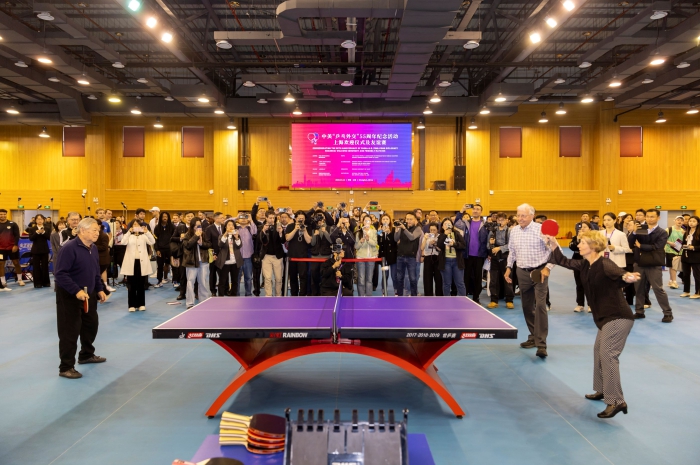
Representatives from China and the U.S. play a friendly table tennis match at Shanghai University of Sport in Shanghai on April 13 (XINHUA) These exchanges do not eliminate geopolitical disagreements, but they reduce unfamiliarity and make disagreements easier to manage. A relationship in which governments continue talking while their societies become increasingly unfamiliar with one another may appear stable at the diplomatic level while becoming progressively more fragile underneath. Commercial relationships deserve similar attention. Governments understandably focus on national security, while businesses also consider customers, markets, investment, innovation, supply chains and predictability. Economic interdependence can produce vulnerabilities, but it also creates powerful incentives for stability. Agriculture, healthcare, aviation, energy, financial services, environmental technologies, logistics and consumer markets continue to provide areas where practical cooperation can coexist with strategic competition. Multiple channels U.S.-China relations should also extend far beyond the two national capitals. Both countries are continental-scale societies whose relationships operate through states and provinces, cities, universities, chambers of commerce, ports, hospitals, museums, scientific institutions and nonprofit organizations. These networks create resilience. A state-to-province agricultural relationship, a university partnership, or a sister-city program operates differently from a national-security negotiation. The existence of multiple channels makes the bilateral relationship less vulnerable to disruption by any single political dispute. For a constructive relationship of strategic stability to be most constructive and truly stable, engagement must be encouraged and enhanced at many levels and across many sectors between the two countries. Only through greater societal understanding of one another can top-level agreements be a true reflection of national will. The author is president of AmericaChina. He is also an honorary fellow of the Foreign Policy Association, senior advisor to the China-United States Exchange Foundation, executive council member of the Center for China and Globalization and visiting professor of the School of International Studies at Sichuan University Copyedited by Elsbeth van Paridon Comments to dingying@cicgamericas.com |
|
||||||||||||||||||||||||||||
|