
|
| Voice |
| A Trilateral Opening | |
|
|
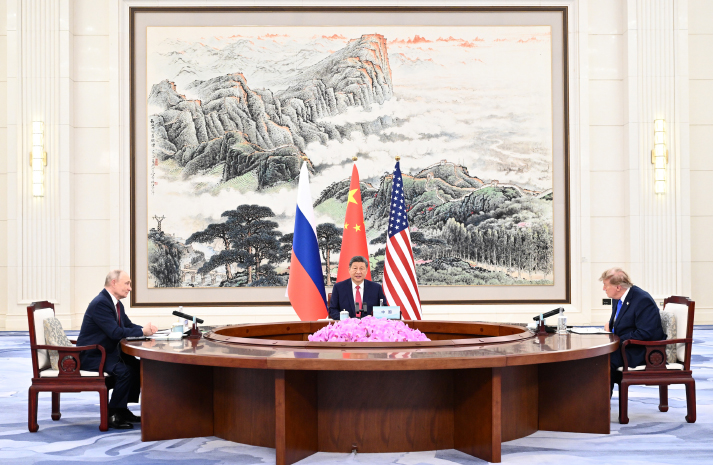 Chinese President Xi Jinping holds a China-Russia-U.S. summit with Russian President Vladimir Putin and U.S. President Donald Trump in Shenzhen, Guangdong Province, on November 19 (XINHUA)
On November 19, on the sidelines of the 33rd Asia-Pacific Economic Cooperation (APEC) Economic Leaders' Meeting in Shenzhen, Guangdong Province, Chinese President Xi Jinping, Russian President Vladimir Putin and U.S. President Donald Trump held a China-Russia-U.S. trilateral summit and issued the China-Russia-U.S. Heads of State Declaration Toward Peace. Bilateral meetings were also held between China and Russia, China and the U.S., and Russia and the U.S. This is not only the first formal trilateral meeting between the three leaders, but also the first time they have appeared together at an international conference since the Ukraine crisis erupted in 2022 and Russia was placed under U.S. and Western sanctions. While summarizing consensus reached, President Xi said that the summit had been positive, constructive and fruitful. Peace matters The global landscape in 2026 has grown more volatile with international institutions proving inadequate in responding to challenges. Trump has devoted enormous energy to mediating the Ukraine conflict, yet progress remains extremely limited. There is no visible sign that the direct parties to the fighting will strike a compromise to end hostilities; if anything, the war might continue to escalate. In the Middle East, the U.S. and Israel launched a hasty war against Iran. Far from delivering any meaningful gains, the conflict has boomeranged on global energy and economic markets. After the U.S. Republican Party suffered a crushing defeat in the midterm elections, the Trump administration now faces mounting pressure to extricate itself from the Iran war quickly, yet it holds a weak hand at the negotiating table. Among the three countries, both the U.S. and Russia are embroiled in major regional conflicts, and both confront the urgent challenge of disentangling themselves in ways that best serve their core strategic and practical interests. China has not intervened and will not directly intervene to fight anyone's proxy battles, nor has it stood aside to reap windfalls. Instead, it has played a balanced, rational role encouraging dialogue and reconciliation, working to contain escalation and spillover. This approach has earned the trust of the leaders of the countries involved, including the U.S. and Russia. "There is hope for peace as long as dialogue does not cease and the door does not close," Xi said during the trilateral summit. The three countries share the same view on safeguarding world peace, and all stressed that the hard-won peace must be cherished, he said. The declaration they issued stressed that as permanent members of the United Nations Security Council, China, Russia and the U.S. committed to reform the UN so that the UN can respond more effectively to global challenges and conform to its fundamental mission of international peace and security. They also reaffirmed the importance of stable energy flows and announced that the three countries plan to increase the production and supply of refined petroleum products for the benefit of all nations. Stable major-country relations The U.S. foreign policy centering on strategic competition with other major countries has severely disrupted international trade and security order. De-globalization under the shadow of a "new cold war" has become the prevailing trend. Yet after years of bruising rivalry, Washington has recognized that it can no longer sustain its hegemony through containment. Late in its tenure, the Joe Biden administration began recalibrating its approach, seeking to put guardrails on its ties with China, Russia and others. In his second term, Trump has further dialed down the rhetoric of great-power competition, making stabilizing relations with China and Russia and avoiding direct conflict a high priority. Since 2026, Xi and Trump have met three times, reaching consensus to build a constructive China-U.S. relationship of strategic stability based on respect, fairness and reciprocity and halting the free fall in bilateral ties. The two presidents are set to meet again at the 2026 Group of 20 Leaders' Summit scheduled for December in Miami, the U.S. Meanwhile, Russia and the U.S. have resumed high-level talks amid the Ukraine crisis with the aim of resetting their relationship. China and Russia maintain a back-to-back comprehensive strategic cooperative partnership. Their mutual trust and cooperation have deepened while weathering dramatic shifts across regional and global affairs. Since 2013, Xi and Putin have met more than 40 times. The two leaders have repeatedly affirmed that with the commitment to non-alliance, non-confrontation and not targeting any third party, China-Russia relations pose no threat to any country in the world, still less are they subject to the disruption and influence of any third party. Stable relations among major countries form the bedrock of international order. Every past transition of regional and global order in human history, however, came about either through hot war or cold war between those major countries. Today, humanity stands once again at a crossroads of systemic change. The unipolar moment that briefly defined the post-Cold War era is long gone. The liberal international order that shaped global affairs for three decades is nearing its end. The order of the future will evolve from the existing one, shaped by geopolitics, major-country coordination, multilateral institutions, technological innovation and other factors. The exchanges in Shenzhen were precisely a manifestation of this rational consensus being reinforced, injecting predictable stability into the international order amid turbulence and transformation. Xi made four points on how major countries could find the right way to get along and jointly underpin world peace. Major countries should uphold mutual respect, peaceful coexistence, win-win cooperation and dialogue and consultation, he said. The three countries should maintain regular high-level exchange, keep dialogue channels open at all levels and establish crisis communication and prevention mechanisms to ensure that misjudgments occur less, differences can be managed, and frictions will not escalate. They should make efforts to avoid the Thucydides Trap, he added. Strategic stability Strategic stability carries broad and narrow definitions. In the broad sense, it refers to a framework for major-country interaction built on managing differences, avoiding miscalculation, and rejecting unilateral advantage at the expense of one another's security. The narrow definition usually centers on the balance of nuclear deterrence and arms control. Judging from recent interactions among Beijing, Moscow and Washington, structural frictions and divergent perceptions over core interests and vital security concerns persist. Still, all three share a willingness to manage disputes rationally and resist sliding into confrontation. Both the U.S. and Russia maintain nuclear arsenals of roughly 5,000 warheads, with around 1,700 deployed. Since acquiring nuclear weapons, China has committed to a no-first-use policy and pursued a defensive nuclear strategy. China has repeatedly stated that it keeps its nuclear forces at the minimum level required for national security and will not enter an arms race with any nation. As a party to the Treaty on the Non-Proliferation of Nuclear Weapons, China proposed in 1994 that nuclear-weapon states conclude a treaty on mutual no-first-use of nuclear weapons. In 2022, it helped bring about the joint statement by the leaders of the five nuclear-weapon states affirming that a nuclear war cannot be won and must never be fought. In 2024, China released a working paper on its no-first-use of nuclear weapons initiative. Faced with U.S. pressure to join trilateral nuclear disarmament talks with Russia, China has argued that such negotiations would be unfair, unreasonable and unworkable. The Chinese Foreign Ministry has stressed on multiple occasions that China's nuclear force is nowhere near the scale of the U.S. and Russian stockpiles. As holders of the world's largest nuclear arsenals, Washington and Moscow bear a special, primary responsibility for nuclear disarmament. This stance does not mean narrow strategic stability is irrelevant to the trilateral relationship. Quite the opposite: The spirit of strategic stability must be translated into crisis-management mechanisms. Even at the height of the U.S.-Soviet Cold War, the two superpowers kept lines of communication open. China, Russia and the U.S. can build dialogue platforms centered on preventing nuclear conflict and lowering the risk of misjudgment. Regular military communications, nuclear policy briefings and crisis consultations can translate the principles of strategic stability into operational norms, reinforcing security guardrails for major-country ties and the international order. During their meeting, the three heads of state also reaffirmed that a nuclear war cannot be won and must never be fought. The three countries will conduct a dialogue on reducing nuclear risks and preventing the proliferation of nuclear weapons. While the Shenzhen gathering of the three leaders captured the bulk of media attention, the other sovereign countries were sidelined in no way. The global system is far broader. Other countries, including the Global South, continue to shape events. As the world moves toward multipolarity, the principle of equality between large and small states will gain greater traction in international politics. The notion that major powers alone decide global outcomes runs counter to China's diplomatic philosophy and traditions and will never serve as its guiding doctrine for global governance and international reform. Still, major powers carry outsized, objectively unique influence in shaping the international order, an influence amplified as technological advantages continue to concentrate in their hands. As Xi has noted repeatedly in meetings with U.S. presidents, big countries should behave in a manner befitting their status and with a greater sense of responsibility. As major countries, China, Russia and the U.S. ought to keep humanity's shared future in view and shoulder their duties for global peace, development and strategic stability, rather than monopolizing regional and international affairs by means of strength. ------ China-Russia-U.S. Heads of State Declaration Toward Peace Xi Jinping, President of the People's Republic of China, Vladimir Putin, President of the Russian Federation, and Donald J. Trump, President of the United States of America, met in Shenzhen on November 19, 2026. The Russian and U.S. heads of state expressed appreciation to China for hosting this historic trilateral summit. The three heads of state had an in-depth exchange of views on the current international situation and committed to maintaining strategic stability and international security. 1. As permanent members of the United Nations Security Council, China, Russia, and the United States committed to reform the UN so that the UN can respond more effectively to global challenges and conform to its fundamental mission of international peace and security. 2. The three countries plan to increase the production and supply of refined petroleum products for the benefit of all nations. They reaffirmed the importance of stable energy flows. 3. The three heads of state recognized that the principle of state consent and respect for immunities of state officials are of paramount importance, and concurred that the International Criminal Court and other similar bodies must not abuse their jurisdiction. 4. The three heads of state reaffirmed that a nuclear war cannot be won and must never be fought. The three countries will conduct a dialogue on reducing nuclear risks and preventing the proliferation of nuclear weapons. (Source: Ministry of Foreign Affairs of China) The author is a non-resident fellow at Tsinghua University's Center for International Security and Strategy and senior editor of China's World Affairs magazine Copyedited by G.P. Wilson Comments to dingying@cicgamericas.com |
|
||||||||||||||||||||||||||||||
|