
|
| Voice |
| Twenty-one Orders, One Benchmark | |
| A convention of Pacific partners in south China | |
|
|
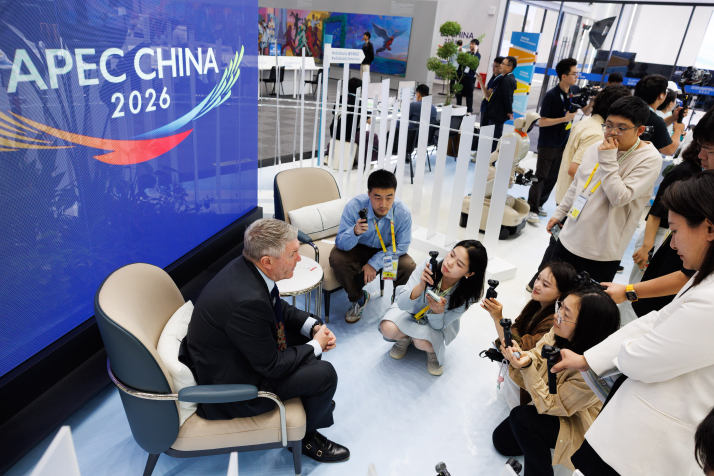 The press center for the 2026 Asia-Pacific Economic Cooperation Economic Leaders’ Meeting Week on November 17.(Xinhua)
At the 2026 Asia-Pacific Economic Cooperation (APEC) Economic Leaders' Meeting in Shenzhen, Guangdong Province, on November 18-19, attention was focused above all on the first, historic trilateral meeting of Chinese President Xi Jinping, U.S. President Donald Trump and Russian President Vladimir Putin. Yet, leaders of 18 other economies were also at the meeting, representing around 3 billion people, more than 60 percent of global economic output and roughly half of world trade. The focus on the big three was therefore a skewed framing, all the more so given that China and Russia have, for years, advocated a multipolar world order in which many states shape their development on an equal footing.
Common ground States need more than protection from external threats. They also need a stable understanding of what they stand for, where they come from and where they want to go. Scholars call this "ontological security." When this understanding is shaken, politics and society lose their bearings, even when there is no direct military danger. In this respect, APEC members could hardly be more different. They include republics and monarchies, orders based on socialism and liberalism, island states and continental powers, and hi-tech hubs and countries facing major development tasks. Each of these orders has its own history and its own understanding of what it stands for. What is remarkable is that APEC asks no member to give up this self-image. The language alone shows this. Members are called economies, because they engage with one another primarily as economic actors. In this way, even the Chinese province of Taiwan participates as well. Decisions are made by consensus, and commitments are voluntary and not legally binding. What may at first look like weakness is, from the perspective of ontological security, a strength. No one has to submit to a foreign order in order to participate. The common ground is not a canon of values but the material, that is, trade, investment, infrastructure and growth. Then there is the power of routine. APEC began in Canberra, Australia, in 1989 as an informal dialogue among 12 participants and has since grown to include 21 members through crises and shifts in power. During China's APEC year in 2026, more than 300 meetings with over 10,000 participants took place before the economic leaders' meeting. This practical cooperation creates continuity, even when political relations between individual members are strained.
Development as the benchmark In Asia specifically, the self-understanding of many societies is closely tied to visible development. Recognition there comes less from professions of belief than from results, from new ports, railway lines, industrial parks and rising incomes. This holds for very different political systems alike. Japan, the Republic of Korea, Singapore, China, Viet Nam and Indonesia have each told their rise as a story of building. The region has backed this story with numbers. Over the past three decades, APEC member economies have mostly grown faster than the global average, and extreme poverty has fallen dramatically. At the same time, the gaps are wide. In 2021, per-capita income stood at just under $3,000 in Papua New Guinea and at more than $70,000 in Singapore. Both are in the same broad region. Both are members of the same regional forums, including APEC. Yet one is among the poorest countries in the region and the other among the richest in the world, a gap of roughly 23 times at that time—a gap that persists today. For many members, the issue is therefore not abstract questions of order but electricity, roads, jobs and access to technology. A society's sense of its own direction depends on its development. When supply chains stall, markets close or technology is cut off, the damage goes beyond lost prosperity: It undermines a society's confidence in the path it has built. Economic stability therefore becomes a matter of national security, not just economic policy. This is why Asian countries in particular press so persistently for open markets and reliable rules; open trade sustains not only their growth but their sense of where they are going. Shenzhen reflects this benchmark. China is hosting the economic leaders' meeting for the third time, after the meetings in Shanghai in 2001 and in Beijing in 2014. Shenzhen lies next to Hong Kong Special Administrative Region in the Greater Bay Area and is home to companies such as car manufacturer BYD, as well as tech titans including Huawei and Tencent. The city itself is evidence of how development shapes self-imagery.
Results, not gestures Shenzhen's agenda is accordingly sober. At its center is the Free Trade Area of the Asia-Pacific (FTAAP), a concept that turned 20 this year. Added to this are a roadmap for AI and the digital economy, more resilient supply chains and better connectivity. One priority is to shape technical cooperation on AI and green energy so that poorer members are not left behind. The consequences of the conflict in the Middle East for energy supply, trade routes and prices affect almost all members directly. The Shenzhen Outlook is intended to record concrete results in trade, connectivity, innovation and development. Such topics have an advantage that debates over values lack. Their results can be counted. Research on international communication shows that concepts such as order, freedom or values are read differently in different societies and that more information often deepens divisions rather than bridging them. How many containers a port handles, which tariffs fall or how many households are connected to the power grid, by contrast, leave little room for interpretation. Such material reference points can be checked by everyone, regardless of their political order. They create a shared reality where shared values are lacking. This also defuses a familiar pattern in international politics. When orders measure one another by values, each declares its own position to be reason and attributes unreason to the other. An order treated this way experiences it as denied recognition and clings all the more firmly to its position. An order measured by results, however, need not convince anyone of its worldview. It is enough that all can read the same result and accept the procedure by which it is determined. This also shows what matters less. Performative gestures, grand images and declarations without consequences may confirm individual actors in their self-image, but they change little in the daily lives of 3 billion people. The meeting of the three presidents will dominate the headlines. What people in Viet Nam, Peru or Malaysia care about in the end is whether supply chains remain stable, whether markets stay open and whether technology is shared. In a multipolar world, peace and prosperity arise not from shared truth but from joint work on what can be measured. Since 1989, APEC has been an attempt to do exactly that. Whether Shenzhen is a success will therefore be seen not in images from the sidelines of the economic leaders' meeting, but in what is actually built, traded and developed in the 21 economies in the years to come.
The author is a promoter of China-Germany exchange in the fields of business, academia and politics. He is pursuing a Ph.D. at Peking University's New Media Research Institute Copyedited by Elsbeth van Paridon Comments to dingying@cicgamericas.com |
|
||
|
||||||||||||||||||||||||||||
|