
|
| Voice |
| Another Chip in the Wall | |
| A look into Jensen Huang's exit from Nvidia | |
|
|
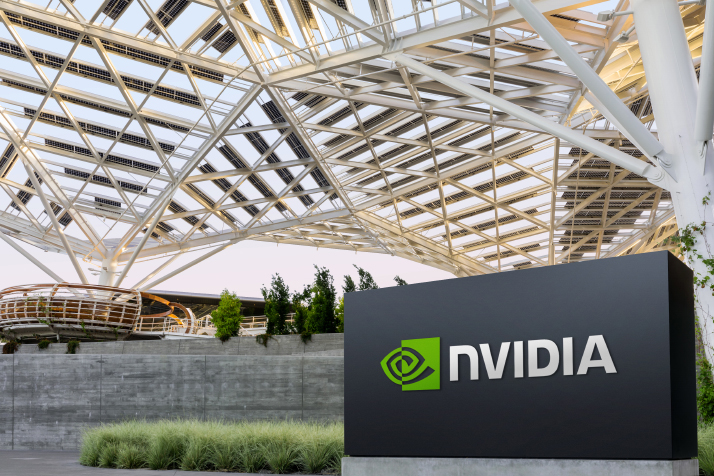 Nvidia’s headquarters in Santa Clara, California, the United States.(Xinhua)
"Do you like the color orange?" By U.S. President Donald Trump's own account, that is how America manages the risks of AI. Days before Jensen Huang, co-founder and long-time Chief Executive of Nvidia, the world's dominant AI-chip firm, resigned, the U.S. president told CBS' 60 Minutes on November 9 that his administration recently called the leader of "one of the big" AI companies and told him to go home, kiss his wife and children good night, and get ready for jail. (Context: American inmates wear orange jumpsuits.) Trump stopped short of naming the executive, but it's worth noting Huang is one of the few executives from a top American AI corporation who has both a wife and children. Either way, the real revelation is how the government governs. AI is sold to the public as the purest expression of American free enterprise. But in this episode, it looks like something else entirely: An industry where the president personally directs outcomes, rewards loyalty and decides case by case who thrives and who is threatened. On November 12, Huang resigned after admitting to having an extramarital affair. Set aside the scandal, and the picture reveals three bigger patterns. First, Washington claims to champion free markets, yet it manages the chip industry directly, deciding who can sell to whom, taking equity stakes and extracting revenue shares in exchange for access. Second, the export controls meant to contain China's chip industry have instead incubated it, giving Chinese firms a protected home market and a powerful incentive to catch up. Third, China's market is now so large that global companies organize their strategies around it, regardless of U.S. policy. For the U.S. tech sector, the fallout means more fragile and politicized chip trade; for global AI, an accelerating split into two supply chains and for China, a near-term squeeze that hastens technological self-reliance.
The managed market Washington preaches free markets while practicing industrial policy whenever strategic dominance is at stake. In semiconductors, market access now runs straight through the Oval Office. Export controls and the Entity List decide who may buy advanced American processors, with licenses granted case by case. H200 chips are designed specifically for AI and high-performance computing, and are at the center of the United States' China export control drama. However, even after Washington cleared the chips for export to China, their sales accounted for less than 1 percent of Nvidia's data center revenue last quarter. Worse, access carries an explicit price tag. In August 2025, the administration conditioned China export licenses on Nvidia and Advanced Micro Devices (AMD) handing the federal government 15 percent of their Chinese chip revenues, the same month Washington took an $8.9-billion equity stake in Intel. Two months later, following a deal permitting chip sales to China, Nvidia quietly gave $25 million to Trump's White House ballroom project, tied for the largest donation, and anonymous by request.
The blockade's material contradiction The deeper contradiction of Washington's blockade is material. Blocking chip shipments to the world's largest manufacturing workshop guarantees a protected home market for local competitors. In one episode of the Special Competitive Studies Project podcast in April 2026, Huang said the bans made little strategic sense, had "largely backfired" and had left Nvidia's China share at zero. Industry tracker TrendForce projects that domestic suppliers including Huawei and Cambricon will hold roughly 90 percent of China's high-end AI chip market in 2026, reinforced by Beijing's directive steering state-funded data centers toward domestic silicon and restricting even the H200 processors Washington licensed. On November 5, Reuters reported that around 600,000 Nvidia chips are quite literally piling up in Hong Kong Special Administrative Region while awaiting approval from Beijing to enter China's mainland. Precedent points toward catch-up followed by leadership. Four years into U.S. sanctions, Huawei stunned industry observers in 2023 by shipping the Mate 60 Pro with a domestically fabricated 7-nanometer processor. In January 2025, Chinese startup DeepSeek released an open-weight reasoning model that rivaled leading American systems despite hardware limits. China followed a similar path in electric vehicles (EVs), solar panels and lithium-ion batteries. Even Trump admitted on 60 Minutes that China stands just one year behind the United States in AI. China still faces bottlenecks in extreme ultraviolet lithography and high-bandwidth memory, and gray-market trading shows that demand for Nvidia's chips has persisted. (In this context, "gray-market chips" refer to advanced AI chips, like Nvidia's restricted models, that are diverted, smuggled or resold through unofficial channels to bypass U.S. export controls and reach buyers in China—Ed.) Yet every year Washington's wall stands, gives Chinese foundries another year of guaranteed domestic orders.
The market's gravity Seen in that light, Huang's fall reflects the gravitational pull of a market that global capital simply cannot ignore. When China embarked on its reform and opening-up journey in December 1978, its leadership wagered that the scale of a modernizing economy of 1 billion people would draw multinational firms inward on sovereign terms. Forty-eight years later, the world's most prominent executives and brands organize their calendars around Beijing. Born in Taiwan and fluent in standard Chinese, Huang spent years lobbying Washington for the right to sell in China; when Trump discovered Huang had been left out of his May delegation to Beijing, he issued a personal invitation for him to join. Tesla's Elon Musk and Apple's Tim Cook joined the same trip. For the U.S. technology sector, the recent shock developments exposed acute concentration risk. One founder's exit knocked roughly hundreds of billions of dollars off Nvidia's intraday market value before shares closed down 4.34 percent on November 12, capping a month in which the company lost about a third of its value. Governance vulnerabilities masked by soaring share prices—including 36 direct reports under Huang, no named successor, and no independent board chair until the day he resigned—will push investors to scrutinize founder-led tech giants. Once a newly elected Democratic Congress takes office in January 2027 with subpoena power, export licenses and chip tracking will become partisan flashpoints, further narrowing legal sales to China. Across the global AI industry, two supply chains will harden faster. Southeast Asian hubs like Singapore and Malaysia are set to face stricter end-use audits, while allies woven into Nvidia's ecosystem confront sudden uncertainty. Meanwhile, countries across the Global South will increasingly weigh two distinct technology stacks, one American and one Chinese. Trump must now make one of the most important choices of his presidency: Should American factories continue to produce and export the world's most valuable AI chips, or should they retool to make leather jackets in orange instead?
The author is an American political commentator currently living in Shanghai Copyedited by Elsbeth van Paridon Comments to dingying@cicgamericas.com |
|
||
|
||||||||||||||||||||||||||||
|