
|
| Voice |
| Leibniz, Westphalia and the Trilateral Meeting in Shenzhen | |
| A historical perspective on a historic meeting | |
|
|
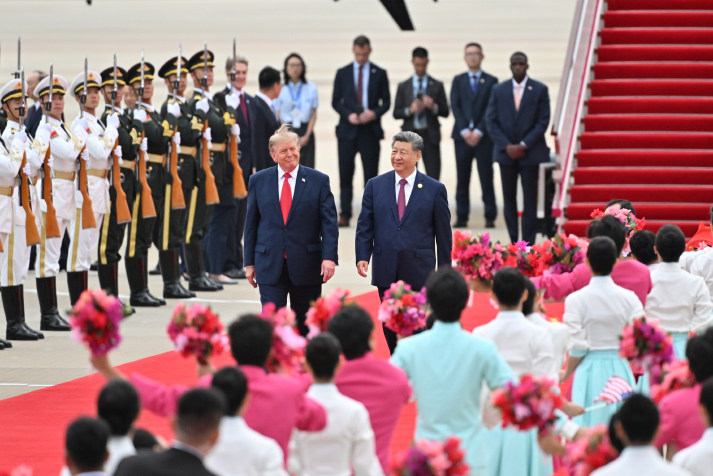 President Xi Jinping welcomes U.S. President Donald Trump at Shenzhen Baoan International Airport in Shenzhen, Guangdong Province, on November 18.(Xinhua)
Thoughtful observers of the world expected the Asia-Pacific Economic Cooperation (APEC) Economic Leaders' Meeting in Shenzhen, Guangdong Province, on November 18-19, to be an opportunity for the presidents of China, the U.S. and Russia to initiate an era of economic cooperation, peace and stability. There was a historical precedent for such a dialogue, which reaches back centuries and is best reflected in an observation made by 17th-century universal genius Gottfried Wilhelm Leibniz. He wrote in his News From China (1697), "Perhaps Supreme Providence has ordained...that as the most cultivated and distant peoples (referring to China and Europe and specifically, Russia) stretch out their arms to each other, those in between may gradually be brought to a better way of life."
The old order is disintegrating The geopolitical world order is undergoing a systemic crisis and a shift in paradigms. Indeed, there is an imperative that China, the United States and Russia come to an understanding that addresses the shifting economic centers of power, the nature of the financial system, the principles of international law and the wars, which are a sign of the disintegration of the rules-based order. What is needed is a pathway from the unipolar oligarchical system to a Westphalian arrangement between sovereign nations. Some Western observers labeled the Shenzhen meeting as a "Yalta 2.0." The original Yalta Conference, which took place between the leaders of the Soviet Union, the U.S. and the United Kingdom in Yalta, Crimea, in February 1945, carved the post-World War II world into spheres of influence, created the United Nations and an international system of relations that has endured to the present day. They had no better options at the time: Germany's defeat was imminent, but Asia's fate was by no means settled. One positive aspect of the process became the international economic system established in July 1944 at the UN Monetary and Financial Conference at Bretton Woods, New Hampshire, which provided stability to the global monetary system. It is sad to see that the U.S. has torn apart the system it championed after the war, mostly through its own imperial policies that disregard international law, including its military adventures, financial exploitation and diplomatic bullying, to name a few. At the same time, the rate of U.S. withdrawals from security and economic agreements has accelerated: It exited the Trans-Pacific Partnership (TPP, 2017, signed but never ratified by the U.S.), the Joint Comprehensive Plan of Action (JCPOA, 2018, also known as the Iran nuclear deal), the Intermediate-Range Nuclear Forces (INF) Treaty (2019), and other agreements. This has been due both to governance gridlock in the U.S. Senate and to the shift into triumphant unilateralism. The dissolution of the USSR in 1991 initiated the terminal phase of the post-war system. The cure had become worse than the disease. Now the Pax Americana is unraveling: International institutions are no longer trusted to provide stability in the global economy, mediate between nations to prevent wars, enforce international law, end poverty or develop new resources for the greater good. U.S. policymakers are intensifying the rivalry with China at the expense of Russia and Europe to preserve global hegemony. Any one of the current crises could trigger a collapse of the quadrillion-dollar derivatives bubble and the parallel bubbles in the valuation of companies developing AI, including for the military industrial complex. Furthermore, the growing threat of nuclear war is precisely why there is a need for a new arrangement.
Toward the next 1,000 years Transforming itself over the last 40 years, China has sought to strengthen the principles of international law that those institutions represent. The Shenzhen meeting can initiate a healing process for humanity: economic cooperation based on mutual benefit, the common good, restoring international law, restoring national sovereignty and a new financial system devoted to investment in Great Projects. The three powers would resolve to keep economic competition nonconfrontational, and cooperation would not create opposing power blocs. A trilateral meeting of Xi, Putin and Trump could fuel the environment for a flourishing vision of joint contributions and shared benefits along the lines of President Xi Jinping's Global Governance Initiative. Rather than scrapping the ailing international system, new institutions can relieve the pressure by restoring and improving it with an eye to the next 1,000 years of human development. A framework of security can finally supersede the logic of aggressive war and economic warfare: The security of one nation cannot be achieved at the expense of another. Russia and the U.S. can resolve to renew nuclear disarmament and the U.S. and China can jointly correct the Thucydides misconception. Open dialogue is the pathway to ensuring the safety of the world. Pragmatic goals for what is best for all three nations—and by extension all nations—can replace endless suspicion. Each nation wants to be safe. Each nation wants to be rich. Each nation can take comfort in the stability that other nations' prosperity creates. That would be the basis for addressing the confrontation between India and Pakistan, the genocidal conflict in Palestine, Europe's security architecture as defined by the conflict in Ukraine, the Israel-American conflict against Iran, the countless civil wars across Africa, and the unsettled Chinese civil war.
The fundamental Westphalian solution A new principle of economy can take shape in the aftermath of such a dialogue: the "benefit of the other" rather than a zero-sum game, recognizing all sovereign states as formal, legal equals, a return to the legacy of the 1648 Treaty of Westphalia. Nations should develop new resources through broad investment in new discoveries, rather than by leveraging nations' vulnerabilities through trade wars. Reinstating Glass-Steagall principles (separating commercial and investment banking) would institute a "fiscal firewall" where derivative speculation of a few no longer threatens the livelihood of the many. The trilateral meeting in Shenzhen can affirm those fundamental principles that have proven effective in the past: All nations have the right to determine their own development paths with due respect for their national and cultural differences; eliminate the risk of global catastrophe through the reconstruction of international institutions; independent nations forge win-win relationships while respecting international law; eradicate extreme poverty across the globe; and investments in great projects such as greening deserts, creating fresh water resources, and eradicating persistent diseases through scientific cooperation will energize humanity's creative capacity. The core principles of the Peace of Westphalia established a new legal and diplomatic order for Europe centered on state sovereignty, non-interference in domestic affairs, the legal equality of states and religious rights. The three nations can reinvigorate them today. These principles, coupled with the BRICS cross-border payments and settlement arrangements, provide a multi-nodal opportunity, an alternative forum in which nations can address their relations. BRICS formed in reaction to U.S. policy, but could represent a way to supplement and breathe new life into existing institutions. Now is the time to ripen human relations to revive the international system where security does not mean war, and economy does not mean colonialism and exploitation. The recent APEC Economic Leaders' Meeting could become the pivot by consequential nations to embrace the changing world order together. It can be one where distant nations at the far corners of the globe stretch out their arms to each other so those in between may be brought to a more harmonious life in the present and for the generations that come after us.
The author is a Texas-based geopolitical analyst, long-time Congressional legislative advocate and co-host of podcasts The Winers and The Sonar Briefing Copyedited by G.P. Wilson Comments to dingying@cicgamericas.com
|
|
||
|
||||||||||||||||||||||||||||
|