
|
| World |
| Japan's military pivot triggers high alert | |
|
|
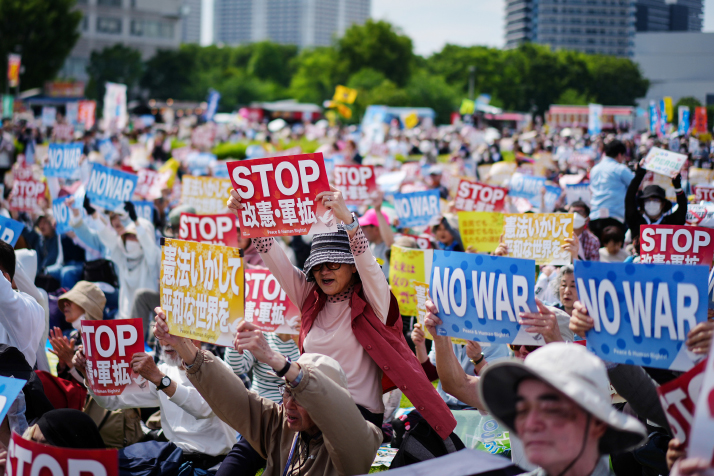 Protestors opposing a potential constitutional amendment and military expansion hold a rally in Tokyo, Japan, to mark Constitution Memorial Day on May 3 (XINHUA)
Japan breached its postwar security restraints on May 6, with the Japan Self-Defense Forces (SDF) firing Type 88 land-based anti-ship missiles as part of the U.S.-Philippines Balikatan joint military exercises, held in northern Luzon, the Philippines, from April 20 to May 8. The missiles struck a decommissioned Philippine Navy vessel during a joint maritime drill. More than 17,000 troops from the United States, the Philippines, Japan, Australia, New Zealand, France and Canada took part, making it the largest edition of the annual exercise so far. Japan participated for the first time as a formal participant rather than an observer, and deployed about 1,400 SDF personnel. Instead of just a live-fire drill, the missile launch was the latest sign that Japan's security policy is moving beyond the postwar principle of "exclusive defense." "As the world marks 80 years since the opening of the Tokyo Trial, not only has Japan, the aggressor, failed to deeply reflect on its historical crimes, it has even sent military forces overseas and fired offensive missiles under the pretext of security cooperation. This is yet another example of the Japanese right-wing forces' push for the accelerated remilitarization of Japan," Chinese Foreign Ministry spokesperson Lin Jian told a regular press briefing in Beijing on May 6. In the wake of World War II (WWII), the Tokyo Trial, formally known as the International Military Tribunal for the Far East, convened from May 1946 to November 1948, trying 28 Japanese Class A war crime suspects. Historical wounds Japan's appearance as a military actor on the Philippine soil carries a particularly heavy historical burden. In December 1941, hours after the attack on Pearl Harbor, Japan invaded the Philippines. In 1942, following the fall of Bataan, an estimated 78,000 American and Filipino prisoners of war were forced by Japanese troops to embark on the notorious Bataan Death March. The prisoners were given no clear indication of the distance or duration and they suffered "unspeakable cruelties." The trauma did not end there. In February and March 1945, during the Battle of Manila, Japanese troops slaughtered hundreds of thousands of civilians. Japan's wartime practice of keeping sexual slaves, known as "comfort women" also left deep scars across Asia, including in the Philippines. Against this historical background, Japan's return to the Philippines as an armed participant in a U.S.-led military exercise has caused unease among many observers. The Japan-Philippines Reciprocal Access Agreement, signed in July 2024 and officially entering into force in September 2025, provides a legal framework for the two countries' forces to train and conduct exercises in each other's territory. AP News said the arrangement paved the way for Japanese SDF personnel to become a regular participant in Balikatan drills. Herman Tiu Laurel, President of the Asian Century Philippines Strategic Studies Institute, a Manila-based think tank, told Xinhua News Agency that the rise of Japan's "new type of militarism" was in effect serving U.S. imperial expansion in the Asia-Pacific and turning Japan into a proxy for containing emerging regional economies. He warned that the Philippines should not become an appendage of the U.S. and Japan, and that turning the country into a forward position for confrontation would expose it to greater conflict risks. It was "deeply ironic" that the Philippine Government had allowed the United States and Japan, two former colonial and invading powers, to send troops to the Philippines, Raymond Palatino, Secretary General of the New Patriotic Alliance of the Philippines, said. Remilitarization Japan's first overseas missile launch in 80 years was the latest step in a decade-long process through which right-wing forces have pushed the country toward remilitarization. In 2015, then Prime Minister Shinzo Abe forced through new security legislation that reinterpreted Japan's right to collective self-defense. The legislation made it possible for the SDF to use force even when Japan itself was not under direct attack. The move undermined the postwar principle of "exclusive defense" and opened a legal path for Japan's military operations overseas. In December 2022, the government of then Prime Minister Fumio Kishida adopted three key security documents: the National Security Strategy, the National Defense Strategy and the Defense Buildup Program. These documents formally introduced "counterstrike capabilities," a shift from a defensive posture toward a capability to directly strike targets on another country's territory. At the same time, Tokyo decided to raise defense spending to around 2 percent of GDP by fiscal 2027, which broke with the long-standing postwar ceiling of roughly 1 percent. This process has accelerated under the leadership of Prime Minister Sanae Takaichi, who took office in October 2025. On April 21, the Japanese Government revised the "three principles on transfer of defense equipment and technology." The revisions scrapped rules limiting Japan's defense equipment exports to five noncombat categories—rescue, transport, warning, surveillance and minesweeping—and instead divided equipment into "weapons" and "non-weapons" categories depending on lethal capability. Kyodo News described the change as a major turning point in Japan's security policy. On the same day, Takaichi sent a ritual masakaki offering to the Yasukuni Shrine, which honors soldiers including convicted Class A war criminals from World War II, followed by a monetary donation the next day. These acts, coupled with visits to the shrine by Japanese lawmakers, drew severe condemnation from China. The Yasukuni Shrine is a spiritual tool and symbol of Japanese militarists' war of aggression, Chinese Foreign Ministry spokesperson Guo Jiakun said on April 22. "The negative moves concerning the Yasukuni war shrine show that Japan, in total disregard of international concerns and just voices from both inside Japan and the world, has all along refused to acknowledge its history of aggression during World War II, attempted to change the verdict on its war of aggression and the Class A war criminals and even gone further to challenge the judgment of the Tokyo Trial and postwar international order," he added. Japan's domestic opposition has also been visible. On May 3, Japan's Constitution Memorial Day, about 50,000 people gathered in Tokyo in support of the pacifist constitution, according to The Guardian. Protesters opposed efforts to revise Article 9, which renounces war and the use of force as a means of settling international disputes. Wojciech Nowiak, a professor of political science at Adam Mickiewicz University in Poznań, Poland, said Japan's recent moves have made countries that once suffered from its aggression feel disrespected, including China and other countries in the region. Meng Mingming, an assistant research fellow at the Institute of Japanese Studies, the Chinese Academy of Social Sciences, argued that Japan's failure to thoroughly reckon with the crimes of militarism had allowed right-wing ideology to linger and re-emerge over time. From the 2015 reinterpretation of collective self-defense, to the 2022 adoption of "counterstrike capabilities," and now the 2026 relaxation of restrictions on lethal arms exports and the overseas firing of offensive missiles, Japan has steadily dismantled the postwar restraints that were established to prevent the resurgence of militarism. "Is Japan still indulged in a dream of reviving militarism?" Lin, the Chinese Foreign Ministry spokesperson, asked at a regular press briefing in Beijing on April 30. Japan is following "a very wrong historical path," Vladimir Berezhnykh, Editor in Chief of Russia and China magazine, told Beijing Review. He noted that China's sacrifices were many times greater than those of any other country that fought against Japan, and that "we understand China's concern when it watches the revival of militarism in Japan today." Berezhnykh said China does not want a repetition of World War II or the tragedies it brought, and therefore "we understand and sympathize with the way China's representatives at the United Nations criticize every new step Japan takes toward reviving militarism." "The rise of neo-militarism in Japan is posing a real threat to world peace and stability. The Chinese people, together with anyone in the world who stand for justice, should stay on high alert and firmly safeguard the outcome of the WWII victory so that the tragedies of history will not repeat themselves," Lin noted. (Print Edition Title: The Return of Old Shadows) Copyedited by G.P. Wilson Comments to liwenhan@cicgamericas.com |
|
||
|
||||||||||||||||||||||||||||
|