
|
| World |
| The Girl Who Crossed the Net | |
| How Ping-Pong Diplomacy changed the life of an American teenager and helped reshape the global landscape | |
|
|
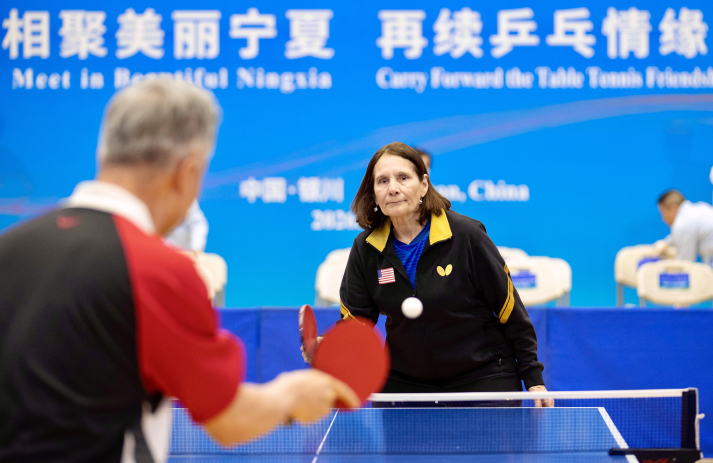 Judy Hoarfrost, who traveled to China in 1971 as part of Ping-Pong Diplomacy, serves the opening ball for the China-U.S. Youth Table Tennis Friendship Match at Ningxia Gymnasium in Yinchuan, Ningxia Hui Autonomous Region, on April 16 (XINHUA)
Judy Hoarfrost turned 70 this year. She sometimes jokes that she can't remember the name of someone she met five minutes ago. Yet one memory remains perfectly clear: the melody of a Chinese song she first heard more than half a century ago. The song is The East Is Red, one of the most recognizable tunes in China and widely heard across the country in the 1970s. The simple, steady melody has stayed with her for 55 years. The memory connects her to a moment when history shifted and when a teenager from Oregon in the United States found her future unexpectedly intertwined with the relationship between China and the U.S. A teenager inside history In the spring of 1971, 15-year-old Hoarfrost boarded a plane to compete in the 31st World Table Tennis Championships in Nagoya, Japan, without realizing she was stepping into history. She had not even been expected to attend. As the second alternate on the U.S. team, she only made the trip after two players had dropped out. But while she was there, an unexpected event sent ripples far beyond the tournament. During the championships, one of her teammates, Glenn Cowan, accidentally boarded the Chinese team's bus. In the silence that followed, Chinese world champion Zhuang Zedong stepped forward, shook Cowan's hand and offered him a silk painting as a gift—an encounter that soon helped open a door between China and the U.S. On the final day of the championships in Nagoya, the American team received an invitation from China to visit the country. At that time, the two countries, having been estranged for more than two decades, had no diplomatic relations. "I'll go! I'll go!" Hoarfrost exclaimed when the invitation was announced. As a minor, she had to call her parents for permission. Her parents agreed, believing the experience would be educational rather than dangerous. On April 10, 1971, a 15-member U.S. table tennis delegation, with Hoarfrost as the youngest member, arrived in Beijing, becoming the first American sports team to visit China in 22 years. "It was a big surprise. A big honor. A red-carpet tour. We learned so much," Hoarfrost told Beijing Review. Before traveling to China, her knowledge of the country was limited to what she had learned in school: the long history, dynasties and Sun Yat-sen (1866-1925), a Chinese revolutionary and statesman. But she didn't really know modern China. Once in China, she tried to absorb everything around her. They traveled across the country, playing exhibition matches. Hoarfrost played four exhibition matches during the visit and won three. "The Chinese players kindly let me win," she said. "But I knew Chinese table tennis players were world-class, and I understood what they often say, 'Friendship first, competition second.'" Also, they visited historic sites such as the Great Wall and the Summer Palace, and talked with ordinary people in schools and communities. Hoarfrost tasted unfamiliar foods, watched ballet and traditional Chinese opera, and learned popular songs of the time. At a banquet at the Great Hall of the People in Beijing on April 14, 1971, Hoarfrost shook hands with Chinese Premier Zhou Enlai. Zhou told the Americans they had opened the door to friendly contacts between the people of the two countries. On the same day, then U.S. President Richard Nixon announced new measures easing trade restrictions with China. The following year Nixon himself traveled to Beijing, a historic visit that began the process that eventually led to the normalization of relations in 1979. The eight-day trip would later become known as the beginning of Ping-Pong Diplomacy—often described as "the small ball moving the big ball." Hoarfrost said, "We helped crack the ice that opened the doors to China. We were in the right place at the right time." A life shaped by one trip For Hoarfrost, the trip became something deeply personal—the moment history crossed a table tennis net and quietly reshaped the course of her life. When she returned home, she discovered that she had become a public figure. She gave interviews, appeared on television and spoke at events about her experiences in China. "All of us were inundated with people in our country who were so hungry for information about China," she said. In May 1971, the Oregon State Legislature declared a "Judy Bochenski Day" in her honor—before her marriage, she was known as Judy Bochenski. "I still remember the letter I received from our Oregon governor," she said. "It said, 'Oregon is proud of you.'" The story of Ping-Pong Diplomacy was included in history textbooks, and some students who read about it later came to ask Hoarfrost questions about China. As a teenager, Hoarfrost learned about China from textbooks; today, she has become a "living textbook" through which younger generations can learn about China. Perhaps the most lasting legacy of that first trip lies within Hoarfrost's own family. Her family founded a table tennis club in Portland in the early 1970s called Paddle Palace. Hoarfrost continued to run the family business after she retired from the national team. The club became a gathering place for players from around the world and later evolved into a major equipment company. Today Paddle Palace is one of North America's leading distributors of table tennis equipment, supplying players across the continent. The company's global supply networks frequently involve Chinese manufacturers—a reminder of how dramatically relations between the two countries have changed since 1971. Her three children now work in careers that connect them with China in different ways. Her daughter collaborates with colleagues in China on global projects. Her son runs the family business, sourcing products through international partnerships, including Chinese sports equipment giant Double Happiness. Her youngest child mentors Chinese students in scientific research. "I ended up making table tennis my life," Hoarfrost said. In the past 55 years, she has visited China 10 times, either for reunion trips or business trips. "It almost always has something to do with table tennis," she said. This year is the 55th anniversary of the beginning of Ping-Pong Diplomacy. As part of events held to mark the anniversary, an American delegation visited China in April, including former table tennis players, experts on China-U.S. ties, young athletes and students. Among them were Hoarfrost and students from her club. "Being in China when I was 15 sparked my interest in learning about China and other cultures. It fostered an open-mindedness," Hoarfrost said. "I would like to see all young people have the opportunity to learn about other cultures at a young age and to communicate so they can better understand one another." To her, these people-to-people exchanges represent the true foundation of international relations. "The value of people-to-people exchange is that it enables us to work together. It also enables our politicians to work together, because it grows from the bottom up," Hoarfrost said. Her perspective echoes a broader reality in China-U.S. relations. More than half a century has passed since Ping-Pong Diplomacy began. Relations between China and the United States have gone through many phases—curiosity, cooperation, competition and even conflict. Hoarfrost does not ignore those tensions. She has watched them develop over the decades. Yet she believes the logic of table tennis still offers a lesson: to compete, players must first agree on the rules. The same is true between nations. In an interconnected world, what happens on one side affects the other, and progress depends on cooperation that allows both sides to benefit. Despite political ups and downs, exchanges continue. Trade continues. Students still cross borders. Researchers collaborate. Businesses depend on global partnerships. "Peace comes from the bottom up, from people working together," she said. "With all the changes since 1971, we need to work together more than ever." BR Copyedited by G.P. Wilson Comments to linan@cicgamericas.com |
|
||
|
||||||||||||||||||||||||||||
|