
|
| World |
| Building a Belt and Road between hearts | |
|
|
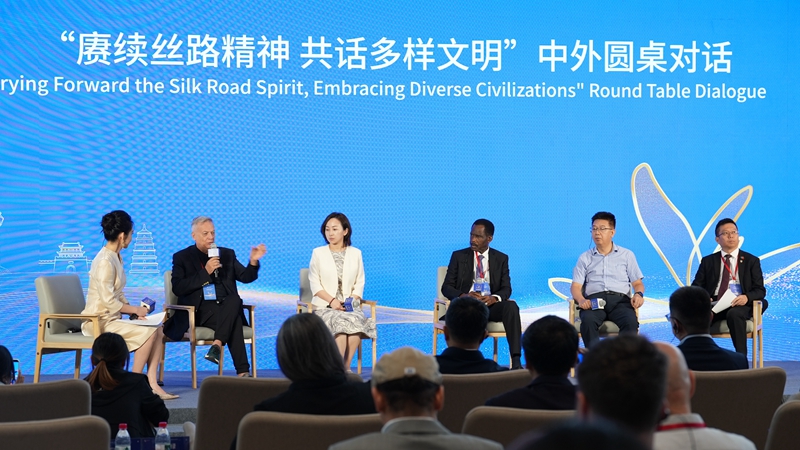 Experts participate in a round table dialogue at Chang’an Academy in Xi'an, Shaanxi Province, on September 9. The dialogue was part of the Global Civilizations Dialogues—Rendezvous With the Orchid event (ZHANG QINZHENG)
More than 20 international delegates gathered at the foot of the ancient city wall in Xi'an, Shaanxi Province, on September 7. Soon, conversations were underway in English, Chinese, Japanese, Arabic and Portuguese. Historians talked about the role of cultural heritage in cross-cultural communication, AI researchers discussed how the technology could facilitate exchange between civilizations and artists reflected on how the Belt and Road Initiative, a China-proposed initiative that aims to boost connectivity along and beyond the ancient Silk Road routes, was reshaping cultural cooperation. As delegates moved through museums, research centers, ecological reserves and industrial hubs over the course of six days in Xi'an and Hanzhong, also in Shaanxi, they repeatedly mentioned the idea that civilizations have become richer and more colorful through exchange and mutual learning, echoing the speech by Chinese President Xi Jinping in 2014. The study tour, organized by the Orchid Awards Secretariat, was held in conjunction with this year's Global Civilizations Dialogues—Rendezvous with the Orchid, a cultural exchange event based on the platform of Orchid Awards. Inclusive awards Initiated by China International Communications Group, the awards aim to recognize and honor foreign individuals and institutions around the world who are committed to international cultural exchange and have made outstanding contributions to promoting cultural exchange between China and other countries, as well as mutual learning among civilizations. The awards are presented in three categories: the Lifetime Honor Award, Outstanding Achievement Award and Friendship Envoy Award. The selection criteria primarily focus on achievements, contributions and international influence. During the first two editions held since its establishment in 2022, the awards honored 19 foreign individuals and one institution, attracting widespread attention both in China and internationally. Carrying out activities related to the Orchid Awards brand was written into the outline of China's 15th Five-Year Plan (2026-30) adopted in March. This year's applications for the awards were reviewed and a shortlist was announced in Beijing in early September. Inclusiveness is a leading feature of this year's Orchid Awards nomination. In the previous two editions, nominees were mainly concentrated in fields such as Sinology, translation, art and international cultural exchange. This year, the scope of nominees has expanded to include literature, sports, science, museums and cultural heritage. On September 6, the final winners were selected by a panel of Chinese and international judges, and will be announced later this year at the award ceremony. Tony Brown, a tenured professor and doctoral supervisor at French art school Beaux-Arts de Paris and a jury member of the Orchid Awards, highlighted the awards' broad inclusiveness and international reach. "It's very encompassing," he told Beijing Review. "The awards touch on many different layers, many disciplines, many cultures and many countries, so they are very big, inclusive awards." A platform beyond awards The exchange activities under the Orchid Awards brand reflected how organizers define civilization dialogue in broad, practical terms. Iain Inglis, a British television presenter based in Henan Province, applied for the first Orchid Awards in 2022. Failing to advance beyond the first round that year, he assumed his association with the awards would have ended there. This year, when he was invited to participate in the exchange activities, he was pleasantly surprised. "It seems that the Orchid Awards are not simply a medal, a trophy, a round of applause," he told Beijing Review. "I can see now what the Orchid Awards organizing committee is trying to do. It is trying to build a platform that will facilitate ongoing cultural exchange." That distinction between a one-time award and a continuing international network has become increasingly central to the Orchid Awards' identity. So far, the Orchid Awards Secretariat has organized 12 cultural exchange side events in four countries. That model reflects the broader logic of the Orchid Awards itself: Cultural exchange is no longer isolated from economics, science, sustainability or media ecosystems, but rather embedded in everyday systems such as transportation, energy, trade, and environmental protection. In Xi'an, delegates visited electric vehicle maker BYD's research center, witnessing firsthand how Chinese electric vehicles have become symbols of the country's industrial transformation. At solar panel manufacturer LONGi Solar, guests learned its solar innovations are now shared with more than 160 countries and regions. At the Eurasian railway hub in Xi'an and Aiju Grain and Oil Industrial Group, discussions shifted toward food security, logistics, and cross-border cooperation under the Belt and Road Initiative. In Hanzhong, the exchange program shifted focus from urban modernization to environmental protection. Delegates visited the crested ibis ecological reserve in Yangxian County. Once nearly extinct, the crested ibis population there has recovered from just seven wild birds discovered in 1981 to several thousands today. The symbolism resonated beyond environmentalism. Organizers framed the recovery of the crested ibis population not only as a conservation success story, but as a metaphor for coexistence itself, with humanity and nature surviving through long-term stewardship and cooperation. A linking of minds Xi'an was the starting point of the ancient Silk Road. "I believe a truly great road does more than simply connect two places. It brings different civilizations closer to one another," Thai scholar and Orchid Awards judge Wirun Phichaiwongphakdee said at a salon at Chang'an Academy on September 9. During the salon, archaeologists, linguists, AI researchers, heritage conservation specialists, broadcasters, entrepreneurs and scholars of Tang Dynasty (618-907) poetry shared their views on cultural exchange and mutual learning. "What the Orchid Awards are doing is bringing together more people who believe in peace, dialogue, and mutual learning among civilizations, enabling people from different countries and cultures to build shared understanding. Mutual learning among civilizations does not mean turning the world into a single civilization; rather, it means helping different civilizations find a common direction for progress through exchange and dialogue," Phichaiwongphakdee added. The conversations repeatedly returned to the theme of how civilizations communicate in the digital era. At the center of that discussion was AI. Alex Matthew Lamb, an assistant professor at Tsinghua University's College of AI and a judge of the Orchid Awards, argued that AI itself may become a new infrastructure for cultural connectivity. He described AI not simply as software, but as a vast collaborative ecosystem involving semiconductors, data centers, scientific research, education and global talent mobility. The movement of students and researchers between countries, he suggested, represents a new form of cultural exchange as important as historical trade routes. That emphasis on human connection rather than abstract geopolitics became one of the defining characteristics of the event. Phichaiwongphakdee perhaps captured the project's ambitions most directly. "The Belt and Road is connecting countries in the material world," he said. "The Orchid Awards are building another Belt and Road—between people's hearts." BR (Reporting from Xi'an, Shaanxi Province) Copyedited by G.P. Wilson Comments to linan@cicgamericas.com |
|
||||||||||||||||||||||||||||
|