
|
| World |
| Wuhan brings the world's mayors together | |
|
|
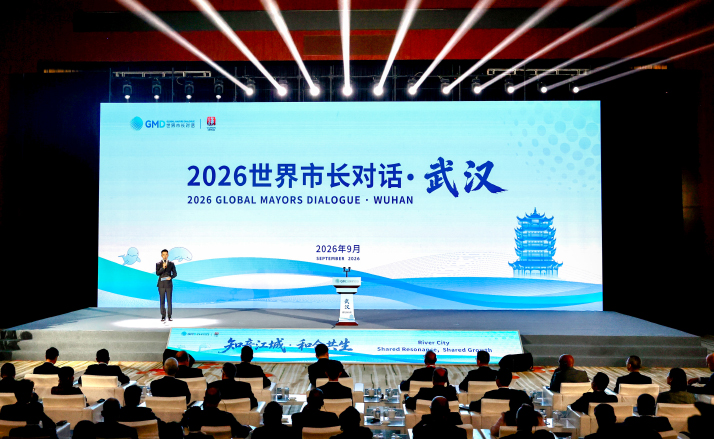 The 2026 Global Mayors Dialogue underway in Wuhan, Hubei Province, on September 20 (XINHUA)
This September, the city of Wuhan in Hubei Province hummed with a waterborne energy. Straddling the middle reaches of the majestic Yangtze River, the longest river in Asia, this metropolis in central China wears its geography like a badge of honor. The river divides the city into three historic towns, yet for millennia, it has served not as a barrier, but a connection binding communities together. Eighty-odd international guests, including mayors, deputy mayors and special envoys representing 24 cities across 22 countries on five continents, crossed oceans and mountains to convene on the banks of the Yangtze for the Global Mayors Dialogue on September 18-21. The dialogue focused on how technological innovation, industrial collaboration and cultural exchange can advance sustainable urban development. Gathering near Wuhan's Yellow Crane Tower, the participants shared a unifying preoccupation: How to pilot modern urban life through an era of sweeping technological disruption, ecological anxiety and geopolitical friction? "What we experience nowadays is that geopolitics has made international cooperation among cities more difficult. However, cities are still trying. They are still moving ahead with their dialogue, even when their governments are in more difficult relations," Jordi Vaquer, Secretary General of Metropolis, a global association of major metropolitan areas with its secretariat based in Barcelona, Spain, told Beijing Review during the four-day event. In an international climate fractured by distrust, Wuhan offered a different horizon, one rooted in municipal pragmatism, shared vulnerability and the ancient philosophy of the river. 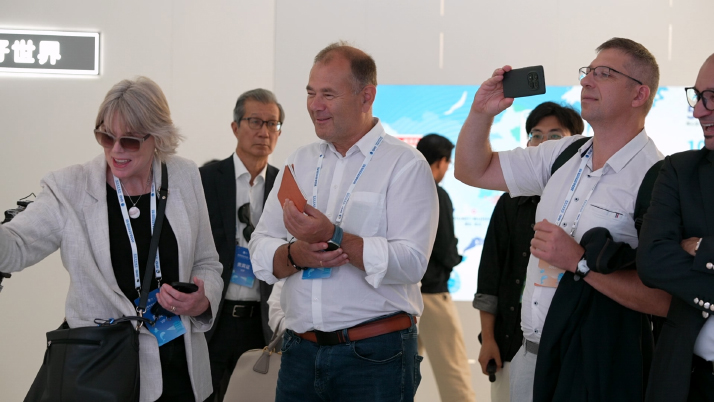 Participants of the 2026 Global Mayors Dialogue visit hi-tech firm HGTECH in Wuhan, Hubei Province on September 19 (HE XIAO)
A city shaped by the river To understand Wuhan, one must begin not in sleek corporate boardrooms, but on the water. A local saying holds that for just a few yuan (not even $1), one can purchase the two most precious experiences the city has to offer: a steaming bowl of reganmian (literally "hot dry noodles") plus a cross-river journey on the Yangtze. Breakfast in Wuhan is a sensory ritual, eaten within minutes on bustling street corners by people who aren't necessarily rushing so much as moving in rhythm with the city's daily heartbeat. Down at the docks, for just 1.5 yuan ($0.22), passengers can board a ferry that glides across the broad, silt-laden river. The city's skyline has grown taller over the past decade, bristling with futuristic glass and steel towers, yet the ferry remains, quietly carrying ordinary people from one bank to the other just as it has for generations. For dialogue participants, the sheer scale of Wuhan's aquatic ecosystem is humbling. Ria Johnson, President of the Tacoma Sister Cities Council in the U.S. state of Washington, captured this awe during a night cruise on the Yangtze: "One of my favorite impressions—it wasn't my first, but my favorite—is knowing about this river, how large it is. It has a wonderful importance to the development of the land." If the river represents Wuhan's historical depth the Wuhan East Lake Hi-Tech Development Zone, also known as Optics Valley of China, offered the dialogue participants a glimpse into its growth trajectory and hyper-accelerated future. At Optics Valley, participants learned that its growth has not been all smooth sailing. For years, skeptics watched as massive capital poured into the zone with seemingly little immediate return. But perseverance bore fruit. In 1988, Yangtze Optical Fiber and Cable was founded there. The global market share of its fiber products has ranked first globally for 10 consecutive years since 2016. It was followed by technology companies HGTECH in 1999, Yangtze Memory in 2016 and, more recently, Chinese consumer electronics and smart manufacturing company Xiaomi's sprawling smart-home appliance factory in late 2025. He Peng, a hydrogen energy and laser engineer at HGTECH, witnessed Optics Valley's transformation from empty fields into a global tech hub. "A dozen years ago, even the heart of present-day Optics Valley was all farmland. Eight or nine years ago, people were still pessimistic about the development of the project. But today, its optoelectronics, semiconductors and medical technologies all show strong development," he said. Locals have a specific term for this relentless drive to innovate through adversity: bufuzhou, basically referring to an unyielding refusal to back down. It is not born out of a desire to crush rivals or exclude outsiders, but rather a stubborn, generational commitment to grinding through hardships until everyone can share in the gains. Universal language of ecology Urban development in the 21st century cannot be measured by GDP alone; it must be measured by sustainability and the preservation of all life. At the summit, ecological restoration emerged as a powerful common denominator. In the waters of Wuhan, the Yangtze finless porpoise, affectionately nicknamed the "smiling angel" in Chinese for its naturally upturned mouth, once faced extinction. However, following China's nationwide implementation of a 10-year fishing ban on the Yangtze starting in 2021, coupled with rigorous local protection policies at the Yangtze Finless Porpoise Breeding and Protection Center, the population had rebounded to 1,426 as of late 2025. This triumph of ecological healing struck a deep chord with the delegates, proving that the topic of conservation transcends borders. Victoria Henstock, Deputy Mayor of Christchurch in New Zealand, when visiting the East Lake and its conservation facilities in Wuhan, was struck by the universal parallels in wildlife preservation. "What we do to preserve our kiwi is just like what you are doing here," she said. Michael Chan, Deputy Mayor of Markham in Canada, echoed this sentiment, emphasizing the enduring power of grassroots connection: "I think we should have much, much more cooperation in this regard. Country-to-country relations sometimes are not good. But in terms of people-to-people exchange, I think it is important to make it continue. So, in terms of learning from each other, we can protect the environment better, and live better." True urban strength, the delegates agreed, is measured not just by concrete and steel, but by whether other living species choose to stay and thrive alongside human civilization. Unknown into trust Beyond technology and ecology, the core of the Wuhan dialogue was about human diplomacy. In a world where national governments frequently clash, municipal leaders are finding that grassroots diplomacy offers a practical antidote to polarization. Agnès Bickart, Director of International Relations for Metropolis, summarized the ethos of the gathering: "I think joint forces are the purposes of this gathering. We all learn from our experiences, not only from our successes, but also from the difficulties that we face," she said. Sandesh Sadalge, a City Council member from Tacoma, described how face-to-face interaction can transform relationships. "If you can change the unknown into someone you've met, you can change that unknown into understanding, and that understanding into trust," he said. People-to-people diplomacy, he added, means recognizing that even when nations or governments don't see eye to eye, the people who live there can still see each other's humanity. A well-known Chinese idiom goes, "When the water rises, the boat rises." This September, in Wuhan, the Global Mayors Dialogue made one truly feel that as the waters of cooperation and exchange rise, every boat afloat is lifted together. BR (Reporting from Wuhan, Hubei Province) Printed edition title:The Rivers That Bind Us Copyedited by Elsbeth van Paridon Comments to taozihui@cicgamericas.com |
|
||||||||||||||||||||||||||||
|








