
|
| World |
| Shenzhen offers a window into the country's transformation and its growing role in shaping APEC | |
|
|
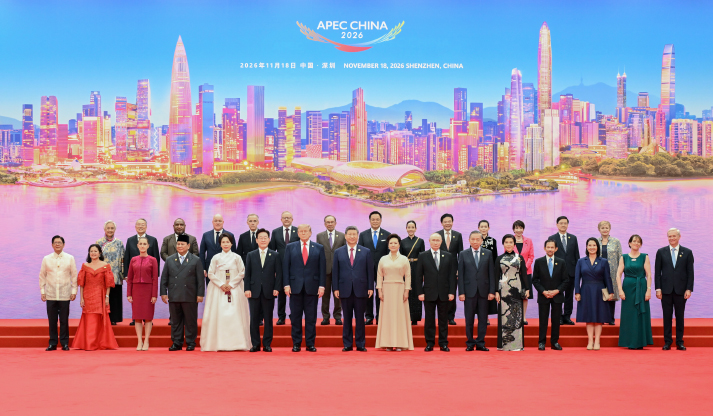 Chinese President Xi Jinping and his wife Peng Liyuan pose for a group photo with guests attending the 33rd Asia-Pacific Economic Cooperation (APEC) Economic Leaders’ Meeting in Shenzhen, Guangdong Province, on November 18 (XINHUA)
'Members of APEC are like passengers riding the same ship." Chinese President Xi Jinping used this image on November 19 as he addressed the 33rd Asia-Pacific Economic Cooperation (APEC) Economic Leaders' Meeting in Shenzhen, Guangdong Province. "To navigate the waves of the Pacific, we must unite as one and look out for each other," Xi said. The meeting, held on November 18-19, brought together leaders and representatives of 21 economies spanning both sides of the Pacific. Together, they account for nearly 40 percent of the world's population, more than 60 percent of global economic output and almost half of international trade. They gathered at a time when trade disputes, geopolitical tensions and rapid technological change were testing economic ties across the region. Yet those same economies remained closely linked through markets, investment, manufacturing and supply chains. The question facing the meeting was how to maintain and deepen those connections while managing competing interests and new sources of uncertainty. China's third turn as APEC host, following Shanghai in 2001 and Beijing in 2014, brought those discussions to Shenzhen, a city transformed by more than four decades of reform and opening up. Building bridges "Together, we must strive to build an Asia-Pacific community characterized by solidarity and mutual assistance, openness and integration, enterprise and innovation, as well as inclusive development," Xi said in his November 19 remarks. He called for building the four key pillars of an Asia-Pacific community: economy and trade, connectivity, innovation and development. Xi stressed the need to uphold open regionalism and steadily advance economic integration in the Asia-Pacific. "The Free Trade Area of the Asia-Pacific (FTAAP) is a shared vision of APEC members," he said. On upgrading connectivity, he called for measures to improve infrastructure networks, enhance coordination in policies and regulations, promote people-to-people exchange, and foster mutual understanding and closer bonds among peoples. Emphasizing innovation, Xi said greater efforts need to be made to build digital infrastructure and promote the broad application of AI. He also called for cooperation on energy and food security, green and low-carbon transition, and efforts to improve people's wellbeing. "I hereby announce that China will provide $20 million to support APEC's practical cooperation," Xi said. A Center for Asia-Pacific Community Studies will be established in Shenzhen to conduct policy research and exchange, and provide intellectual support, Xi said. China will also set up cooperation institutions in areas including digital technology, cross-border data flow, clean energy and the development of small and medium-sized enterprises. The announcements followed his November 18 keynote address to the APEC CEO Summit. Looking ahead, as China's ties with the Asia-Pacific grow increasingly close, Xi said China's 15th Five-Year Plan (2026-30) provides a list of opportunities for promoting economic growth in the Asia-Pacific and the wider world. Xi said the Asia-Pacific should support free and open trade and investment while keeping the global industrial and supply chains stable and unimpeded. He emphasized the need to forge partnerships in science, technology and innovation, deepen cooperation in the digital economy and AI, and promote green and low-carbon transition. He highlighted China's accelerating efforts to develop a big, open market and build a modernized industrial system, pledging a more stable and predictable first-class environment for companies from around the world to invest and do business in China. These priorities ran through China's year as APEC host. Themed Building an Asia-Pacific Community to Prosper Together, China organized more than 300 meetings and events across 16 cities throughout 2026. The meetings addressed subjects ranging from trade and finance to food security, energy, tourism and digital technology. Held on November 17-18, the APEC CEO Summit brought together more than 2,000 business and political representatives from the 21 APEC economies and 13 economies outside the grouping, including representatives of 115 Fortune Global 500 companies. U.S. businesses formed the largest group of participating companies from economies other than China. The summit released the Shenzhen Initiative, calling for a more open regional economy, inclusive innovation, stronger connectivity and mutually beneficial cooperation. It was the first outcome document issued in the form of an initiative in the CEO Summit's 30-year history. Business leaders also discussed how cooperation could be maintained amid geopolitical tensions. Suzanne Clark, President and CEO of the U.S. Chamber of Commerce, stressed the importance of long-standing relationships between companies, particularly those capable of lasting through political changes and disruptions to supply chains. "I think that at the end of the day, we want commercially strong relationships built on beneficial trade between countries. But it starts with the human relationship," Clark said during the summit. Sean Stein, President of the U.S.-China Business Council, pointed to partnerships that combined American innovation with Chinese technological capabilities and manufacturing scale. Such cooperation, he said, has enabled businesses to develop green technologies and electronic payment services that individual companies could not easily deliver alone, all the while helping reduce costs and improve services across APEC economies. Antonio Basilio, Director of the APEC Business Advisory Council Secretariat, said China's experience in infrastructure, digital payments and advanced manufacturing had offered practical lessons to other developing economies. In an interview with Xinhua News Agency, he cited the Jakarta-Bandung High-Speed Railway in Indonesia and Kuantan Port in Malaysia as examples of infrastructure projects that reduced transport costs and improved access to markets. China's role in regional commerce has consequently moved beyond manufacturing goods for export to include investment, technology, infrastructure and the development of overseas supply chains. Beyond the economic agenda, the Shenzhen gathering also served as a venue for high-level diplomacy. On November 17-18, Xi held bilateral meetings with leaders including Canadian Prime Minister Mark Carney, Republic of Korea President Lee Jae Myung and Russian President Vladimir Putin. The meetings covered issues including bilateral trade, investment, energy, technological cooperation and coordination within multilateral institutions. The diplomatic agenda also included an unprecedented meeting between the leaders of China, Russia and the United States. Jeffrey Sachs, an economist and professor at Columbia University, said during an APEC discussion that cooperation among major powers was necessary to address global challenges. He welcomed the trilateral meeting and expressed hope that it would send a message that the countries could manage their differences and pursue common interests. 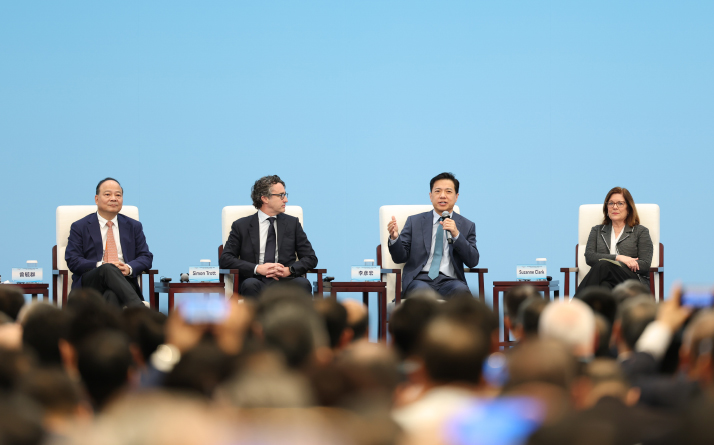 A dialogue session underway during the APEC CEO Summit 2026 in Shenzhen on November 17 (XINHUA)
Three chapters of change APEC was established in Canberra, Australia, in 1989 with 12 founding members. Its aim was to strengthen economic cooperation as trade and investment links expanded across the Pacific. Unlike a conventional trade agreement, APEC operates through voluntary commitments, consensus and dialogue rather than legally binding obligations. The forum expanded to 21 economies and became a platform for trade and investment facilitation, economic and technical cooperation, and discussion of new challenges facing regional businesses. In 1994, its members adopted the Bogor Goals, which called for free and open trade and investment in the Asia-Pacific. Subsequent initiatives sought to reduce trade costs, improve customs procedures and strengthen connections between member economies. China joined APEC in 1991, a decade before its first turn as host. When leaders gathered in Shanghai in 2001, China was preparing to enter the World Trade Organization (WTO). Its average tariff rate had fallen from 39.5 percent to 15.3 percent since joining APEC, while trade with other member economies had nearly tripled. The Shanghai meeting produced the Shanghai Accord, reaffirming the Bogor Goals and setting out measures to facilitate trade and strengthen economic cooperation. China entered the WTO in December that year, deepening its integration into global markets. Over the following decade, expanding manufacturing and trade helped strengthen production networks connecting China with other Asia-Pacific economies. By the time China hosted APEC again in Beijing in 2014, it had become the world's second largest economy. That meeting endorsed the Beijing Roadmap for APEC's Contribution to the Realization of the FTAAP, advancing a proposal for wider regional economic integration. Leaders also adopted the APEC Connectivity Blueprint for 2015-25, covering infrastructure, institutional coordination and people-to-people exchange. The economic relationship between China and the region has continued to expand. In the first three quarters of this year, China's trade with other APEC economies reached 24.07 trillion yuan ($3.59 trillion), an increase of 24 percent year on year and accounting for around 60 percent of China's total foreign trade, according to Chinese customs data. China has also become the largest trading partner of 13 APEC economies, while Chinese companies have expanded investment and production networks across the region. An international setting During the welcome banquet for APEC leaders on November 18, Xi offered his guests a journey through China's history. He pointed to Xi'an for China's ancient history, Beijing for the past five centuries and Shanghai for the past century. Then he added another destination: "To see 50 years of China, come to Shenzhen." Once a small border town, the city has become a global manufacturing and technology hub, and now welcomes leaders from across the Asia-Pacific region. Designated as one of China's first special economic zones in 1980, Shenzhen had a GDP of just 270 million yuan ($150 million at the 1980 exchange rate) that year. These zones are test fields for China's reform and opening-up policy, designed to attract foreign investment and serve as windows for economic experimentation. By 2025, its GDP had reached 3.87 trillion yuan ($576 billion), placing it behind only Shanghai and Beijing among Chinese cities. The city became a manufacturing center for international markets before developing extensive industrial networks in electronics, telecommunications, electric vehicles, robotics and AI. Companies including tech titan Huawei and car manufacturer BYD grew from local businesses into global competitors. That transformation attracted attention from international media covering APEC. In a November 16 report, the Associated Press (AP) explored Shenzhen's driverless taxis, robots and technology companies. Gary Ng, a senior economist for the Asia-Pacific at French bank Natixis, told AP that the city's role in global trade, manufacturing and innovation made it an important symbol of China's reform and opening up. British newspaper The Guardian described Shenzhen's illuminated skyline and technology demonstrations, portraying the host city as a showcase of China's growing technological capabilities and economic influence. Reuters, meanwhile, interviewed entrepreneurs at local hardware startups, reporting that many continued to target overseas customers despite geopolitical uncertainty. Its coverage documented the close relationship between the city's innovation ecosystem, manufacturing networks and international demand. The links between Shenzhen's development and the wider Asia-Pacific were also raised by participants at the summit. During an APEC discussion on November 17, Sachs proposed establishing a major United Nations campus in China focused on green and digital technologies. He argued that governments needed long-term planning and closer regional cooperation to carry out technological and environmental transitions, and that Shenzhen could offer policymakers a firsthand look at industrial development and innovation. "They would see the wonders of Shenzhen," Sachs said. In his November 19 address, Xi closed with another image drawn from Shenzhen, also known as the City of the Roc, after a legendary bird associated with strength. "I hope that with our joint efforts, Asia-Pacific cooperation will spread its wings like the roc and fly high and far to a bright future," he said. Setting the Scene Shenzhen celebrated the 100-day APEC countdown on August 10 with a light display across its landmarks, but the city's physical transformation had started much earlier; road works and venue upgrades were already in full swing months before the final sprint. The result was a city by turns spectacular and, at times, a little inconvenient. The most visible layer included dozens of skyscrapers that staged a synchronized four-night light show from November 12, alongside floral installations, bilingual signage and APEC banners. The top-down push was extensive: According to the municipal government, more than 100,000 foreign-language signs were standardized and over 7,000 AI-powered translation devices installed at key locations. But how did residents react to it all? Oliver, a therapist and born-and-bred Shenzhener, was working from home, as the city advocated during what it called "APEC week." Located far outside the conference zone, his neighborhood felt "very calm, quiet and peaceful"—no schools, no construction, no cars. With people encouraged not to drive for five days, residents were offered 100 yuan ($15) in public transport vouchers: "encouragement, rather than punishment," in his words. Appealing to the therapist within, Beijing Review asked Oliver about the larger impact on residents. He described two types: workers comparing cities—Shanghai granted five days' official holiday when APEC landed there in 2001, while Shenzhen merely encouraged working remotely, breeding some disgruntlement—and parents facing a different inconvenience: "Schools are out for five days, but we still have to work. Who'll look after the kids?" Oliver remained pragmatic: Locals are proud to show the world Shenzhen, and "a little inconvenience is necessary." The city's neon night lights weren't the only thing exuding excitement; his mother's reaction captured the local mix of pride and bewilderment: "Trump's coming!" Pride recurs. TV producer, theater director and Shenzhen resident Tang Huixia told Beijing Review how she had noticed residents paying more attention to their appearance in the lead-up to and during the event: restaurant staff in extra makeup, neat hair, spotless uniforms; people ditching shorts for long pants and swapping flip-flops for nice shoes despite the lingering southern heat. Tang lives in the city center, with hotels including a Westin and an Indigo hosting APEC attendees nearby. Preparations began months ago; the area outside the nearest subway station, for instance, was tidied up. A once-crowded food market—tourists, kids, shared bikes strewn about, zigzagging delivery riders—made just walking there dangerous, especially for children. "Thanks to APEC-related urban upgrades, the road was repaved and the area cleaned up. A hopefully lasting improvement born of temporary disruption," Tang said. (Ma Miaomiao, Zhang Shasha and Elsbeth van Paridon contributed to the story) (Print Edition Title: Grow And Prosper Together) Copyedited by Elsbeth van Paridon Comments to liwenhan@cicgamericas.com |
|
||
|
||||||||||||||||||||||||||||
|