
|
| Xinjiang Today |
| Stage boom | |
|
|
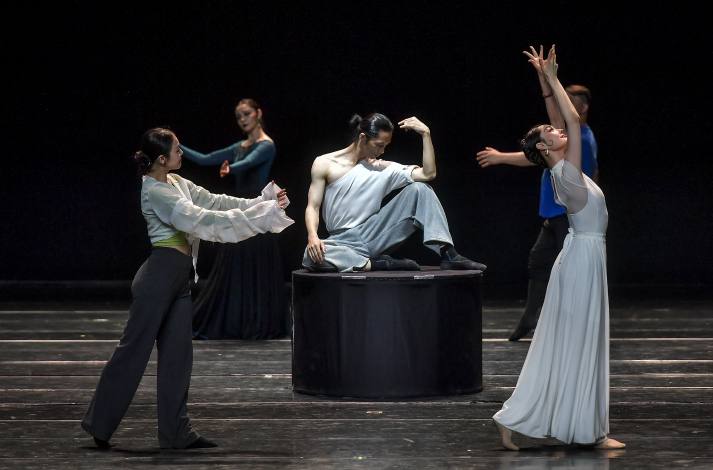 Dance performance Qiuci on its trial run in Urumqi on May 15, 2025 (COURTESY PHOTO)
In the spring of 2021, the story of a Han Dynasty (206 B.C.-A.D. 220) princess took to the stage in Yili (Ili) Kazak Autonomous Prefecture and began a journey that would crisscross Xinjiang for years to come. Princess Jieyou, a large-scale original song-and-dance drama commissioned by the Song and Dance Theater of Yili Kazak Autonomous Prefecture, told the story of Liu Jieyou, a Han Dynasty royal who married into the Wusun Kingdom in the second century B.C. and spent five decades promoting peace across the Western Regions. The Western Regions, or xiyu in Chinese, covers the majority of Xinjiang nowadays.
The Wusun Kingdom was one of the most powerful nomadic states in the Western Regions during the Western Han Dynasty (206 B.C.-A.D. 8), located around the Yili River Valley and Lake Issyk-Kul. Wusun maintained long-standing marriage alliances with the Han Dynasty. Princesses Xijun and Jieyou were both married to Wusun rulers, forming a joint front against the invaders. The Princess Jieyou show was an immediate success. It won the National Arts Fund's 2022 Publicity and Promotion Project award. By 2024, it had already been staged over 100 times. On May 26 this year, Princess Jieyou landed at the Nalati Grand Theater in the Nalati Scenic Area for a run lasting through October, which suggests it had become a part of Xinjiang's cultural landscape. "The arrival of Princess Jieyou at Nalati represents a key step in our effort to empower tourism through culture. Going forward, we will continue to develop more products that integrate culture and tourism, ensuring that the grassland scenery and cultural narratives complement each other. Our aim is to make Nalati a cultural gateway where visitors can come to understand and fall in love with Xinjiang," Dubek Alambek, Deputy Director of the Management Committee of the Yili Nalati Tourism Scenic Area, told news portal Ylxw.com.cn. "We have worked with Yili to thoroughly refine the production. It will now become a permanent, long-term resident performance at the scenic area. Our goal is to create a signature Yili repertoire that leverages the scenic area's core strength in drawing visitors. At the same time, by integrating distinctive offerings such as the Wusun Ancient Street and grassland bonfire parties, we have built a whole-day immersive grassland leisure and vacation system. This expands nighttime consumption opportunities, addresses the previous lack of evening activities and delivers a comprehensively upgraded visitor experience," Fan Lianfeng, General Manager of Xinjiang Cultural and Tourism Development Co. Ltd., told Ylxw.com.cn. 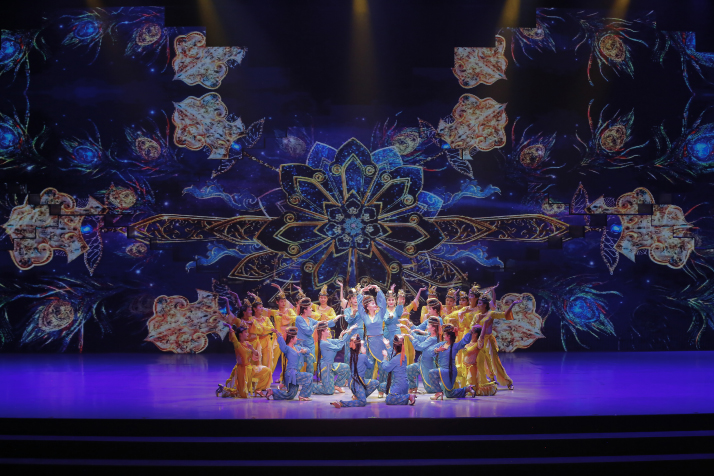 A dance performance themed on Qiuci culture in Kuche (Kuqa), Aksu Prefecture, on July 16, 2024 (COURTESY PHOTO)
Bringing history to the stage Princess Jieyou is a key project under Jiangsu Province's support for Xinjiang. It is part of a broader national initiative known as "nourishing the cultures of Xinjiang"—a pillar of China's governance strategy for the region in the new era. The initiative, which has been advanced through paired assistance provided to Xinjiang by economically advanced provinces and Central Government funding, aims to strengthen cultural identity, promoting exchange and integration among ethnic groups in Xinjiang. The concept was first formally introduced at the third work symposium about Xinjiang in September 2020. Since its inception, the "nourishing the cultures of Xinjiang" initiative has supported countless stage productions, cultural exchanges and talent development programs across the region. Beyond Princess Jieyou, the initiative has yielded a rich harvest of acclaimed works, including Shanghai's ballet In Search of Muqam, Beijing's dance drama Five Stars Rise in the East, Jiangsu's musical Night on the Prairie—The Ballad of Cocodala, as well as Zhejiang Province's dance drama Qiuci. The ballet Searching for Muqam, a key Shanghai cultural enrichment project, premiered in Urumqi on July 18-19, after three years of creation and six research trips to Xinjiang. The production follows a young musician named Guli as she returns to her hometown in Xinjiang and rediscovers her roots through the melodies of the Twelve Muqam, the "mother" of Uygur music. Muqam evolved along the Silk Road from ancient folk songs. Nearly lost by the 1950s, it was preserved through recordings. In 2005, UNESCO added it to its list of Masterpieces of the Oral and Intangible Heritage of Humanity. "Muqam was never an intangible cultural heritage displayed in a glass case. It is part of people's daily lives here. What we are seeking is its spiritual core, its living stories and above all, its infinite possibilities for the future," Wu Husheng, Deputy Director of the Shanghai Ballet, told newspaper Xinjiang Daily. During the creative process, the Muqam Art Troupe of the Xinjiang Art Theater was deeply involved in the project's planning and development. They provided a wealth of invaluable primary source materials, including Muqam music, scores, lyrics, dance references and traditional instrument designs. They also meticulously proofread and translated every line of Muqam lyrics and dialogue, completing three separate recording sessions along the way. "From music composition and dance choreography to the overall stage presentation, Xinjiang's artists poured tremendous passion and effort into this production," Xin Lili, Artistic Director of the Shanghai Ballet, told Xinjiang Daily. "This work is cultivated by artists from Shanghai and Xinjiang together, it carries the dedication and wisdom of everyone involved." Then there is Five Stars Rise in the East, a dance drama based on the legendary brocade armguard unearthed at the Niya site in Hetian (Hotan) County. The armguard, woven in five colors—blue, green, red, yellow and white—features mythical birds, kylins and cloud patterns. Its eight-character inscription in small seal script, "Five stars rise in the east, benefiting the Middle Kingdom," was an ancient astrological omen of good fortune for the Central Plains of China. The brocade represents the pinnacle of Han Dynasty silk weaving, with 220 warp threads per centimeter, and is now listed among China's artifacts prohibited from overseas exhibition. The show won the prestigious national awards and has been performed over 100 times since its 2021 premiere. Its signature dance section, Jin Xiu, appeared on the 2023 China Media Group Spring Festival Gala and has toured internationally, including performances in North America. In May 2026, the production was filmed and streamed simultaneously to over 20 theaters and cinemas across 10 provinces. Since 2024, the Hetian New Jade Song and Dance Troupe has staged the production as a regular resident show at the Hetian Film Theater, accumulating 72 performances and receiving 12,800 audience members as of this June. "To think that 2,000 years ago, we already had an inscription like 'Five stars rise in the east, benefiting the Middle Kingdom' appearing in such a distant place. The historical significance and its contemporary relevance are unparalleled by any other subject matter," Dong Ning, Deputy General Manager of Beijing Performance Arts Group, told newspaper Beijing Youth Daily. "This dance drama places great emphasis on innovation in drama, dance and subject matter. When audiences step into the theater, they will find that we have managed to interpret such a serious theme in a highly accessible and down-to-earth way. At the same time, there are artistic innovations across the stage design, music, multimedia and costumes." 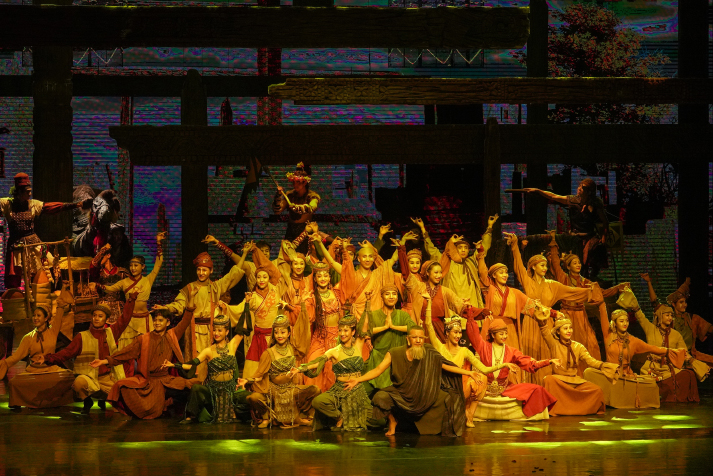 The dance Five Stars Rise in the East is performed in Wuhan, Hubei Province, on July 14, 2024 (COURTESY PHOTO)
Modern echoes Contemporary history is also finding its stage. Night on the Prairie—The Ballad of Cocodala, a song-and-dance drama supported by Zhenjiang City of Jiangsu Province as part of the assistance for Xinjiang program, was staged in Yining, capital of Yili, on July 29, and ran through August 9. The production tells the story of three members of the Xinjiang Production and Construction Corps (XPCC) who settled in the Cocodala region of the Yili River Valley, interweaving their struggles with the lives of the Uygur, Kazak and Mongolian communities they came to call neighbors. The XPCC was founded in October 1954, with the core mission of reclaiming wasteland and guarding the border in Xinjiang. "Xinjiang is rich in song and dance heritage, but we didn't want to stop at the level of folkloric display. Instead, we wanted to elevate song and dance into an expression of shared values," Lin Chen, the production's chief director, told Xinhua News Agency. He chose the hybrid genre of "song-and-dance poetic drama" to reinterpret the XPCC spirit. "The XPCC members of that era voluntarily traveled to the frontier for a national mission, giving up personal comfort. Our younger generations, including many post-1990s, left our hometowns as children to study and build careers elsewhere. This shared emotion is precisely what resonates with contemporary audiences." The stage design, featuring a main set constructed from letters of longing and a 5D interactive snowstorm sequence, drew standing ovations. "It put the XPCC spirit into every note and every dance move," 96-year-old Yan Xinqiu, a national model for ethnic unity, told newspaper Yili Daily. "Young people can understand it and feel it." Beyond the big stage While grand theaters and large-scale productions grab the headlines, the true heartbeat of Xinjiang's performing arts renaissance often pulses in more intimate spaces. The "small stage" experience, whether in a boutique theater, a repurposed cultural venue or an immersive night tour, has become a powerful engine for cultural engagement and consumer spending. In Tulufan (Turpan), the Night at Jiaohe light show transforms the ancient earthen city into a living stage. The Jiaohe Ruins, near Tulufan, is a 2,300-year-old Silk Road city. The name of the city means "river junction" as it was built on a 30-meter-high cliff between two rivers. Uniquely, it was carved down from the ground rather than built up, making it one of the world's largest and best-preserved earthen cities. A UNESCO World Heritage Site since 2014, it was abandoned in the 14th century. As dusk settles, visitors are led along winding paths where dancers in period costumes emerge from the shadows of millennia-old ruins. Onto the weathered walls, projections cast Silk Road caravans in motion, making the past feel startlingly alive. The immersive experience has become a key driver for Tulufan's night-time economy, with nearby businesses reporting a significant uptick in visitors on show nights. In Hetian's Tuancheng Scenic Area, the performance A Glimpse of Tuancheng offers an even more decentralized model. Instead of a single stage, the show unfolds across nine distinct chapters, each set in a different alleyway or traditional courtyard. Performers lead the audience through the neighborhood, stopping to sing, dance or act out vignettes of local life. "Zero-distance engagement is one of our core features. Many tourists start by watching and end up learning the steps," Shadaket Eniwa, a performer in the show, told Xinjiang Daily. Perhaps the most commercially successful integration of stage and setting can be found at the Xinjiang International Grand Bazaar, where the dinner show Silk Road: A Millennium Impression has added to the city's evening leisure. The format follows a "dinner theater" model: A lavish Xinjiang-style buffet opens at 7:30 p.m., followed by performances featuring Uygur Muqam, Kazak eagle dances, and Tajik flute music. The finale, a traditional meshrep carnival dance, invites the entire audience onto the floor. The format has significantly extended visitors' dwell time at the grand bazaar from under an hour to nearly three hours. The shift is also happening at scale. According to a December 2025 report by Xinjiang Daily, as of the time of the report, the Xinjiang People's Theater completed 220 performances so far in that year, receiving more than 71,000 audience members. During the 2026 Spring Festival season alone, 1,032 stage works were staged across the region. However, industry insiders note that smaller, more intimate venues are seeing some of the fastest growth. "Audiences have moved from 'watching the spectacle' to 'seeking depth,'" Ba Fangyong, General Manager of 91 Tickets, a local ticketing platform, told Xinjiang Daily. "More viewers now prefer works that blend ethnic culture with modern aesthetics. The demand for interactive and immersive experiences is rising, and repeat purchase rates for immersive productions where audiences participate in the storyline have notably increased." The shift in audience preference is also pushing local troupes to innovate. At the Xinjiang Art Theater Drama Troupe's newly opened small theater, productions such as Angel? It Came! and the mime piece Hello became surprise hits, recouping their entire upfront production costs during the first run—a rare feat for a state-owned ensemble. Young faces now fill the seats; sold-out small theaters packed with young audiences have become the new normal. "To bring theater back to young audiences, we must align our subject matter and creative approach with their lives and ways of thinking," Yuan Chen, director of the Xinjiang Art Theater Song and Dance Troupe's small theater production Angel? It Came!, told newspaper China Daily. The play, a contemporary urban drama about two unemployed middle-aged men who receive a mysterious windfall, breaks the traditional proscenium stage through carefully arranged environments, layered plot twists and direct audience participation, transforming viewers from observers into experiencers. Comments to zhangyage@cicgamericas.com |
|
||||||||||||||||||||||||||||
|