
|
| Xinjiang Today |
| People-centered development in south Xinjiang | |
|
|
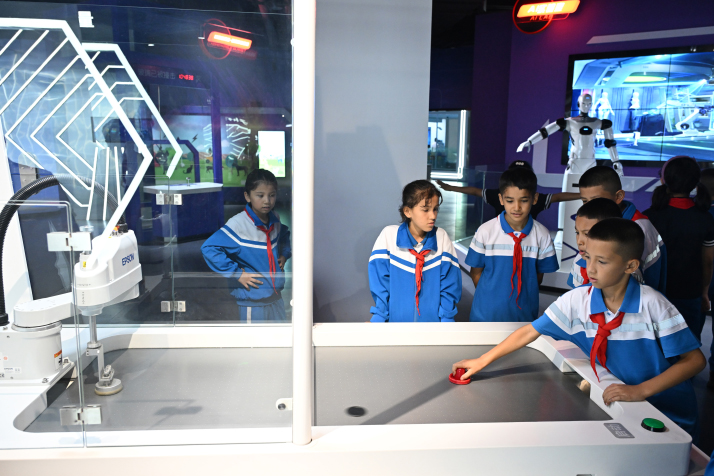 Primary school students visit the Kashi (Kashgar) Science and Technology Museum in Kashi on August 26, 2024. The museum, built with support from Shenzhen in Guangdong Province, is the first comprehensive science and technology museum in south Xinjiang (CNSPHOTO)
Xinjiang Uygur Autonomous Region is divided into north and south by the Tianshan Mountains and south Xinjiang has historically lagged behind the north in infrastructure, education and industrial and economic development. These disparities are due both to south Xinjiang's geographical isolation and formidable landscape, much of which is covered by the Taklimakan Desert. Promoting balanced development of the north and the south is at the top of Xinjiang's agenda and over the past five years, south Xinjiang has seen accelerating progress, industrial revitalization, improved livelihoods and the strengthening of ethnic unity.
Industrial revitalization The economic engine of south Xinjiang is being powered by a strategic focus on industrial revitalization, transforming resource-rich areas into robust pillars of economic growth. Kuche (Kuqa) City in Aksu Prefecture is one of the cities benefiting from south Xinjiang's focus on high-quality development. The 11th Communist Party of China (CPC) Xinjiang Uygur Autonomous Regional Congress was held from October 19 to 23. Xu Zhong, a delegate representing Kuche at the congress, told Xinjiang Daily newspaper, "Kuche's GDP increased from 33.73 billion yuan ($5 billion) in 2021 to 45 billion yuan ($6.7 billion) in 2025, with an annual growth rate of 5.9 percent." He also said the city is extending the industrial chain through projects such as the Tahe Refining and Chemical Project, which takes crude oil through all stages of refinement and even produces materials for textiles. Similarly, Yecheng County in Kashi (Kashgar) Prefecture is building its economic strength through two dominant industries: green mining and the deep processing of agricultural products. Cheng Long, a delegate from Yecheng, said, "We rely on our resource endowments, advantages provided by our location, and our industrial foundations to strengthen the two leading industries of green mining and deep processing of agricultural products." Yecheng is modernizing its agriculture by establishing industrial parks for the deep processing of fruit and producing vegetables in modern facilities. As of the end of 2025, the county was home to 269 industrial enterprises, creating over 12,000 jobs and achieving a total industrial output value of 6 billion yuan ($900 million), a significant surge from the end of the 13th Five-Year Plan period (2016-20). 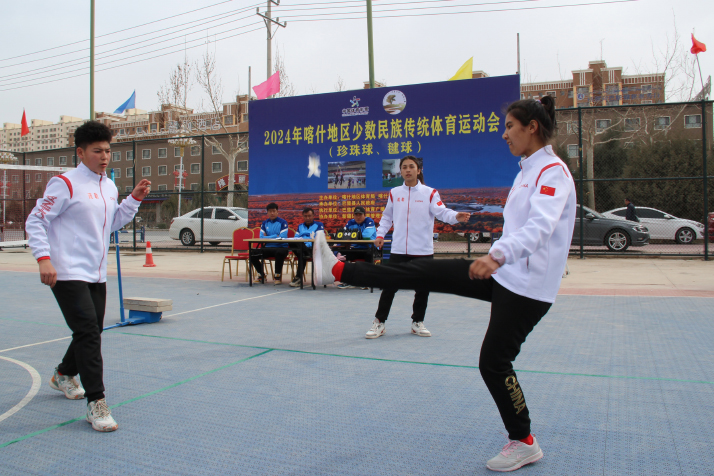 The Shule County team prepares for the women's Jianzi (shuttlecock kicking) group match at the 2024 Ethnic Minority Traditional Sports Games of Kashi Prefecture on March 11, 2024 (CNSPHOTO)
Improving livelihoods Improving people's wellbeing and livelihoods is a cornerstone of south Xinjiang's development strategy. The sentiment is best encapsulated by Rehaiguli Abulizemu, a delegate to the 11th CPC Xinjiang Uygur Autonomous Regional Congress and a community worker in Hetian (Hotan) City in Hetian Prefecture. In 2016, after graduating from university, Rehaiguli joined the Xingmin Community in Hetian and immersed herself in the busy community work. The community provides services such as meal assistance for the elderly and in-home care. It also offers free after-school tutoring, providing a safe and supportive environment for children while parents are still at work. Employment is recognized as the most important aspect of people's wellbeing. In Kuche City, the Human Resources and Social Security Bureau has renovated a vacant building to establish the Wuqia Gig Job Market, which has been welcomed by laborers. Previously, they waited by the roadside, exposed to the elements, often with uncertain outcomes and concerns about timely payment. One laborer, Aihemaiti Kuwani, said, "With the gig job market, finding work is easier, and my rights are protected." Since its opening in June 2022, the market has served approximately 122,000 individuals, posted 9,881 job vacancies and facilitated employment for around 21,000 people. Kuche City has also undergone significant urban renewal and its urbanization rate has reached 50.5 percent. Its academic performance, particularly in the high school entrance examination, ranks among the top in south Xinjiang. The region has also established a three-tiered medical system, with 94.68 percent of patients receiving medical services within the city, contributing to the growing happiness of local people. Yutian County in Hetian Prefecture has also seen remarkable improvements in people's living standards. Ye Fei, a delegate from Yutian, said, "The appearance of urban and rural areas, as well as people's lives and public services, have undergone great changes across the county." The construction of key urban roads, coupled with the operation of the Ruoqiang-Hetian Railway, which connects Ruoqiang County in Bayingol (Bayingolin) Mongolian Autonomous Prefecture with Hetian City, and the opening of 16 domestic and international flight routes from Yutian Wanfang Airport, has greatly improved travel conditions for local residents. 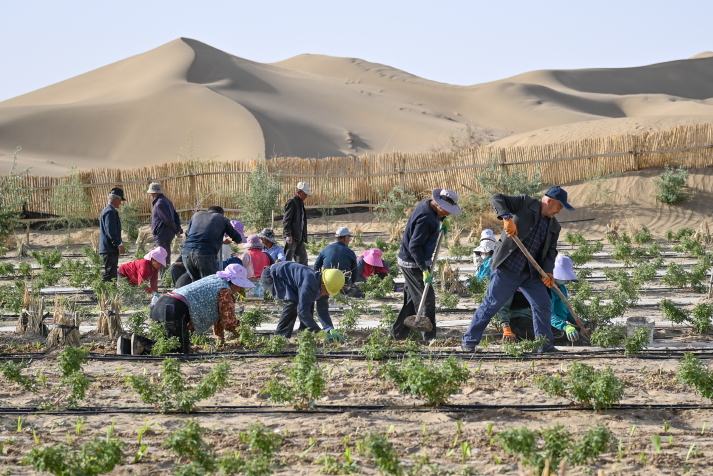 Villagers interplant leopard lily (Iris domestica), a herbal medicine, in a commercial rose garden in Yutian County, Hetian Prefecture, on April 15 (XINHUA)
Cultural enrichment Over the past five years, south Xinjiang has fostered a sense of unity and collective progress through targeted cultural enrichment programs. Bachu County in Kashi, for instance, regularly organizes "Cultural Bazaar" activities. These events serve as platforms to promote excellent traditional Chinese culture, including calligraphy, painting and opera, integrating them into the everyday lives of the community. People of all ethnic groups participate in one another's traditional festivals, including communal meals, song and dance performances, and opportunities for mutual learning of customs. Through these regular interactions, exchanges and integrations, participants naturally enhance their sense of shared cultural identity. The Kunlun Guoxue (studies of Chinese ancient civilization) Academy in Yecheng County has become an effective platform for promoting unity. By offering 13 free courses in disciplines such as calligraphy, traditional Chinese painting, dance and pottery, the academy has become popular among both parents and students. Yutian County is also committed to spearheading public communication and outreach activities alongside artistic performance initiatives. These efforts aim to foster the creation of popular cultural works that resonate with the people, thereby enriching their intellectual and cultural lives. The county is intensifying efforts to promote the use of standard Chinese, expanding the reach and impact of activities designed to encourage learning and the proficient use of the standard language. Across south Xinjiang, the sense of unity is increasing as the region makes progress, creating a brighter and more cohesive future for its people. (Print Edition Title: Unity and Progress) Comments to jijing@cicgamericas.com |
|
||||||||||||||||||||||||||||
|