
|
| China |
| Beijing's Evening, Xinjiang's Afternoon | |
|
|
 The author in Urumqi, capital of Xinjiang Uygur Autonomous Region, on July 29, at 8:43 p.m., about an hour before sunset
During my first summer living in Urumqi, capital of Xinjiang Uygur Autonomous Region, I annoyingly kept getting the time wrong. On my first working day, I arrived at an office at 9 a.m. sharp and found the doors locked and the corridor dark. Nobody had told me that the working day in Xinjiang starts at 10. A few weeks later, a friend in Beijing messaged me to say good night. It was nearly 10 p.m., and I was just sitting down to dinner on a balcony still full of evening light. I asked to meet a friend at 7 p.m. for dinner and they were two hours late. How rude, right? China officially runs on a single clock, Beijing Time. The sun, however, keeps its own schedule. In Urumqi, it rises and sets around two hours later than in the capital, and daily life quietly follows it. Government offices here open at 10 a.m. and, in summer, close at 8 p.m. Lunch is at 2 p.m., dinner at 9 p.m., and the night markets are only getting busy when much of Beijing is heading to bed. For a long time, I thought of those long evenings simply as one of the pleasures of living here. I never imagined they had a price. It turns out Beijing is willing to pay that price. Lighting up Beijing's evening At around 5 p.m., Beijing's evening rush for electricity begins. People head home, switch on lights, cook dinner and pack into trains and elevators. Theaters prepare their stages. Just as demand starts to climb, the sun over the capital is sinking. Nearly 2,000 km to the west, in Hami, Xinjiang, it is only about a quarter past three by the sun. The solar panels there are still working hard. In April 2025, Beijing completed its first time-shifted green power trade. Through the first deal, 12 million kilowatt-hours (kwh) of solar power were delivered in Beijing's evening hours from Xinjiang to users including the National Center for the Performing Arts, the National Library and the Capital Museum. I once read an article that poetically described it as Xinjiang's afternoon sunshine "lighting up" Beijing's night. I love that image. Yu Xiao, who manages technical operations at an arts center run by the National Center for the Performing Arts, said that its stages rise, slide and rotate above a pit 21.5 meters deep, and all of it runs on electricity. Its busiest period, from 4 p.m. to 6 p.m., is now fully covered by green power, and since April its theaters have been lit with electricity from Xinjiang. In other words, as the stage machinery comes to life in Beijing, part of the power comes from an afternoon that is still going on in Xinjiang. I teach statistics here in Urumqi, and whenever something like this catches my eye, it tends to end up in a lesson. So I asked a simple question: How strong is the sun at 5 p.m. Beijing Time in different parts of China? Using standard equations for the sun's position, I worked out how much sunshine falls through a clear day in mid-April in Beijing, in Hami and in Kashgar, Xinjiang, near China's western border. By 5 p.m., Beijing's sun has dropped to about a third of its midday strength. In Hami, it is still at around 70 percent. In Kashgar, it is close to 90 percent. 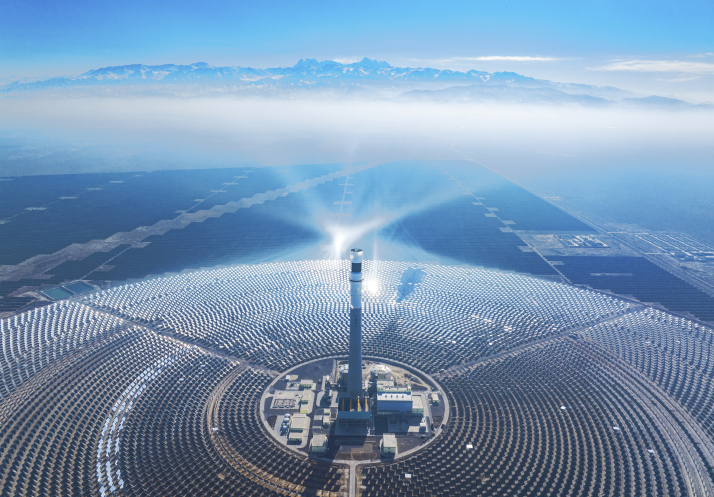 A solar power and thermal storage project in Changji Hui Autonomous Prefecture, Xinjiang, on October 30
Buying sunshine by the hour Until recently, power traded between regions has usually been sold in big bundles, a bit like a monthly phone plan: You buy a large amount but have little say over exactly when it arrives. The new arrangement is closer to booking a train seat. Beijing buys Xinjiang's power for particular hours of particular days. There is a second reason the match works so well. Because life in Xinjiang runs later, so does its own demand for power. The region's electricity prices for businesses are lowest in the afternoon and highest from 7 p.m. to midnight. So Xinjiang has sunshine to spare just as Beijing switches on its lights, and needs most of its own power later in the evening, after Beijing's rush has passed. It reminds me of two flatmates who share a bathroom without ever arguing, because one showers at 7 and the other at 10. Highways for electricity None of this would work without a way to move the power. China has been building ultra-high-voltage power lines, which do for electricity roughly what high-speed rail does for passengers. In 2025, Xinjiang sent about 141 billion kwh of electricity to other provinces, roughly as much as the whole state of New York buys in a year. The newest line, from Hami to Chongqing Municipality, opened in June 2025 and runs 2,260 km, about the distance from New York to Dallas, Texas. The United States has a similar time gap: The sun sets on California nearly three hours after New York. But America's eastern and western grids are only loosely connected. A U.S. government laboratory has described the capacity between them as "not much more than a rounding error." California's late sunshine cannot easily help New York through its evening. In China, Xinjiang's surplus power can reach Beijing through the interconnected grid. Saving sunshine for later Even Xinjiang's sun sets eventually, and two extra hours only go so far. On a trip to Hami, I saw one answer from a distance: A vast field of mirrors in the Gobi that, in the afternoon heat, looked just like a lake. The plant, built by China Three Gorges Corp., combines ordinary solar panels with a solar-thermal station. About 260,000 mirrors follow the sun and focus its light onto pipes, heating molten salt to 550 degrees Celsius. The hot salt holds the heat, and it can keep the plant generating for up to eight hours after dark. Why it matters to me Across China, the value of electricity increasingly depends on the time of day. As eastern provinces add more solar panels, power at lunchtime is becoming cheap. In Shandong Province, east China, which had more photovoltaic power generation capacity than any other province in 2025, businesses can now buy electricity between 11 a.m. and 2 p.m. for as little as 0.25 yuan (around $0.03) per kwh. Evening power, after the sun has gone, is worth far more. That is exactly when Xinjiang's sun is still shining. There is also a link to my own work. Training AI models takes enormous amounts of electricity, and much of that work does not need to happen at any particular hour. My own experiments do not mind whether they run at noon or at 6 p.m.; they just need the power. This year, "computing-power and electricity coordination" appeared in China's annual Government Work Report for the first time. I would love to see more AI training scheduled around Xinjiang's late sunshine, right here, close to where the power is made. For most of its history, Xinjiang's distance from the east has been a cost. Goods take longer to arrive, and electricity has to travel thousands of kilometers. The late sun is one of the few places where that distance becomes an advantage: The farther west the solar panel, the later its afternoon. Next June, I will probably be sitting outside in Urumqi at 6 p.m. with the sun still high, in no hurry to start dinner. I will think of a stage in Beijing, 2,400 km away, lit by the same long afternoon. The author is a British AI researcher and teacher living in Urumqi. Comments to ffli@cicgamericas.com |
|
||||||||||||||||||||||||||||
|