
|
| Xinjiang Today |
| Harsh landscapes become opportunity in Bayingol | |
|
|
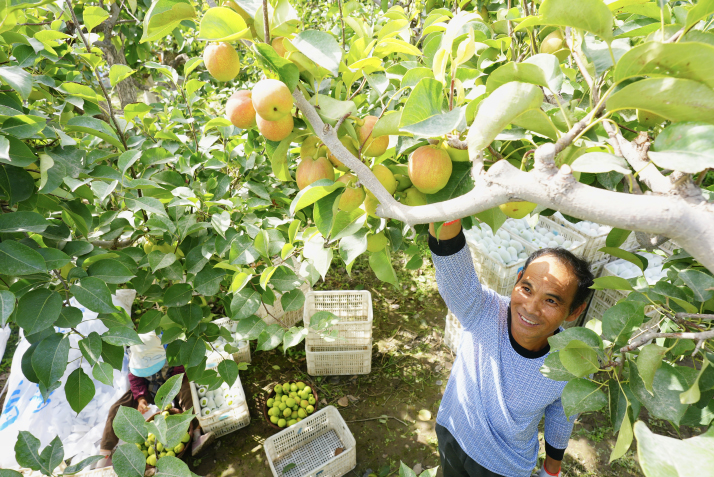 A farmer picks fragrant pears in Yingxia Township, Kuerle (Korla) City, on September 1, 2024 (VCG)
Bayingol Mongolian Autonomous Prefec-ture sprawls across 471,500 square km of inland grassland on Xinjiang's border with Qinghai and Gansu provinces and Xizang Autonomous Region. It is China's largest prefecture-level administrative region by land area—equivalent to the combined size of Jiangsu, Zhejiang, Fujian and Jiangxi provinces in the east. It leans against the Tianshan Mountains to the north and the Kunlun Mountains to the south, cradling the Tarim Basin in between.
When many people hear the name Bayingol, however, the first scene that comes to mind is a high cliff towering over the ocean. In 2019, writer and professional race car driver Han Han directed Pegasus, a film about a down-and-out racer returning to the track. The climactic final race was filmed on the Bayanbulak Grassland in Bayingol. At the end, the protagonist's car breaks through a safety barrier, launches off a cliff and soars out over the sea. Han later publicly clarified that both the cliff and the sea were special effects—and that "there is no sea in Bayanbulak." Bayingol, meaning "fertile basin" in Mongolian, may not have a sea, but life there is defined by water. While water nurtures prosperity, it can also take it away. Yet the people of Bayingol have refused to let geography dictate their fate. 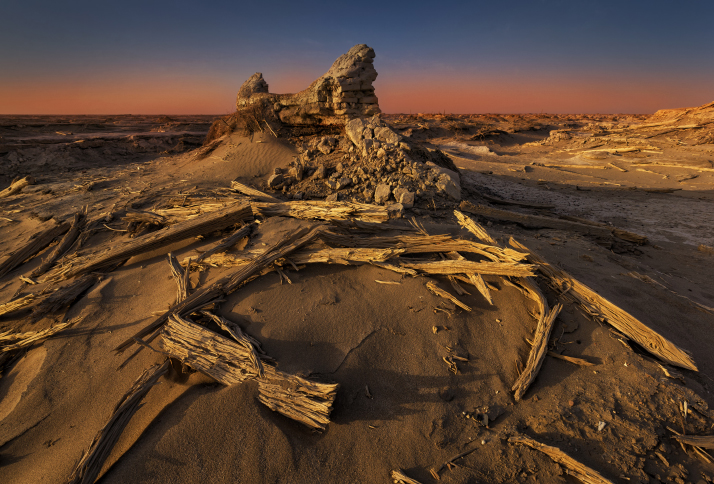 Ruins of the ancient city of Loulan in Bayingol Mongolian Autonomous Prefecture in 2019 (VCG) The ancient Loulan On April 14, 1980, archaeologist Mu Shunying led a team to a cemetery by the Tieban River in Lop Nur, a former saltwater lake that is now largely a dry and salt-crusted desert basin, where they slowly lifted the woolen veil from the face of a female corpse. A journalist accompanying the team later recorded that moment: long eyelashes, intact eyebrows, a high nose bridge, deep-set eye sockets, slightly parted lips revealing well-preserved teeth, dark and lustrous skin that still felt elastic when gently pressed. This female corpse, which had slept for 3,800 years, became known as the Loulan Beauty. Loulan was an ancient state in the Western Regions, recorded in the Records of the Grand Historian (China's first biographical general history) and a hub on the Silk Road, which suddenly disappeared around the 5th century. Loulan's rediscovery was entirely accidental: In 1900, Uygur guide Eldik, working for Swedish explorer Sven Anders Hedin, stumbled upon the ruins of the ancient city; the following year, Hedin excavated more than 150 Chinese documents, 17 of which bore the two characters Loulan. Whether Loulan perished from lack of water, war, or climate change remains unsettled to this day, but all hypotheses point to the same fact: At the edge of the desert, once the water is gone, even the most prosperous city will be collected by the yellow sand. Loulan is a warning written in dust—a reminder of what happens when a civilization loses its lifeline. 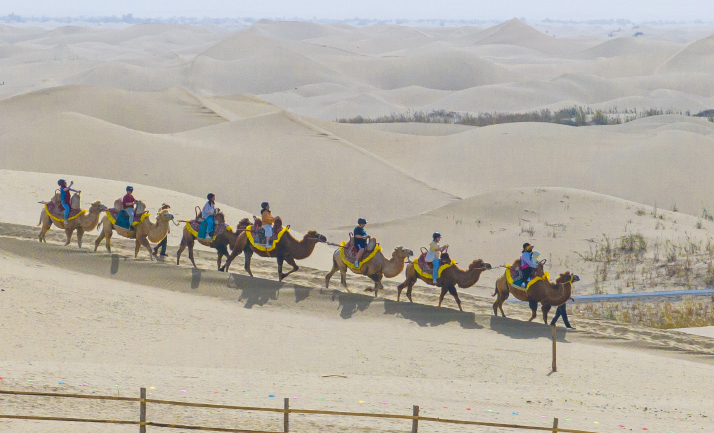 Tourists ride camels in Lop Nor Village, a desert resort in Yuli County, Bayingol Mongolian Autonomous Prefecture, on October 2 (VCG)
The oasis Locals in Bayingol do not want Loulan's fate to repeat itself. In Ruoqiang, sand-control workers squat on the scorching sand, inserting wheat straw about 15 cm deep in a grid pattern, leaving 20 cm exposed. Straw checkerboards block wind and sand, while sacsaoul and black goji berry are planted alongside straw, stabilizing the sand and bringing in income. Since 2000, water has been continuously channeled into the Tarim River. In November 2024, the 3,046-km Taklimakan sand-blocking belt, completely surrounding the desert, was fully closed. By the end of 2025, the prefecture had treated more than 533,600 hectares of desertified land. Lake Taitema, which had been dry for years, refilled with water, blocking the narrow "handshake" between the Taklimakan and Kumtag deserts. The greenery brings tourists. In Bayanbulak, Bayin Alidel, whose family has herded livestock for generations, sold the family's yaks and kept the outside of his ger, a Mongolian yurt, unchanged while converting the inside into standard rooms with heating and showers. He now rises before dawn every day to roast meat for his guests. Herder Tsering Drolma opened a family homestay and now earns more than 20,000 yuan ($2,976) a month during peak season. In 2025, Bayingol received 45.7456 million tourist visits and 30.3 billion yuan ($4.5 billion) in revenue, up 14.6 percent and 16.2 percent, respectively. The harvest on the oasis is sweet—and red as well. In an autumn pear orchard in Kuerle (Korla), the capital of Bayingol, sunlight filters through green leaves onto fragrant pears. Wu Di, chairman of the local cooperative, told Xinjiang Today, "The heavy pears have bent the branches. This year we're sure to bring in a good income!" Kuerle fragrant pears have been grown for more than 1,300 years and were China's first product to receive a geographical indication. In Ruoqiang, by the desert, more than 1,300 hectares of red dates are grown, with date income accounting for more than half of local farmers' per-capita income. The Yanqi Basin produces about 40 percent of China's industrial chili peppers and 80 percent of the world's capsanthin, a natural red dye. More than 80 percent of its industrial tomato products are exported—much of the ketchup on the world's dinner tables and the red in lipsticks comes from this basin. 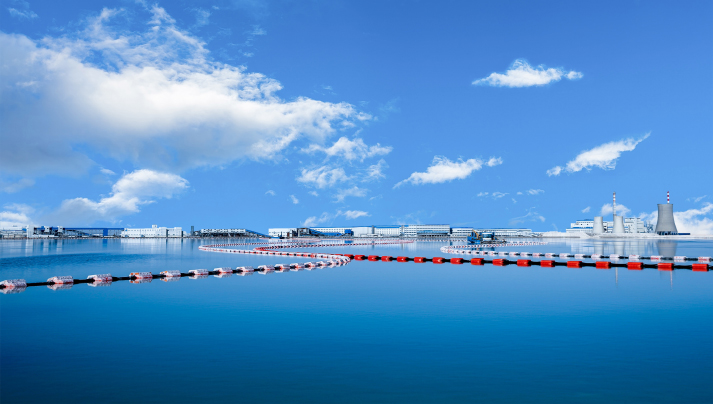 The SDIC Xinjiang Luobupo Potash Co. Ltd. (COURTESY PHOTO)
Resources from the desert Seeking resources from the desert accelerated Bayingol's development. On November 18, 1988, in Lunnan, 35 km south of Luntai County, the Lunnan No. 2 Well, known as the "meritorious well," was opened, producing 631 cubic meters of black crude oil per day. That was the beginning of massive oil exploration in the Tarim Basin. In April 1989, the Tarim Petroleum Exploration and Development Command was established in Kuerle, and drilling towers rose across the vast wasteland. An even more magnificent scene unfolded more than a decade later, in 2004: The first West-East Gas Pipeline was opened, linking Lunnan Town in the west to Shanghai in the east, spanning 4,200 km. With a single turn of the valve at the Lunnan First Station, natural gas from the Tarim Basin crossed half of China to light up the east. By 2026, the oilfield had supplied a total of 400 billion cubic meters of gas to the pipeline. Another group achieved the impossible in Lop Nur. In the spring of 2000, Yin Xinbin, who later served as vice general manager of SDIC Xinjiang Luobupo Potash Co. Ltd., and his colleagues arrived in a lifeless wasteland in search of potash. "We are the sons of farmers, and we know how important grain is," he told China News Service. "With potash fertilizer, grain yields can increase, so we felt this was something worth doing." Lop Nur is also known as Luobupo, a spelling based on the official pinyin romanization system. There were no houses, so they dug pit dwellings beneath the salt crust, with four to six people crowded into each one. At night, salt water often seeped into them. Today this place is the world's largest single potassium sulfate production base, with an annual output of 1.5 million tons and cumulative potash production of more than 18 million tons, raising China's potash self-sufficiency rate to 50 percent. The pit dwellings from those years have been preserved at the factory gate, becoming a classroom for those who came later. 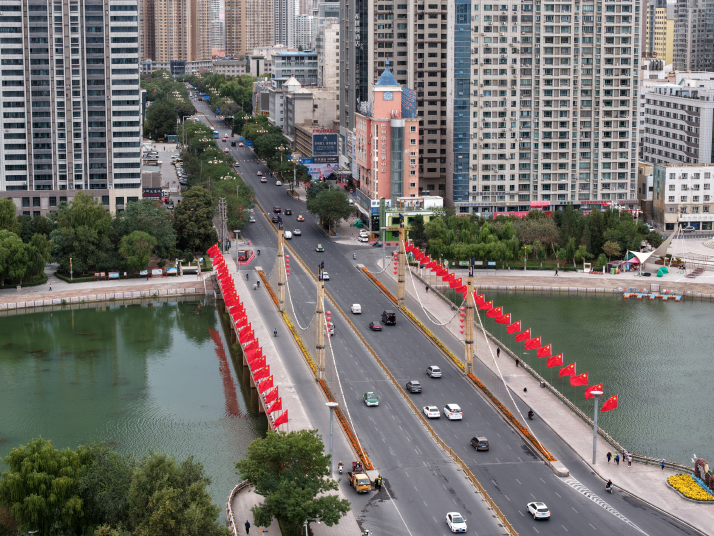 Kuerle, capital of Bayingol Mongolian Autonomous Prefecture, on September 27 (VCG)
A blue ocean in the desert Ruoqiang, where ancient Loulan was located, is now growing a "blue ocean." The fourth channel of the "Xinjiang power transmission to other regions" project, with a total investment of about 100 billion yuan ($14.85 billion), has broken ground here. Wind and solar power from southern Xinjiang's first 10-million-kilowatt-level "desert, gobi and wasteland" base will travel thousands of miles to light up Sichuan Province and Chongqing Municipality. Wang Liang, the on-site manager, said land leveling alone has covered 80 hectares, "equivalent to 112 standard football fields." The project also gives priority to hiring local farmers for sand control, increasing each person's monthly income by about 6,000 yuan ($891). In 2025, the prefecture's solar power generation reached 5.533 billion kilowatt-hours, more than doubling in a single year. From cherishing every drop of water to turning a sea of sand into energy and hope, the people of Bayingol have made one thing clear: Geography determines the starting point, but it cannot determine the direction. (Print Edition Title: Defying the Desert) Comments to shangzhouhao@cicgamericas.com |
|
||||||||||||||||||||||||||||
|