
|
| Voice |
| Twenty years on, the Global South speaks louder | |
|
|
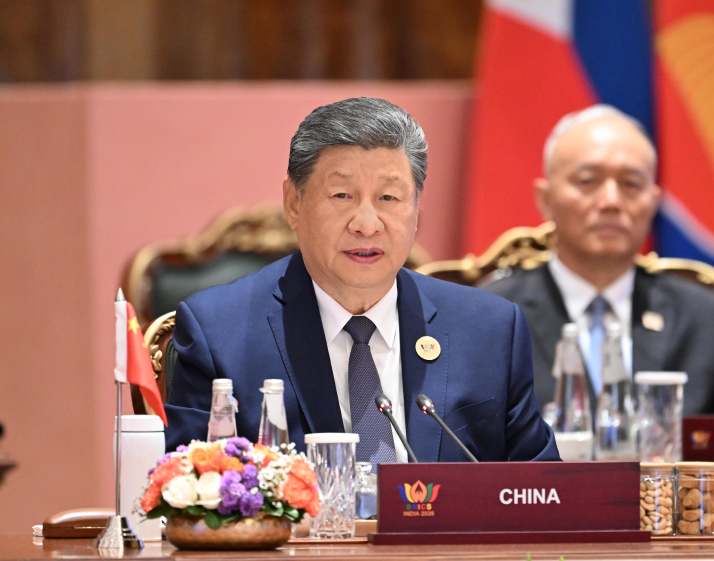 Chinese President Xi Jinping delivers a speech at Session II of the 18th BRICS Summit in New Delhi, India, on September 13 (XINHUA)
The 18th BRICS Summit was held in New Delhi, India, on September 12-13, reaching two pivotal milestones: the 20th anniversary of the group's founding in 2006 and the third summit since this grouping of emerging economies, originally consisting of Brazil, Russia, India, China and South Africa, welcomed new members in January 2024. The summit convened against the backdrop of a profoundly unstable global landscape. The international system is plagued by intertwined conflicts and uncertainties. The world economy is diverging and trending downward, while regional armed conflicts are dragging on and the multilateral order faces risks of collapse. Most notably, the world suffers worsening deficits in peace, development, security and governance—crises that have made this year's BRICS gathering a focal point of global attention and expectation. Outcomes delivered India attached particular importance to this year's event. Currently, the BRICS presidency rotates annually according to the letters of its acronym. Given an upcoming reform of the rotation formula in two years, the country may not be hosting another BRICS summit for many years to come. New Delhi launched long-term preparations and invested massive resources, aiming to turn the leaders' meeting into India's moment in the spotlight and steer the future direction of greater BRICS cooperation. As disclosed by Indian authorities, as of late August, India had organized more than 350 meetings and high-level engagements across more than 25 of its cities. Themed Building for Resilience, Innovation, Cooperation and Sustainability, the summit established these four pillars as guides for all negotiations. Drawing on its experience hosting the Group of 20 (G20) Summit in 2023, India prioritized the interests and collective weight of the Global South, a broad term referring to developing and emerging economies across Asia, Africa and Latin America that have long been marginalized in global governance. Prime Minister Narendra Modi said India's BRICS chairmanship is based on "a people-centric and humanity-first approach." India also embedded its national priorities in the BRICS agenda. In key fields including the digital economy, industrial development, public health, climate change, environmental protection, sustainable development and infrastructure construction, it highlighted its own development experiences and traditional culture, leaving a distinct imprint. The summit concluded with substantial, tangible achievements. Members adopted the New Delhi Declaration, a 45-page official document encompassing 140 collective commitments and consensus agreements. According to Indian sources, the summit delivered 64 concrete outcomes categorized under the four core pillars. The resilience pillar produced 12 outcomes, covering agriculture, public health, disaster management and global trade, most notably a new framework for logistics and supply chain cooperation designed to stabilize cross-border commodity flows amid global volatility. Thirteen innovation-centered outcomes were reached, targeting digital tools, research infrastructure, open platforms to incubate and scale up new technological and industrial ideas across members and beyond. Another 27 cooperation-focused outcomes aimed to advance cross-border collaboration in areas including anti-corruption, finance, trade, labor standards, industrial bench-marking and judicial coordination. Twelve outcomes addressed sustainability, focusing on climate resilience, green energy transition and the promotion of eco-friendly, sustainable lifestyles worldwide. Beyond the declaration, the summit approved landmark strategic documents. Following negotiations at the Meeting of the BRICS Trade Ministers in August, all parties finalized the BRICS Economic Partnership Strategy 2030, laying out a clear five-year roadmap for economic cooperation under the greater BRICS framework. The military strike jointly launched by the United States and Israel against Iran earlier this year severely undermined internal BRICS solidarity, causing multiple ministerial-level preliminary meetings prior to the summit to end without results. Against this backdrop, the success of the summit proved that the group has survived the most severe test since its membership expansion, demonstrating strong institutional vitality and laying the foundation for broader cooperation in the future. The concrete deliverables of the gathering have further consolidated and expanded the boundaries of BRICS collaboration. 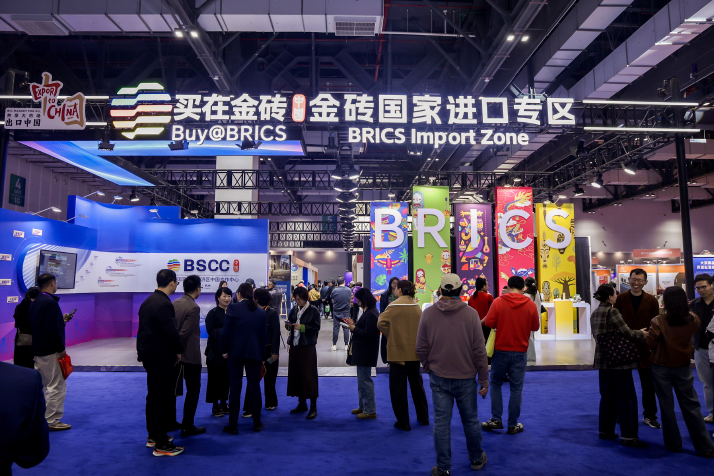 The BRICS Import Zone at a trade promotional event in Hangzhou, Zhejiang Province, on March 15 (XINHUA)
China's participation China's participation emerged as a major highlight of the summit, drawing global focus. Chinese President Xi Jinping delivered speeches at the summit's two sessions, outlining China's consistent, forward-looking stance and grand vision for the future of greater BRICS cooperation. Xi described the group's 20-year journey as one of "self-reliance and self-strengthening," "standing together through wind and rain" and "fruitful outcomes." Today's BRICS stands at the forefront of the Global South. It is the world's most influential cooperation platform for emerging markets and developing countries, and sets a fine example of emerging markets and developing countries seeking strength through unity. Having entered a new stage of high-quality development in greater BRICS cooperation, BRICS must remain committed to its positioning, adhere to a development path guided by independence, solidarity, mutual trust and a focus on concrete actions and tangible results, and further consolidate the foundation of its collaboration. Xi said BRICS must strive to be a pioneer of our times, steer the international order in a direction that is more just and equitable, and work together to build a community with a shared future for humanity. Xi made the following proposals: First, BRICS should be a pioneer in advancing innovation-driven development. BRICS countries must keep the initiative firmly in their hands, strengthen cooperation in the field of AI, encourage open source, openness, collaboration and sharing, and break new ground and scale new heights in their practical cooperation. Second, BRICS should be a pioneer in upholding peace and stability. BRICS countries should act on the vision of common, comprehensive, cooperative and sustainable security. They should participate constructively in the settlement of hotspot issues, and make BRICS' unique contribution to addressing both the symptoms and root causes. Third, BRICS should be a pioneer in facilitating mutual learning between civilizations. BRICS countries should promote the common values of humanity, and advocate exchange, mutual learning and harmonious coexistence among civilizations. Fourth, BRICS should be a pioneer in reforming and improving global governance. BRICS countries should align with the trend toward greater democracy in international relations, work toward a more just and equitable global governance system, and uphold the authority of the United Nations. To translate visions into tangible progress, Xi put forward five initiatives covering open source and inclusive AI, trade and investment facilitation, digital industry cooperation, intelligent manufacturing collaboration, and science and technology talent development. Forming a systematic, interconnected framework, these initiatives prioritize talent development as the foundation, sci-tech innovation as the driving engine, industrial collaboration as the carrier, trade and investment facilitation as the connecting thread, and inclusive global development as the goal. They position BRICS to capitalize on the new global industrial and technological revolution and advance common prosperity for all members. 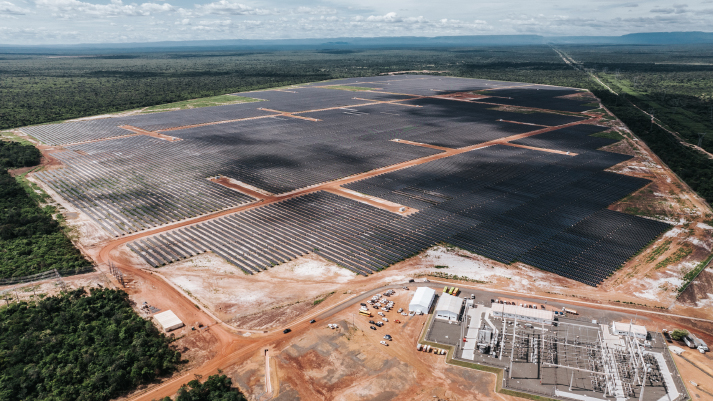 The Marangatu Solar Complex, built with investment by SPIC Brazil, a subsidiary of China's State Power Investment Corp. (SPIC), in Piaui state, Brazil, on June 7, 2024 (XINHUA)
The next 'golden decade' Looking ahead, BRICS faces a mixed landscape of mounting risks and historic opportunities. Several Western countries have openly framed BRICS as a strategic threat amid its growing overall strength, worsening its external diplomatic environment. The doubling of BRICS members has raised internal coordination costs. Several ministerial-level meetings in 2026 failed to issue joint communiqués, exposing lingering internal divides. Additionally, BRICS lacks a permanent secretariat and operates under a rotating chairmanship system, resulting in fragmented agendas and uneven progress. Its existing institutional framework is unable to fully match its upgraded global mission. Yet BRICS retains unparalleled resilience and structural advantages. Its vast combined population, territory, resources, industrial capacity and market size generate unique synergies for collective cooperation. Diverse political, economic and cultural backgrounds among BRICS countries create diversified development momentum. Guided by inclusive development principles, such as prioritizing dialogue over confrontation and partnership over military alliances, BRICS delivers institutional dividends that support flexible risk mitigation and sustained growth amid global shocks. As the collective rise of the Global South accelerates and global multipolarity becomes an irreversible historical trend, BRICS stands at a pivotal strategic window of opportunity. China will take over the BRICS chairmanship in 2027 and host the 19th BRICS Summit. "The Chinese side will seize the opportunity to build consensus and work with all parties to plan for the future. Together, we will usher in the third golden decade of BRICS cooperation, and open up a bright prospect of shared prosperity and progress," Xi said when addressing Session I of the New Delhi summit. Despite lingering challenges, greater BRICS cooperation aligns with the prevailing historical tide and global public opinion. With favorable timing and momentum on its side, the group will embrace greater prospects. (Print Edition Title: A Bolder Voice) The author is director of the Center for BRICS and G20 (Group of 20) Studies at the China Institutes of Contemporary International Relations Copyedited by Elsbeth van Paridon Comments to dingying@cicgamericas.com |
|
||||||||||||||||||||||||||||
|








