
|
| Voice |
| Unity without uniformity | |
|
|
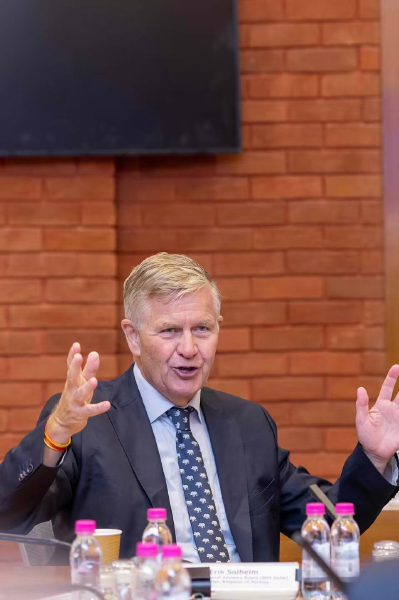 Erik Solheim
War, tariffs, technological upheaval wrought by the rapid advancement of AI and a warming planet are testing an already strained international order. It was against this backdrop that the 18th BRICS Summit was held in New Delhi, India, on September 12-13. In an interview with Beijing Review reporter Peng Jiawei, Erik Solheim, former Under Secretary General of the United Nations, reflected on what binds together a group of emerging economies marked by profound differences. Edited excerpts of their conversation follow: Beijing Review: What was your biggest takeaway from this year's BRICS summit? Erik Solheim: What struck me most was the emphasis on peace. Much of the discussion centered on defusing global conflicts, from easing tensions between the United States and Iran, to pushing for restraint in the Middle East and bringing Sudan's civil war to an end. Peace matters in its own right. But the summit's focus on stability also reflects a broader recognition: Economies are far more likely to grow, and living standards to rise, in a world at peace than in one at war. Many of the largest BRICS economies have a vested interest in global peace because their overriding priority remains domestic development. China, for instance, has not engaged in any war since 1979, which was around the time the country embarked on its reform and opening-up agenda. Brazil, another major country in the Global South, has likewise remained uninvolved in major wars for decades. Chinese President Xi Jinping made, in my view, a very important call at this year's BRICS summit, when he said BRICS should strengthen cooperation in the field of AI. This July, China, together with a number of other countries, established the World AI Cooperation Organization in Shanghai, with the aim of ensuring that AI develops in ways that are beneficial, safe and fair. A few months earlier, India hosted the India AI Impact Summit in New Delhi, bringing together global leaders around a similar principle: AI should not be the preserve of a wealthy or powerful few, but a tool available for all. Through mechanisms like these, the power of AI can be directed toward the public good, from diagnosing and treating cancer, to deepening our understanding of human behavior, improving education and making our energy systems more efficient. The scope for positive impact is enormous. 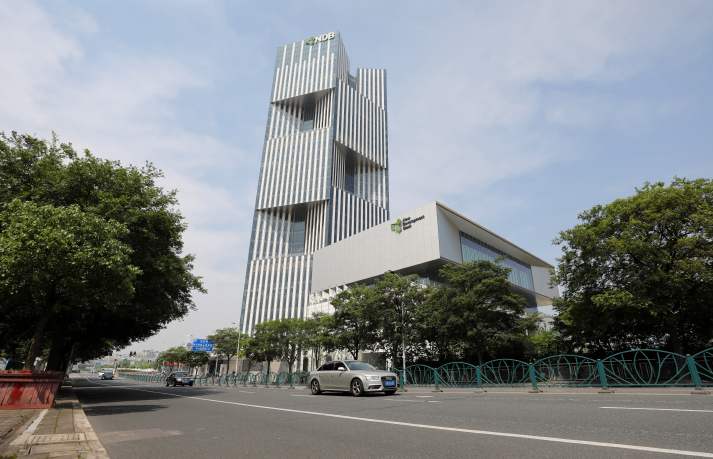 Headquarters of the New Development Bank, a multilateral development bank established by BRICS, in Shanghai on September 10 (XINHUA)
Why does the world need an organization like BRICS today, and what can it offer that other institutions cannot? BRICS reflects a broader shift in the balance of the global order. The old order is giving way to a more multipolar world, driven in large part by the rise of the Global South. China is central to that transformation, but it extends well beyond China to countries such as India, Indonesia, Brazil and Viet Nam. The term "United Nations" was first conceived by then U.S. President Franklin D. Roosevelt toward the end of World War II. Over time, a system emerged, built around the UN, the World Bank and the International Monetary Fund. These institutions made sense for the world of their time. However, when they were established, the People's Republic of China had not yet been founded. India was still under British rule, the Philippines was under American control, and much of Africa remained under Western colonial domination. It was, in other words, a profoundly different world. This is precisely why creating new institutions has become so important. They provide greater agency for the Global South. There are other key bodies of this kind, such as the Shanghai Cooperation Organization and the African Union. But BRICS is particularly significant because it brings together many of the biggest players in the developing world. These countries have been a major force behind the dramatic decline in global extreme poverty over the past few decades. That is, to a large extent, thanks to China, but not to China alone. We have also seen sharp reductions in poverty in other major developing economies, including Indonesia, Viet Nam and India. Today, the BRICS group represents nearly half of the world's population and accounts for around 40 percent of global GDP. In that sense, BRICS represents the future: a world not defined by a small number of players, but one in which the Global South is given a voice and role that better reflect its scale. What do you think is the biggest challenge for BRICS moving forward? I think the biggest challenge is to establish BRICS as a non-Western, but not anti-Western, organization. It should be a platform for the Global South to come together and help transform the world, rather than a group of nations positioned against the West. It is important to recognize that BRICS is composed of countries that are drastically different in their histories, cultures, political systems, priorities and agendas. It brings together countries as different as Iran, which is currently in conflict with the U.S., and the United Arab Emirates, which maintains close ties with the West. And that is where the strength of BRICS lies. Despite their vast differences, these countries are brought together by a shared emphasis on development and economic growth for all. Take China and India as an example. The relationship between the two countries is central to the BRICS community. Both are giant nations, each with a population of more than 1.4 billion, and they are the two largest economies among BRICS members. Yet the two countries differ sharply in their political systems, their views on a range of international issues and even their people's perspectives on life. Bilateral relations have also been strained at times. At the same time, important areas of common ground remain. One that deserves particular attention is the environment. Recent devastating mudslides in Nepal are a reminder of how difficult it can be for a less developed country to cope when a disaster of such scale strikes. Climate change is a challenge that no country can address alone. Countries in the region, including China and India, should work together by sharing technology and knowledge, by better identifying the most likely risks across the Himalayas, and by deepening scientific partnerships and accelerating green transitions over the longer term. There is yet another important common denominator. Both China and India are seeking their own paths to modernization rather than simply following a Western model, with each drawing on its own traditions and circumstances. The paths may differ markedly, but they are connected by a shared pursuit of a distinct mode of development. And this applies not only to China and India. BRICS need not become an anti-Western alliance. It can instead serve as a platform that gives developing countries greater room to chart new paths beyond the established Western route. Its value lies in creating a space for dialogue despite differences, and in enabling its members to work together on shared challenges that extend well beyond the group itself. BR Copyedited by G.P. Wilson Comments to pengjiawei@cicgamericas.com |
|
||||||||||||||||||||||||||||
|








