|
| Voice |
| Sovereignty Is Not for Sale | |
| Brazilian president's absence from New Delhi cannot be read as a retreat | |
|
|
|
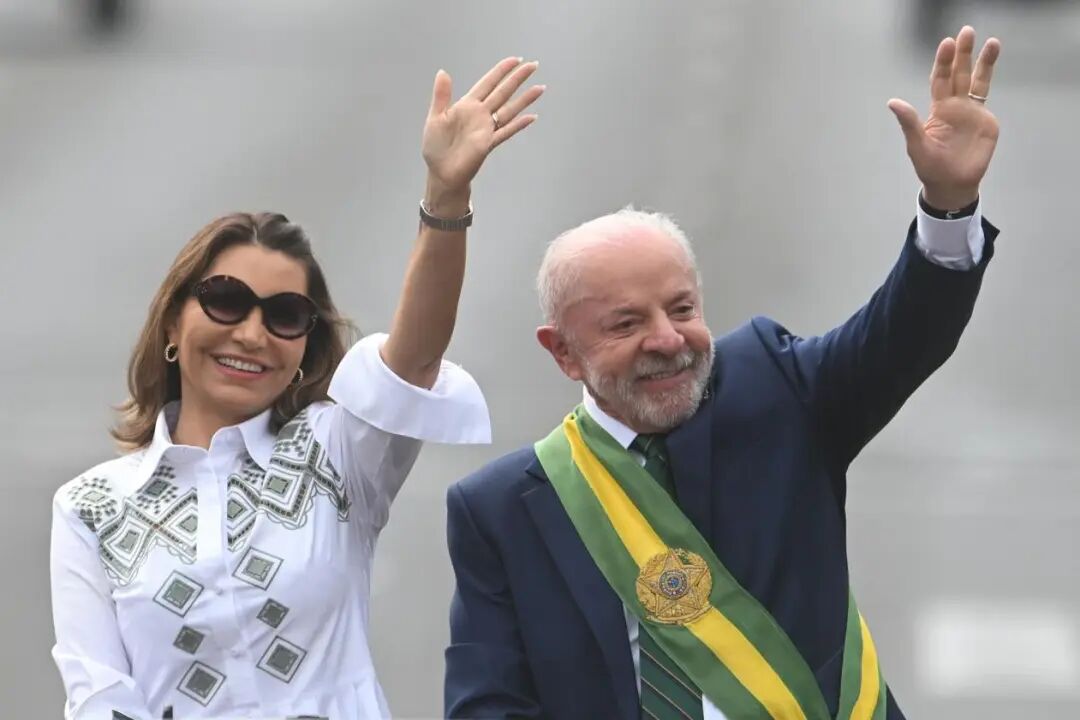
Brazilian President Luiz Inácio Lula da Silva and First Lady Rosângela Lula da Silva attend the Independence Day celebrations in the Brazilian capital of Brasília on September 7. (XINHUA) As the 18th BRICS Summit took place in New Delhi, India, on September 12-13, Brazilian President Luiz Inácio Lula da Silva was conspicuous in his absence, Brazil being one of the group's four founding members. Several Brazilian media outlets, loyal to Washington, tried to frame his absence as either a sign of the group's fraying cohesion, or as an indication of Brazil's diminishing role as a mediator in building a multilateral order. That framing, however, mistakes a scheduling decision for a strategic one: Lula has delegated the summit to his foreign minister and BRICS ambassador precisely because the more consequential fight over Brazil's place in the multi-polar order is being waged at home, on the ballot, in October. Lula remains on the ground, campaigning in Brazil for re-election in October, as Brazil's election has become essentially a referendum on two irreconcilable visions of the country's place in the world: multipolarity represented by Lula versus the "Project for a New American Century" by the Bolsonaros. The far-right Bolsonaro family has staked its political future on subservience to Washington, lobbying the American Donald Trump administration for sanctions against Brazil's own institutions and openly courting a Donroe Doctrine that treats Latin America as U.S. territory. Their declared intention is to hollow out Brazil's role in the multipolar order and mark the distancing of ties with China on behalf of Washington.【The Monroe Doctrine was a U.S. policy (1823) declaring that the Western Hemisphere was closed to European colonization or interference, while the U.S. would stay out of European affairs. The Donroe Doctrine is a play on the former, a term used to describe Trump's approach to asserting U.S. dominance over the Western Hemisphere—Ed.】 The strategic convergence between Brazil's far right and Trump's project has paradoxically placed BRICS, and Brazil's deepening partnership with China, at the center of Lula's strategy to resist what he calls foreign interference in the country's own decisions. Brazil's sovereignty debate has, more than ever, taken on an electoral, economic and international dimension: Current U.S. attacks on Latin America and tariffs have made the sovereignty question more real and immediate than at any other point across Lula's three presidential terms.
Brazil's BRICS vision Lula's absence from New Delhi cannot be read as a retreat. Foreign Minister Mauro Vieira led the Brazilian delegation, alongside Ambassador Maurício Lyrio. At the BRICS Business Forum ahead of the summit in September, Vieira made the case for deepening ties among the group's productive sectors, warning explicitly that global trade is under threat from protectionism, economic coercion and unilateral sanctions—language clearly aimed at Washington's tariff campaign, and unusually explicit for a career diplomat. "At a moment when the global economy is threatened by protectionism, economic coercion and unilateral sanctions, [...] strengthening ties between our productive sectors matters more than ever," he stated. Two days before BRICS leaders gathered in New Delhi, former Brazilian President and President of the BRICS bank Dilma Rousseff inaugurated the BRICS-New Development Bank platform designed to share technical knowledge, development experience and technology across the Global South. Rousseff, re-elected unanimously to a second term as the bank's president in March 2025, provided the clearest illustration of Brazil's investment in the group. She is the woman Lula entrusted as his successor to the Brazilian presidency, a woman who fought in the armed resistance against Brazil's military dictatorship, was captured and tortured under a regime Washington had backed and helped install, and years later became president of Brazil herself. A woman who, as president, was spied on by the U.S. National Security Agency and who was ultimately removed from office in a parliamentary coup in a concerted effort with the U.S. Department of Justice, according to court documents. This woman now heads one of BRICS' most important decision-making institutions in Shanghai.
The sovereignty question Among the progressive forces in Brazil, it has become a consensus amid Trump's escalation in Latin America that multipolarity is no longer a foreign policy preference, but the conditio sine qua non of Brazilian sovereignty itself, the precondition without which strategic autonomy is not achievable at all. The Partido dos Trabalhadores (the Workers Party), in particular, has always considered BRICS a pillar of its national strategy, the main organizational vehicle of that project and that it should be integrated into state policy to outlast individual governments. It is not by chance that Lula's campaign today explicitly argues the idea that his victory will decide whether the multi-polar order evolves or whether Latin America finally succumbs to Trump's Donroe Doctrine. "Brazil belongs to Brazilians" has become Lula's rallying cry, a deliberate act of antagonism, drawing a sharp, necessary contrast with what Lula's camp calls the Bolsonaro family's "sell-out politics." In his September 7 Independence Day address, Lula declared: "No foreign ruler has the right to say who we can buy from or sell to. We are a sovereign country." He went further, still, telling Brazilians that the country "will not be anyone's colony again." Senator and presidential candidate Flávio Bolsonaro, however, has been negotiating in the opposite direction. He has discussed bringing Brazil into the U.S.-led "Shield of the Americas," a hemispheric security initiative launched on March 7, with the participation of 17 Latin American states, with the explicit goal of countering "Chinese leverage in the region" and has instead proposed a long-term rare earths and critical minerals partnership with Washington. To lead that effort, Flávio Bolsonaro intends to appoint his brother, Eduardo Bolsonaro, as foreign minister. The latter is currently a fugitive from Brazilian justice and living in the U.S. state of Texas. Brazil's more pragmatic, productive sectors do not accept this sort of ideological approach. The country now trades more with China than with the U.S. Chinese investment in Brazil reached $6.1 billion in 2025, and the two countries' central banks maintain a currency swap line worth 190 billion yuan ($28 billion), a buffer against the kind of dollar-based pressure Washington has applied this year.
More than multipolar rhetoric The stakes Lula is fighting for at home were on display in New Delhi. Attendance was heavyweight: Chinese President Xi Jinping, on his first visit to India in seven years; Russian President Vladimir Putin, in his first in-person BRICS appearance outside Russia since 2022; Iranian President Mahmoud Pezeshkian, Egyptian President Abdel Fattah El-Sisi, Ethiopian Prime Minister Abiy Ahmed and United Nations Secretary General António Guterres, all sending a direct message to Washington condemning unilateral coercive measures and trade-restrictive actions inconsistent with World Trade Organization rules, calling for UN Security Council reform with greater African, Asian and Latin American representation. On September 11, BRICS finance ministers and central bank governors took matters to the next level, calling for reform of the International Monetary Fund and World Bank to give developing economies greater representation, transparency and accountability, while backing continued work on cheaper, faster cross-border payment systems. India is pushing to link central bank digital currencies across BRICS members, building directly on interoperability work agreed during Brazil's own BRICS presidency in 2025, an effort aimed at letting member states settle trade and payments without routing through Western-controlled financial infrastructure. The group can no longer be perceived as merely a diplomatic coalition calling for a multipolar world or an economic club. BRICS is moving fast toward the construction of financial infrastructure, including development finance, connected payment systems and knowledge transfer, to give emerging economies greater capacity to act outside the traditional centers of global power. Days after Washington's July 2026 tariffs took effect, Xi and Lula spoke on the phone for over an hour on July 27, and agreed to accelerate a long-stalled China-MERCOSUR trade agreement—a reversal, since Brazil had spent years resisting exactly that arrangement inside the group. Beijing offered what officials briefed on the talks called "the necessary flexibilities": accommodation of MERCOSUR's industrial protections, rather than the liberalization China might once have demanded as the price of entry.(The Southern Common Market, MERCOSUR for its Spanish initials, is a regional integration process initially established by Argentina, Brazil, Paraguay and Uruguay—Ed.) Brazil's foreign policy commitment to the multipolar order has not always been what it is today. Brazil traditionally sought accommodation with Washington, and Itamaraty's (the Brazilian Foreign Office) diplomacy historically leaned toward alignment with Europe rather than the Global South. What has changed might not be so much Lula's ideology, but the geopolitical terrain beneath it, with China having become one of the principal architects of a multipolar project and Lula's understanding that his project for Brazil as a country cannot survive inside an order Washington still expects to dictate.
The author is a lawyer and an investigative journalist from Brazil Copyedited by Elsbeth van Paridon Comments to dingying@cicgamericas.com |
|
||||||||||||||||||||||||||||
|