|
| Voice |
| The dragon and the elephant dance together | |
|
|
|
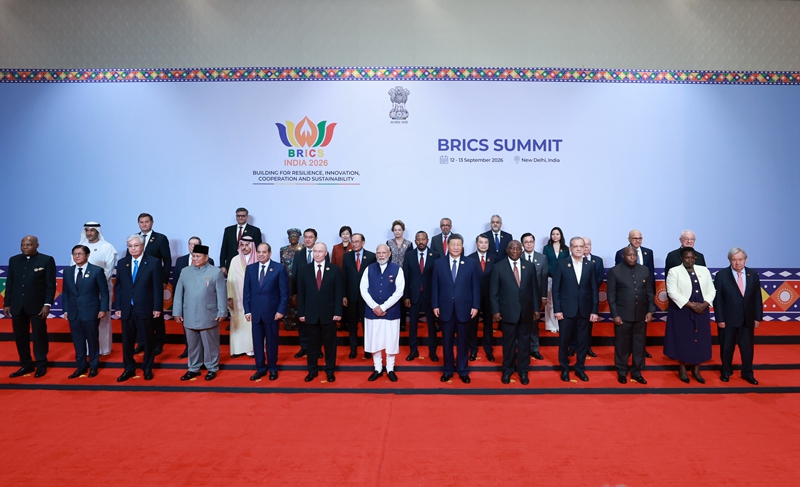
A group photo of leaders attending the 18th BRICS Summit in New Delhi, India, on September 13 (XINHUA) Chinese President Xi Jinping's arrival in New Delhi, capital of India, for the 18th BRICS Summit on September 12-13, was symbolic not only for the world's two most populous nations but for the Global South at large. His first visit to India in nearly seven years coincided with the 20th anniversary of BRICS and the first in-person leaders' summit of the 11-member group to take place in South Asia. Closer cooperation Since the second informal summit between President Xi and Indian Prime Minister Narendra Modi in Mamallapuram in 2019, both nations have consciously prioritized dialogue and crisis management, ensuring that differences have not derailed the broader relationship. The turning point, however, came at the 16th BRICS summit in Kazan, Russia, in 2024. During their meeting there, the two leaders agreed to view ties "from a strategic height and long-term perspective," marking the start of tangible progress. The completion of agreed disengagements in border areas, the resumption of talks between special representatives, and the revival of various dialogue mechanisms have transformed the diplomatic atmosphere. In April 2025, during the 75th anniversary of diplomatic relations, a cultural and emotional shift occurred between China and India. The Chinese president evoked the powerful metaphor of making "the dragon and the elephant dance together." This was more than rhetoric; it reflected a vision backed by action: the resumption of direct flights, eased visa procedures, renewed approvals for commercial joint ventures and the revival of the spiritual pilgrimage to Mount Gang Renpoche in Xizang Autonomous Region, which is of great importance to many Indians. A stable, mutually respectful relationship between these two civilizational states, together home to over 2.8 billion people, is not merely a bilateral luxury but a global necessity. China's vision and India's execution The New Delhi summit showcased BRICS evolution from a dialogue forum into a substantive pillar of Global South governance. India's chairmanship structured discussions around four critical pillars: resilience, innovation, cooperation and sustainability. Together, these pillars address the most pressing insecurities of the developing world, from food and energy to digital divides and climate change. The BRICS family photograph taken in New Delhi showcases a story of successful growth. Alongside Brazil, Russia, India, China and South Africa, the group now includes Egypt, Ethiopia, Iran, Saudi Arabia, the United Arab Emirates and Indonesia as full members. The summit also welcomed 10 new partner countries: Belarus, Bolivia, Cuba, Kazakhstan, Malaysia, Nigeria, Thailand, Uganda, Uzbekistan and Viet Nam. Together, this expanded group represents roughly half of humanity and approximately 40 percent of the global GDP, measured in purchasing power parity terms. This historic expansion has deep roots in China. President Xi championed the "BRICS Plus" concept at the Xiamen BRICS summit in China's Fujian Province in 2017. China's contribution to this institutional evolution has been consistent and principled, a commitment to openness, inclusiveness and win-win cooperation. President Xi has often described BRICS as a "vanguard for advancing global governance reform," a platform to defend the multilateral trading system against unilateralism and protectionism. This vision is backed by tangible projects including the BRICS Partnership on New Industrial Revolution Innovation Center in Xiamen, Fujian, and the Global Governance Initiative, aligning perfectly with the summit's goals. Partners, not rivals The most anticipated moment of the summit was undoubtedly the bilateral meeting between Xi and Modi. The primary objective was to strengthen strategic trust, expand common ground and address lingering differences through constructive dialogue. Both leaders emphasized the importance of maintaining peace and tranquility in border areas through established diplomatic and military mechanisms. They affirmed that the boundary issue should be considered within the broader context of their bilateral relationship. Beyond border management, a considerable and promising agenda for practical cooperation remains. Last year, bilateral trade between India and China exceeded $150 billion; however, India faced a trade deficit of $116 billion. To show its commitment to mutual benefit, Beijing plans to increase its imports of Indian pharmaceuticals, agricultural products and IT services to address this imbalance, while also expediting approvals for joint ventures that enhance manufacturing capabilities in India. People-to-people exchanges, including those involving students, pilgrims, tourists, journalists and scholars, form the foundation of relations between these two ancient civilizations, and these interactions are currently experiencing a robust revival. On the multilateral front, both nations collaborate closely within organizations such as the United Nations, Shanghai Cooperation Organization, BRICS and Group of 20 (G20) to align their development priorities and strongly advocate for the interests of the Global South. At the core of this enduring relationship are the Five Principles of Peaceful Coexistence (known as Panchsheel in India), which China and India agreed upon in 1954. Seven decades later, these principles—mutual respect for sovereignty and territorial integrity, mutual non-aggression, non-interference in each other's internal affairs, equality and mutual benefit, and peaceful coexistence—continue to provide a resilient foundation for the two neighbors. As the world's two largest developing nations, China and India share far more converging interests than diverging differences. Strong relations between them are not just a bilateral triumph; they are a stabilizing force for Asia and the world. A voice for the Global South The New Delhi Declaration 2026, an important outcome of the summit, serves as an exemplary model of effective consensus-building. It reinforces BRICS as a platform for Global South agency without turning into an antagonistic bloc. Geopolitically, the declaration made a major breakthrough by strongly condemning terrorism in all its forms, specifically addressing the terrorist attack in Pahalgam, India, in 2025, while also rejecting double standards, a key priority for host India. In discussing the complex issue of West Asia, the declaration used carefully chosen language to balance various concerns, urging restraint, the protection of civilians and the uninterrupted flow of energy. It reaffirmed the two-state solution, bridging the diverse perspectives of its members. It also advocated comprehensive reform of the UN Security Council, seeking to secure a rightful place for the Global South. From a geo-economic perspective, the declaration promotes practical incrementalism rather than revolutionary change. It offers a clear critique of unilateral tariffs and protectionist measures that negatively impact developing economies. Its approach to de-dollarization is similarly pragmatic, advocating local currency settlements, enhancing payment-system interoperability through the newly established BRICS Payment Task Force and expanding local-currency financing from the New Development Bank. This strategy creates a tangible pathway to reduce transaction costs and strengthen financial resilience without pursuing a common currency, which could be divisive in the short term. The endorsement of the BRICS Economic Partnership Strategy 2030, along with initiatives such as a proposed BRICS Grain Exchange and frameworks for inclusive AI governance, underscores a commitment to practical cooperation that delivers real benefits in trade, food security and technological equity. China and India's increasing cooperation, particularly through BRICS, suggests the once-symbolic image of the dragon and the elephant dancing together may be materializing. The true measure of the New Delhi consensus will be its ability to enhance livelihoods through trade, job creation, educational exchange, resilient supply chains and a fair international system that supports development rights. China, India and the other BRICS partners will continue to promote genuine multilateralism, aiming to transform shared interests into a community with a shared future. BR The author is founder and secretary general of India China Economic and Cultural Council Copyedited by G.P. Wilson |
|
||||||||||||||||||||||||||||
|