
|
| China |
| Sci-fi, from literary niche to soft power dynamo | |
|
|
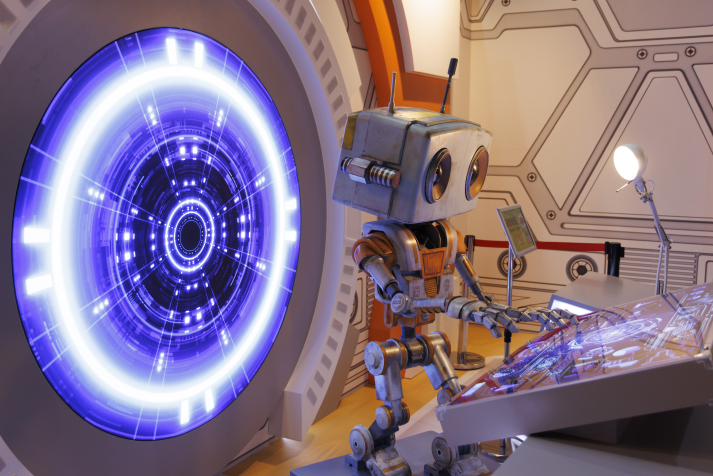 A robot at the 10th China Science Fiction Convention in Beijing on March 27 (XINHUA)
While readers across China turned pages in quiet celebration of World Book and Copyright Day on April 23, the country's science fiction (sci-fi) sector was generating a different kind of energy.
Publishers in suits queued next to cosplayers in futuristic armor. Film executives exchanged business cards with webnovel writers. Outside the convention hall, a digital counter ticked upward: 126.1 billion yuan ($17.4 billion), the total revenue of China's science fiction industry in 2025. These are scenes from the 10th China Science Fiction Convention held on March 27 to 29 at Beijing's Shougang Park, a former steel mill turned innovation hub. Once a literary niche, sci-fi has become one of China's most dynamic cultural engines. According to the 2026 China Science Fiction Industry Report released during the convention, total industry revenue grew 15.7 percent year on year in 2025, for the third consecutive year above the 100-billion-yuan ($13.8-billion) threshold. More importantly, the sector has evolved far beyond its literary origins. It now spans a multi-dimensional landscape that includes reading, video, gaming, merchandise, cultural tourism and technology hardware. Wang Chunfa, President of the Chinese Popular Science Writers Association, described the current moment as a pivotal one. "China's sci-fi industry is still in a key transition period, moving from 'big' to 'strong,'" he said at the convention. "We still lack super-IPs with sustained leading capacity." 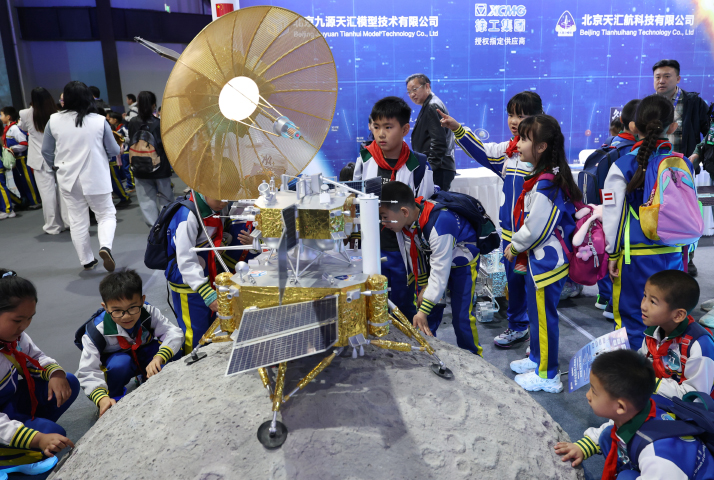 Children explore science and technology at the booth of Beijing Tianhuihang Technology Co. Ltd. at the 10th China Science Fiction Convention in Beijing on March 27 (XINHUA)
A decade in data To understand how quickly Chinese sci-fi has scaled and where its structural weaknesses lie, the Chinese Science Fiction Database (CSFDB), cofounded by scholar Zhang Sanfeng, a visiting researcher at the Southern University of Science and Technology in Shenzhen of Guangdong Province, provided a clear big-picture perspective. According to data from CSFDB, 110 sci-fi novels and 542 short stories were published in China in 2014. One decade on, by 2024, those figures had increased to 226 novels and 823 short stories. Preliminary data of 2025 show sustained high output: 163 novels and 989 short stories. But the real leap has happened on screen. "In 2015, Chinese cinemas showed virtually no domestic sci-fi movies," Zhang told Beijing Review. "By 2025, however, we recorded seven theatrical sci-fi films, 15 series and 64 animated sci-fi shows. Over this decade, Chinese sci-fi has finally turned its long 'rumored' potential into real industrial output." The average quality of sci-fi works, however, is a different story. "Doubling production volume hasn't brought a commensurate rise in average quality," Zhang added. "In any industry's early stage, lower barriers to entry inevitably lead to a flood of works, both good and bad." He noted that truly ambitious works, those that grapple with how technological change reshapes society, ethics and economic models, remain rare. "That is the challenge for the next decade." Wang echoed this concern in a broader context. "In contrast to the rapid expansion of industrial scale, there is a gap in content supply capacity, industrial synergy and theoretical support," he said. "The current industrial structure still relies on a handful of headlining works. A multilayered, sustained supply pattern for original content has yet to take shape." "On the other hand, driven by commercialization and hot topics, thematic homogenization has become a serious issue. In the past two years, for instance, as large language models have surged in popularity, the proportion of AI-themed works has remained persistently high. Many of these stories merely use AI as a trendy backdrop or a simplistic villain; genuinely innovative conceptual frameworks with unique origins are few and far between," Zhang added. Going global Perhaps the most dramatic indicator of Chinese sci-fi's coming of age is its overseas footprint. The 2026 industry report showed international online searches for Chinese sci-fi had jumped 203.3 percent year on year. According to the China Science Fiction Overseas Communication Report (2021-25), also released at the convention, overseas online searches for Chinese sci-fi have more than tripled over the past five years, with the United States as the primary hub, alongside significant search activity from Asia and Europe. Zhang's data back this up: 1,006 Chinese sci-fi works have been translated into 36 languages and published in 41 countries, and 84.7 percent of all foreign translations of Chinese sci-fi in history were produced over the past decade alone. "This shows that overseas attention is no longer limited to iconic works like [Chinese author Liu Cixin's] The Three-Body Problem," Zhang said. "It has become a matrix-style cultural export." Yao Lifen, an associate researcher at the China Research Institute for Science Popularization, said at the convention that Chinese sci-fi is moving from "single-point breakthroughs" toward becoming a more systematic "industrial ecosystem going global." Tian Tian, a Chinese-Japanese sci-fi literature translator, sees both opportunities and limits to this cross-cultural flow. "Science is a universal language, and sci-fi is often easier to translate than other literary genres," she said. "But each country's historical context can still create barriers. A novel set in Edo-period Japan (1603-1868), or one that revolves around China's traditional lacquer art—those details are hard for outsiders to fully grasp."  Sci fi-related figures and intelligent cars at the 10th China Science Fiction Convention in Beijing on March 27 (XINHUA)
Localized aesthetics As Chinese sci-fi reaches global audiences, a parallel and equally important transformation is unfolding at home: the search for a distinctly Chinese cultural identity within the genre. For decades, Chinese sci-fi was often seen as following in the footsteps of its Western and Japanese counterparts. But the past 10 years have witnessed the emergence of something new: subgenres and storytelling approaches that are unmistakably rooted in the Chinese cultural soil. "On one hand, the past decade has seen the emergence of several sci-fi subgenres with strong local characteristics. Take sci-fi realism for example, creators have shifted their gaze from the 'distant stars and oceans'—works based on the universe's infinity—back to contemporary Chinese society, considering 'silkpunk' and other settings infused with Eastern classical aesthetics and local histories of science and technology. These developments show that Chinese sci-fi is actively striving to forge its own cultural identity," Zhang said. Silkpunk is a term coined to describe a blend of technology and magic inspired by East Asian and Pacific cultures. It was coined by Ken Liu, the American-born Chinese sci-fi writer best known for translating The Three-Body Problem into English. Unlike Western steampunk's Victorian-era (1837-1901) brass and gears, silkpunk draws on the materials and engineering philosophies of ancient East Asia: bamboo, paper, silk, feathers and biologically inspired designs. The "punk" element, Liu emphasized, is serious: Silkpunk stories are about rebellion against tradition, revolution and the redistribution of power, themes that resonate deeply with contemporary Chinese readers. A recent landmark in this subgenre is Yang Wanqing's historical sci-fi novel The Golden Peach, which Zhang hailed as a "defining work" in the silkpunk genre. The novel reimagines the Tang Dynasty (618-907), the golden age of the Silk Road, through a technological lens rooted in ancient Chinese mathematics. Instead of silicon chips, information is stored on suanbo, silkwoven data carriers. Instead of fiber optics, a network of bronze mirrors called "mirror towers" transmits sunlight signals across continents. The core technology, the "Golden Peach" algorithm, is derived from The Nine Chapters on the Mathematical Art, a foundational text of ancient Chinese mathematics. "When American sci-fi, for example, still repeatedly talks about cyborgs and interstellar colonization, works like The Golden Peach prove that technological fantasy can be rooted in The Nine Chapters rather than Newtonian mechanics," Zhang said. "Overseas readers and the academic community are using science fiction to decode China's traditional culture, technological development and vision of the future," Zhang said. "China's sci-fi is returning to its own track mainly because our country is returning to its rightful place globally. As our technology and industry advance, the sci-fi ideas we generate become more convincing. But I don't think we need to overdefine what 'our own track' means. We're already on it," Dan Fan, former editor of magazine Science Fiction World, told Beijing Review. "We've moved past the era where everything had to have 'Chinese characteristics.' What matters now is using a Chinese perspective to interpret the world. Works like Kirinyaga by Mike Resnick or Lord of Light by Roger Zelazny explore other cultures through a Western lens. We can do the same: using our lens to interpret and define other civilizations, without being tied to our own cultural symbols." The new engines For years, Chinese sci-fi relied on two pillars: literary publishing and film adaptation. The 2025 report shows a more diversified structure. The sci-fi gaming sector remains the industry's heavyweight, generating 77.91 billion yuan ($10 billion) in domestic revenue in 2025, up 8.5 percent year on year. But two newly tracked indicators stand out as signals of where the industry is heading. First, sci-fi technology hardware alone generated 24.74 billion yuan ($3 billion) in revenue, with a landscape dominated by digital content production, led by AI and characterized by immersive experiences. Second, the surge in overseas online searches signals that foreign audiences are actively seeking out Chinese content, rather than encountering it by accident. Among export channels, games have emerged as the major force. According to overseas media coverage cited in the report, sci-fi games accounted for 80.68 percent of all international media mentions of Chinese sci-fi, far outpacing film and literature. Yao attributed this advantage to two factors: China's mature industrial system for game production, capable of delivering world-class audiovisual experiences, and the unique ability of games to embed grand Eastern philosophical concepts into interactive experiences that cross cultural barriers more easily than text or film. A compelling case study is that of Mecha Break (Jie Xian Ji), a sci-fi battle game developed by Seasun Games based in Zhuhai City, Guangdong Province. Within hours of its global launch in July 2025, it achieved 132,000 concurrent players on American digital game distribution platform Steam and quickly rose to the No.1 trending spot. The game's core narrative is a story of collective action and shared survival, and embodies what its producer described as a "Chinese perspective" on the concept of a shared future for humanity. Zhang sees a direct link between these macro trends and what writers are actually producing. "From the perspective of database tags, although we do not have direct statistical data on 'hardware equipment output value,' we have observed an increase in sci-fi works centered on 'major national engineering,' including aerospace, deepsea exploration, quantum computing and infrastructure projects, the hotspot areas of China's technological innovation in recent years." Dan believes that China's values and future development will also play a bigger role in the development of sci-fi. "China's sci-fi culture isn't just about its literature and IP. China's own development and its grand vision for the future are, in themselves, quite 'sci-fi' to the rest of the world. Science fiction is a window into that vision, but the vision itself is shaped by our technology, culture and values. And I believe that vision is what truly attracts people around the world," Dan said. Beyond these emerging engines, the sector's all-round growth can be seen in three other key data points. First, children's sci-fi: 1,260 works published over the past decade, accounting for 12 percent of total output. Second, webnovels: a compound annual growth rate of 34 percent in revenue from 2019 to 2025. Third, the domestic box office: domestic sci-fi films grossed 27.56 billion yuan ($4 billion) between 2019 and 2025, or 8.85 percent of China's overall theatrical revenue. "Taken together," Zhang said, "these three numbers form a complete closed loop: from cultivating young readers, to online growth, to industrial-scale cinematic success. They paint the whole picture of the robust growth of China's sci-fi industry." The next frontier As for the next popular sci-fi form, Zhang pointed to interactive media. "The most likely breakthrough will be a sci-fi video game or an interactive film-game. Video games are currently the most industrialized medium with the strongest cross-cultural penetration. Released in 2024, Black Myth: Wukong, for instance, proved how traditional Chinese culture can break out globally through games. The potential to spark a global phenomenon is immense," Zhang said. "In terms of subject matter, we may see a shift from 'gazing at the stars' to 'grounded in reality,' which is industrial sci-fi," he added. Zhang is also watching the rise of AI-generated content. He has been running an experiment on social media: feeding AI technical papers to transform into short stories and publishing the output without a single edit. "At first glance, they look impressive, with decent plotting, competent prose and an immersive atmosphere. But after doing this many times, I noticed a pattern: AI inevitably trends toward the mediocre." He defines "mediocre" in the AI age not as "bad," but as "consistently 70 out of 100." "Writers can absolutely use AI to efficiently construct grand sci-fi worldviews and work out technical details. However, the prerequisite for producing truly great work is that human creators must possess exceptionally high aesthetic judgment and, on that foundation, make decisions that 'belong to humanity.' AI can offer countless possibilities; humans must make the final, definitive choice." (Print Edition Title: Hitting Hyperdrive) Copyedited by Elsbeth van Paridon Comments to zhangyage@cicgamericas.com |
|
||||||||||||||||||||||||||||
|