
|
| China |
| The grit behind the glory | |
|
|
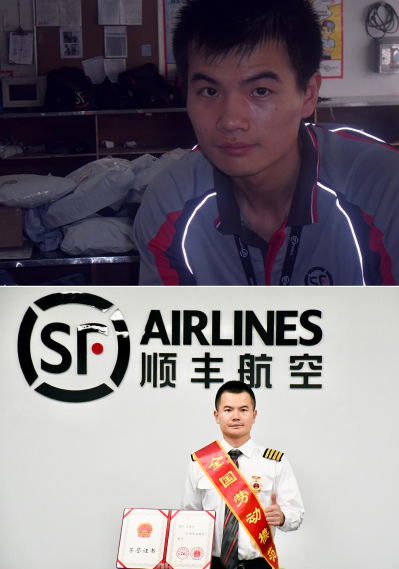 (Above) Newly recruited Wang Qinjin at a warehouse of Shunfeng (SF) Express in Shenzhen, Guangdong Province, in 2009; Wang, now a captain at SF Airlines, poses for a photo after winning the title of National Model Worker in April 2025 for his outstanding performance (XINHUA)
In 2009, after graduating from university, Wang Qinjin joined China's logistics service provider Shunfeng (SF) Express as a warehouse custodian. Three years later, he became a pilot at SF Airlines based in Shenzhen, Guangdong Province, and in 2019, he became a captain. Over 14 years, he has safely flown more than 6,600 hours. On April 27, he received a 2026 China Youth May Fourth Medal, the country's top award that recognizes outstanding young figures. "My growth would not have been possible without the support of national policies and the development of the logistics industry. I will stay in my position and keep doing my job, grounding responsibility in hard work and chasing dreams with determination, flying toward an even higher sky," Wang told local newspaper Shenzhen Special Zone Daily. This year, 29 individuals and 30 organizations received the China Youth May Fourth Medal in recognition of their remarkable contributions to sectors including scientific research, rural revitalization, green economy development and public services. 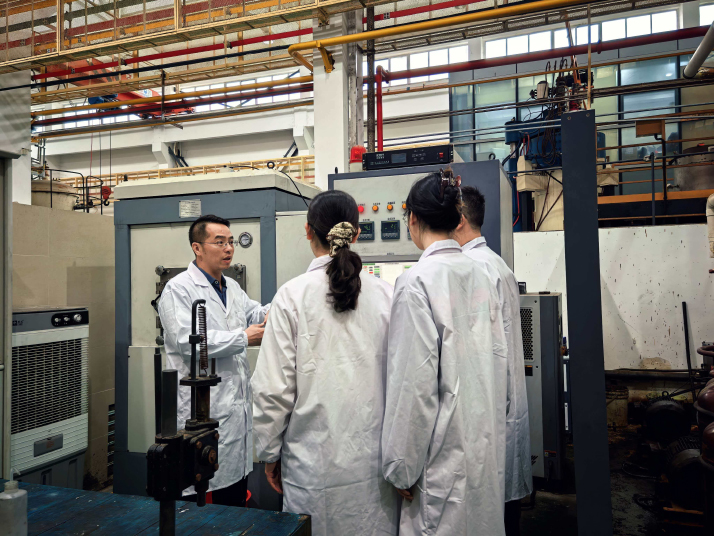 Members of Central South University’s innovation team for key materials and components of strategic aerospace and major equipment on April 28. The team is one of the 30 organization recipients of the China Youth May Fourth Medal in 2026 (XINHUA)
A remarkable transformation So how did a former warehouse custodian become a captain? Wang's journey is one driven by unwavering perseverance. When he first joined SF Express in 2009, every day, he would sort thousands of parcels in a large warehouse, soaked in sweat. Believing that even entry-level work deserves the utmost dedication, he strived to excel at every small task and was promoted to warehouse supervisor merely eight months later. Born in Leping, Jiangxi Province, Wang had dreamed of becoming a pilot since childhood, watching planes soar through the sky above the farmland. In 2010, when SF Express launched an internal pilot recruitment drive, he summoned his courage and applied. After several tough selection rounds, he secured a precious opportunity for receiving flight training overseas. In flight school, he studied English intensively and successfully overcame the language barrier. He devoted himself to theory study and flight practice. His hard work paid off as he finished his assessments ahead of schedule, winning the praise of his instructors. In December 2018, with over 3,000 flight hours, Wang passed the captain qualification test, and he was officially hired as one the following year. His sharp flying skills have helped him handle multiple inflight emergencies, ensuring the safety of SF Airlines' delivery operations. Off duty, he hosts regular flying workshops for junior pilots. He also leads a technical team to solve operational difficulties. His inspiring story has even encouraged a former customer service staff member to become a pilot through SF's internal recruitment program. 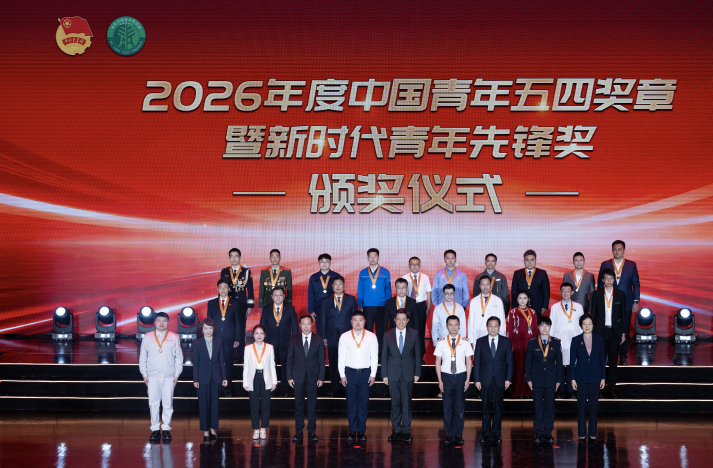 The 2026 China Youth May Fourth Medal recipients pose for a group photo during the awarding ceremony in Beijing on April 27 (XINHUA)
Where the heart takes root While Wang roams the skies, several of this year's China Youth May Fourth Medal recipients have planted their feet deep in the soil of their hometown. Guzailinuer Abula grew up at the foot of the Kunlun Mountain range in Xinjiang Uygur Autonomous Region. Her grandfather and father were both border patrol guards. In 2018, after graduating from a university in Shihezi City of Xinjiang with a nursing degree, she chose to return to her hometown instead of finding a job at a hospital or clinic in the city. She joined a border patrol team in Tumushuke City. Located at an altitude of nearly 4,000 meters, it is also one of the most remote outposts in the region. Life on the border is harsh: thin air, bitter cold and fierce winds. Border guard work includes patrolling the border area to ensure the safety of the frontier. Over the past eight years, Guzailinuer and her patrol team have traveled nearly 30,000 km while on patrol. As a nurse, she brings a medical kit with her every time she goes out. She treats sick herders, delivers medicine and builds health records to help seniors, children and families in need. Guzailinuer refers to her tanned skin and rough hands as "medals from the plateau." Another medal recipient, Li Yao, found the place where his heart took root not in the mountains, but in the flat farmlands of Hebei Province, north China. Born in Kantiangezhuang Village of Panggezhuang Township in Laoting County, a predominantly rural area, Li joined the air force at 19. After leaving the military, he started a business in Shijiazhuang, the provincial capital. He bought an apartment and moved his family there. Business was good. Life was comfortable. But every time he returned to his village for holiday, he saw the same thing: broken roads, broken streetlights and empty yards where young people, who now work and live in the cities, used to live. Elderly farmers watched their vegetables rot in the fields because of the very few ways to get the crop to market. In 2018, Li gave up a lucrative business to return home and was elected to become the top leader of the deeply indebted, underdeveloped village. He first solved urgent problems: installing street lamps, building farm roads, upgrading water and power systems, and improving overall living conditions. To boost local incomes, he introduced an innovative aquaponic farming project. In this type of farming, nutrient-rich water from fish tanks is recirculated to hydroponic vegetable beds, where beneficial bacteria convert ammonia from fish waste into nitrates that fertilize the plants. This closed-loop system not only yields both protein (fish) and produce (vegetables) on the same piece of land but also generates local employment and increases profitability per unit of farmland compared with conventional soil-based or separate aquaculture operations. He also spearheaded the creation of a village-run cooperative, developed high-standard farmland and established links between local produce and high-end markets in the cities of Beijing and Tianjin, altogether raising farmer earnings. Looking ahead, Li is partnering with state-owned enterprises to build a zero-carbon smart village using wind and solar energy, which will generate stable collective income and green jobs. He has also set up training programs to cultivate local agricultural talent and plans to share his successful models with more villages. "I just want my village to get better and the villagers to live happier lives," Li told media. With devotion and innovation, he has turned his hometown into a dynamic model of prosperous rural revitalization. China's rural revitalization, a strategy introduced at the 19th Communist Party of China National Congress in 2017, promotes the economic prosperity and overall development of rural areas. It builds on the success of the nationwide poverty alleviation campaign that had eradicated absolute poverty as of late 2020. 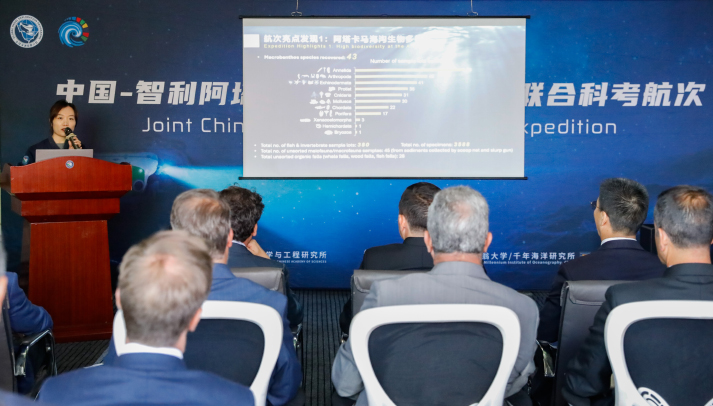 Du Mengran, an ocean researcher at the Chinese Academy of Sciences and a 2026 recipient of the China Youth May Fourth Medal, speaks during a closing reception of the Joint China-Chile Atacama Trench Expedition onboard China’s research vessel Tansuo-1 at the port of Valparaiso, Chile, on March 5 (XINHUA)
Pushing the limits Another trailblazer breaking new ground is Du Mengran. Born in Bozhou, Anhui Province, Du grew up far from the sea. But she dreamed of the ocean. In 2004, she enrolled at the Ocean University of China. A decade later, after earning her Ph.D. from Texas A&M University in the United States on a government scholarship, she joined the newly founded Institute of Deep-sea Science and Engineering of the Chinese Academy of Sciences in Hainan Province. The institute had modest beginnings: a rented two-story building, lab equipment limited to essential apparatus, a few dozen researchers sharing one large office. But Du felt at home. Du has made more than 30 dives aboard China's submersibles. The most remarkable one happened in 2024, when she led a team that discovered an animal ecosystem at over 9,000 meters below the surface of the Kuril-Kamchatka Trench in the northwestern Pacific. That depth is greater than the height of the world's highest peak. Nature journal called Du "Deep Diver" and named her one of the 10 people who shaped science in 2025 for her discoveries. While Du searched for life in the ocean's deepest trenches, another medal recipient, Zhi Deyuan at Beijing Friendship Hospital of Capital Medical University, has been saving lives. He is the chief physician of the intensive care unit (ICU) of the hospital. Over the past decade, he has treated more than 5,000 patients on the verge of death. From daily emergency cases to medical support missions during the 2022 Beijing Winter Olympics, he has saved numerous lives and has brought hope to many families using advanced technologies such as extracorporeal membrane oxygenation and other life support systems. Zhi's path to intensive care medicine was shaped early by his mother, also a medical worker. As a child, he watched her use professional judgment and swift action to win precious time for his chronically ill grandfather. Though he did not understand the science at the time, he grasped what it meant for a family to hold onto a loved one. In 2013, Zhi chose intensive care as his career—one of the most demanding fields in medicine. While many see only relentless pressure and constant challenges, Zhi regards the ICU as the frontline of possibility. Beyond technical expertise, Zhi devotes equal attention to the human side of care: explaining conditions to worried families, listening carefully to their concerns and needs, and turning words into action. His work extends beyond the bedside. Together with his team, Zhi has developed an AI-powered smart critical care system that serves as a digital assistant for doctors in emergency rescue operations. Zhi, together with other medal recipients, represents a new generation of Chinese youth who are steadily changing lives and shaping the future. BR Copyedited by Elsbeth van Paridon Comments to luyan@cicgamericas.com _______________ Youth Honors May 4 is China's Youth Day. The China Youth May Fourth Medal is the highest honor for Chinese citizens aged 14 to 40. The Central Committee of the Communist Young League of China and the All-China Youth Federation began awarding the medals in 1997. In April, the two organizations also granted 677 individuals the title of New Era Youth Pioneer of 2025 for their good morals and noble pursuits. The prestigious recognition is also open to Chinese youths aged 14 to 40. These honored youths have served in positions, mostly on the grassroots level, in sectors including scientific research, cultural promotion, journalism and communication, rural revitalization, social services and healthcare. |
|
||||||||||||||||||||||||||||
|








