
|
| China |
| Are teachers doomed to be underdogs in parent complaints? | |
|
|
 LI SHIGONG
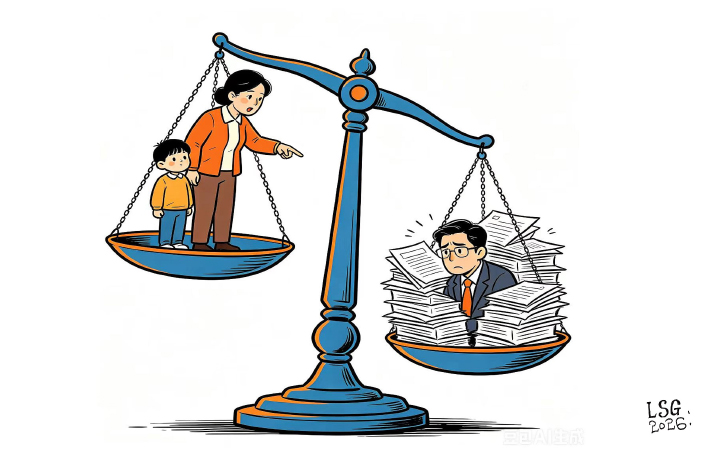
Shen Yifei, an associate professor at Fudan University, who has been researching family education for over a decade, recently attracted controversy for sharing her views on excessive parental complaints and growing pressure on teachers. The incident began after a parent joined Shen's livestream to discuss school bullying she alleged was directed at her child. The parent cited two incidents: First, her child shared snacks with classmates but some classmates did not share theirs with her child in return; second, two children shoved each other in an argument. Shen told the parent the incidents did not amount to bullying, and that the parent's complaints reflected an extreme victim mentality that turned normal childhood conflicts into serious accusations. The parent subsequently filed complaints against Shen with Fudan University, accusing her of privacy violations and neglecting her teaching duties because of her regular involvement in livestream programs. In the following two months, Shen repeatedly wrote explanatory materials and cooperated with the university's investigation, which disrupted her work routine. Fudan University later concluded that Shen's livestream comments were completely professional and neither violated any privacy rights nor affected her teaching activities. Wen Daohe (Wuhan Morning Post): Reporting mechanisms are designed to uphold justice, but they incur almost no cost to the complainant. A simple phone call or letter can trigger an investigation, and even if the allegations are unfounded, the complainant faces no consequences. In contrast, the accused must write bucketloads of materials to prove their own innocence. This severe imbalance between rights and costs is a loophole in the system that is being repeatedly exploited. Professor Shen withstood the pressure. But what about the majority of teachers who receive unfair complaints? Many have to apologize repeatedly. Loopholes in the reporting system must be fixed. After an unsubstantiated report is identified, the malicious reporter must be held accountable. The Ministry of Education has already issued clear provisions: Unsubstantiated reports against teachers must be promptly clarified and the teacher publicly cleared, while acts of malicious defamation and slander must be resolutely countered. This principle should be translated into an enforceable system. Families and schools should work together as partners in nurturing children. Once trust between the two is broken, it's hard to repair. The abuse of reporting will disappoint hardworking teachers and end up hurting the students themselves. Li Qinyu (ThePaper.cn): Excessive complaints against teachers are not news. Data from a local education bureau in southwest China showed that only seven of 128 complaints against teachers between January and August 2024 were found to be largely valid. Struggling with unsubstantiated complaints not only consumes teachers' time and energy but also erodes their enthusiasm for teaching, and may even lead to psychological and mental health issues. For many years, whenever conflicts have arisen, most schools have tended to discipline their teachers first without digging into the complaint, hoping to satisfy the complaining parents and prevent the matter from escalating. However, this approach does not truly solve the problem. If teachers are constantly kept walking on eggshells, they will not dare to discipline students and this will only damage the quality of education. Schools need to backstop teachers who face unsubstantiated complaints so that they can devote passion and energy to their educational work. Fudan University's commitment to seeking truth from facts—refusing to arbitrarily discipline its teachers simply due to external pressure—is truly commendable. BR Copyedited by G.P. Wilson Comments to yanwei@cicgamericas.com |
|
||||||||||||||||||||||||||||
|