
|
| China |
| Connecting through code and culture | |
|
|
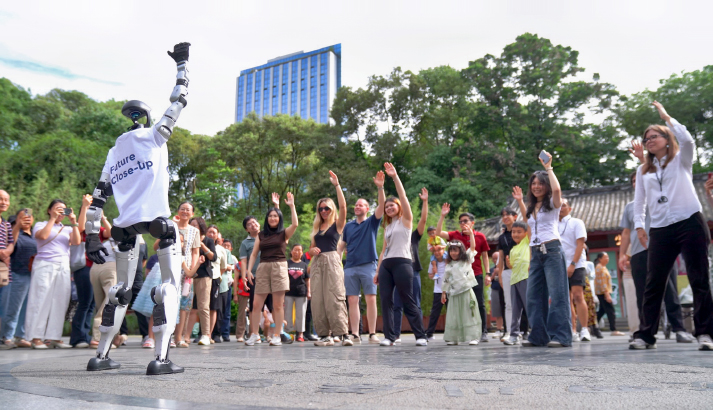 Future Close-Up participants dance with a robot produced by Chinese company Unitree Robotics at Renmin Park in Chengdu on June 11 (ZHANG WEI)
From immersive tech exploration to dancing with local aunties, Joelle Cheeseman, a student at Stanford University in the United States, explored a unique blend of technology and tradition during the fourth edition of the Future Close-Up program in China in June. In March, Cheeseman came to China for an exchange visit. It was during that trip she learned about the high-level youth exchange program and subsequently applied to take part. However, her engagement with China actually began earlier: She had previously volunteered at the South Coast Chinese Cultural Association, a U.S.-based center dedicated to promoting Chinese culture. In Renmin Park in Chengdu, capital of the southwestern province of Sichuan, on June 11, Cheeseman and other participants of the program danced alongside a robot produced by Chinese firm Unitree Robotics. They then played Chinese chess and Go against robots and learned to play mahjong through AI. "I got to experience the local people's daily activities. I really enjoyed it," Cheeseman told Beijing Review. Jointly launched by the China International Communications Group Center for the Americas and the Marketing and Public Relations Department of Chinese tech company Tencent in 2023, Future Close-Up assembles diverse participants from around the world to explore the concept of a shared global future and offers participants an up-close view of how technology and tradition intertwine in China. Themed AI for a Shared Future, the 2026 Future Close-Up brought together a group of 21 Internet influencers, tech professionals, government officials and scholars from 15 countries and regions, including the United States, Brazil, Peru, Russia and Germany. They visited Shenzhen, Guangdong Province, and Chengdu from June 8 to 12. 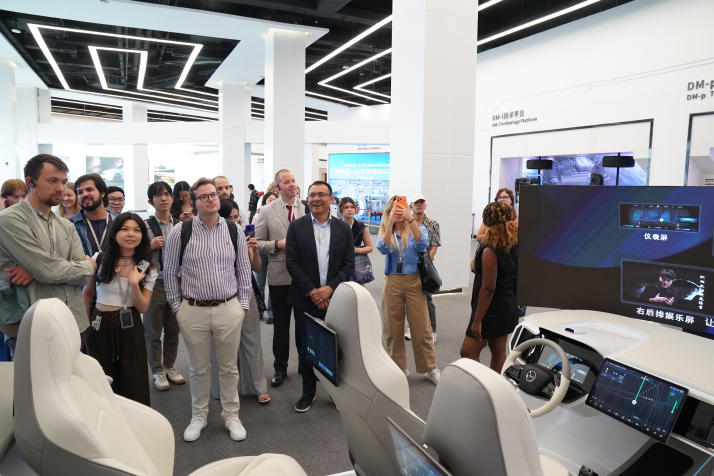 Future Close-Up participants visit Chinese electric vehicle maker BYD's headquarter in Shenzhen, Guangdong Province, on June 8 (ZHANG WEI)
Hands-on tech encounters What stood out most for many participants was the widespread application of AI and robots throughout Chinese industry. At electric vehicle maker BYD's Shenzhen headquarters, the delegation saw how robotics and advanced technology are integrated into vehicle production, and visited a compelling exhibition of cars designed to withstand extreme environments like freezing temperatures. Isabella Sole Bisio, an Italian engineer working at a Singapore-based tech-energy company, was intrigued by the scale and sophistication of the production line when visiting BYD. "My background is in robotics engineering. It is very interesting to see how the Chinese car maker assembles cars using robots for the majority of the manufacturing process," Bisio told Beijing Review. Bisio said she is interested in exploring the use of AI in car production, and found it amazing to see how AI tools developed by Chinese companies could help develop ideas so quickly. Johnny Bonk, an AI consultant at a German company, told Beijing Review that he was impressed by "China speed," regarding how quickly technology producers experiment with innovative solutions. "Customers can test new features extremely fast, and that sense of constant innovation is something they really value," he said. Kacper Raciborski, founder and board member of the Innovations Hub Foundation of Poland, expressed his desire to play an active role in facilitating cooperation between Polish and Chinese companies. "With many manufacturers, fab labs and hardware talents in China, building hardware is almost frictionless," he told Beijing Review. Cheeseman, who has just completed her first year at Stanford, saw the trip as an opportunity to deepen her understanding of Chinese innovation, saying it helped her learn how AI can optimize and bring efficiency to many different industries, like pharmaceuticals. Another highlight for Cheeseman was a visit to Tencent's minor protection program in Chengdu, where the participants explored how AI is being deployed to counter fraudulent activities. "It was really interesting to see the company makes sure that children are able to know how to use AI tools responsibly and that parents and children are supported as AI grows and develops," she said. After playing chess with a robot in Chengdu, John Paul Uminga, a social innovation ecosystem builder at Catalyst Now APAC at the University of Queensland in Australia, told Beijing Review that different applications for technology and innovation are emerging in China, which has inspired him to explore using technologies to solve real-life problems. Uminga first visited China 15 years ago. "I have seen a lot of changes in China in terms of innovation and development, like helping solve poverty and addressing environmental issues and climate change," he said. He was also impressed by the adoption of AI for the protection of minors. "Right now there is a real challenge around protecting minors when it comes to the access to technology," he said. Noting that Tencent's program to protect minors has been running for nine years, Uminga said its integrated nature is a useful model for other programs. "It is not operated by just one organization like the schools, communities or the local government; the whole-ecosystem approach is really there. The experience is worth being shared," he said. For Kevin De Ridder, a legal assistant at Belgium's Ministry of Higher Education and a first-time visitor to China, in addition to being a journey of hi-tech showrooms, the tour was a revelation of how deeply technology is woven into daily life—from making all payments with a single smartphone app to AI translating conversations in real time. De Ridder tested Chinese AI tools with enthusiasm. He marveled at how quickly an image could be generated—just about 15 seconds—compared with some overseas platforms that can take over a minute. "I'm very impressed that it's so fast. It's more useful. I think I will use this app after returning to Belgium," he said. The exchange program has also developed into a platform for turning cross-cultural encounters into lasting ties. De Ridder dabbled in learning the Chinese language a year ago and plans to return to China in the future. "I will learn more about Chinese and hope to speak with people without needing a translator," he said. 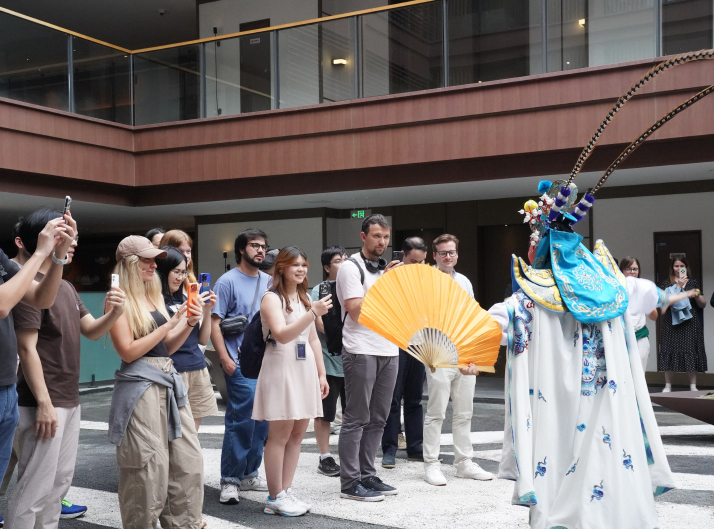 Future Close-Up participants watch a "face-changing" mask performance from Sichuan Opera in Chengdu on June 9 (ZHANG WEI)
Local immersion From ancient intangible cultural heritage to cutting-edge technology, the participants experienced a blend of tradition and modernity in Chengdu, a city with a history of about 3,000 years. They watched performances featuring some of Sichuan's most distinctive intangible cultural heritage, including bianlian or "face-changing" mask performances from Sichuan Opera. After dancing together with locals at Renmin Park, they drank tea at a teahouse along with some local Chengdu expats, soaking in the city's laid-back yet vibrant culture. Lucas Campos de Almeida, a Brazilian media professional, told Beijing Review that it was special to see traditional intangible cultural heritage being passed down by such a diverse group of people, from older generations to young children. "Chengdu is such a vibrant place, and there are many technological innovations and people creating things. It is really inspiring to see how Chengdu lives today using all the knowledge that it has from the past," Almeida said. The delegation also visited the Chengdu Research Base of Giant Panda Breeding for an up-close encounter with the black-and-white bear, a national treasure of China. The young participants tried using Chinese AI tools to create fun photos of themselves with the pandas. "It is my first time in China as well as in Chengdu. It's been super, super fun. I have never seen a panda before," Sarah Hooper, a fresh graduate from California State University in the U.S., told Beijing Review. She also bought many panda-inspired souvenirs during the visit. Hooper said she is currently an intern at a company that works in tech-based immersive experience devices. While traveling, she posts frequently on social media about places she enjoys visiting. She also downloaded and registered on RedNote (Xiaohongshu), a Chinese lifestyle and e-commerce app similar to Instagram. "I have been posting on RedNote, which has been super fun. On the platform, I see people from all different areas around the world and their socials," she said. 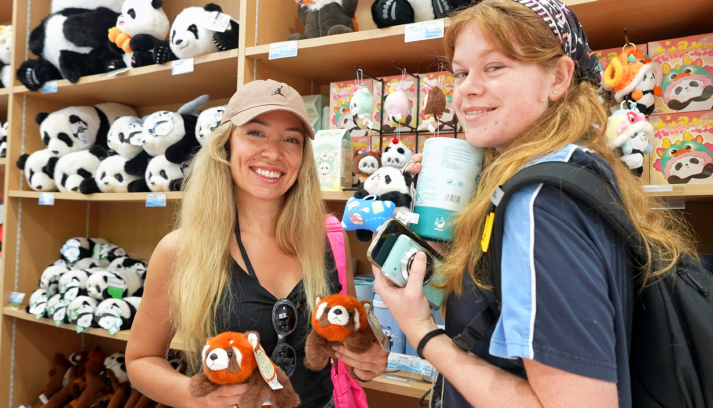 Future Close-Up participants showcase souvenirs at the Chengdu Research Base of Giant Panda Breeding in Chengdu, Sichuan Province, on June 10 (ZHANG QINZHENG)
Lasting connection Many participants sought to explore more opportunities for cooperation through the visit. Sorrel Salb, founder of German technology and humanities consultancy Our Future, told Beijing Review that when she visited Shenzhen for the first time earlier this year, it felt like she was getting a glimpse into the future. "I am excited to experience more of China's technology innovation landscape and hope to deepen this collaboration over the years to come," she said. Guillermo Palacios, a Peruvian entrepreneurship academic, said he believes understanding China's technology ecosystem is now essential. "China's technological advancement represents one of the most significant forces reshaping the global economy," Palacios said, continuing that he hopes to exchange ideas for lasting academic and professional partnerships with China's innovation community. Having previously studied at Tsinghua University in Beijing, Jerry Chong from Malaysia returned to China to witness the country's latest developments. Now serving as domain lead architect at DHL Express, Chong told Beijing Review that one of the most impressive aspects of his visit was experiencing Tencent's AI ecosystem, including Yuanbao AI assistant and Hunyuan 3D generative model. "The tools empower Chinese and international users to fully adopt AI technologies with minimal effort," he said, adding that he hopes to promote more technology cooperation projects between China, Malaysia and other members of the Association of Southeast Asian Nations across a wide range of technology sectors. In a social media post following the visit, Pelumi Fadare, an Associate at the Asian Infrastructure Investment Bank, highlighted that the rise of China's leading companies underscores the importance of long-term investment, experimentation, talent development and strategic planning. "Successful innovation ecosystems do not emerge overnight. They are built through a combination of ambition, supportive policies, entrepreneurship, infrastructure and a willingness to solve local problems at scale," Fadare wrote. According to her, the achievements of these firms reflect the determination and persistence that have driven China's technological progress. China's development experience might offer other regions, particularly Africa, a reference for building innovation ecosystems that allow tech companies to emerge, Fadare added. BR (Reporting from Shenzhen, Guangdong Province, and Chengdu, Sichuan Province) Copyedited by G.P. Wilson Comments to lixiaoyang@cicgamericas.com |
|
||||||||||||||||||||||||||||
|








