
|
| China |
| Hands-on holidays | |
|
|
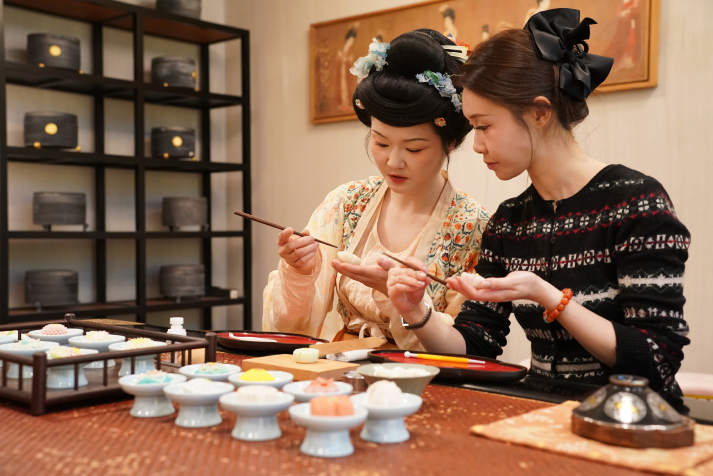 A woman (right) learns to make a Tangguozi dessert from an instructor at a hands-on Tangguozi workshop in Xi’an, Shaanxi Province, on January 9 (XINHUA)
For five days, a handful of city dwellers settled at the foot of the Great Wall on Beijing's outskirts, immersing themselves in the centuries-old art of mortise-and-tenon joinery. Each morning began with tai chi practice and a hike up the mountain or along the Great Wall. At 9 a.m., as class began, everyone gathered to study woodworking techniques. At noon, they cooked lunch together over an open fire. Afternoon sessions ran until 6 p.m., and in the evenings, they sat around a campfire, sharing stories and insights. By the end of the five days over the May Day holiday (May 1-5), each participant had mastered a basic tai chi routine, learned to craft a stool using traditional joinery, and had their own handmade stool to take home. The five-day program, offered by a woodworking workshop on the outskirts of Beijing, costs about 3,000 yuan ($440). Its founder, Wang Beishan, a landscape architect, moved from downtown Beijing to the countryside five years ago. In 2024, he began offering holiday woodworking courses tailored for young people, alongside shorter weekend classes. "Here, everyone can leave their usual identities behind," Wang shared on the social network Xiaohongshu, also known as RedNote. "We're just a group of people who share a love for woodworking." He explained that working with wood demands absolute focus, both physically and mentally. "For those who spend long hours in office buildings and scroll through short videos all day, this offers a completely different and refreshing kind of relaxation," he said. One past participant of a short-term workshop described it as a unique life experience. "Working with my hands felt like a gentle yet profound form of self-healing. You get to connect deeply with nature, and live a slow and peaceful rural life," the participant shared on RedNote. "And finally, bringing home a stool you made with your own hands gives you an immense sense of achievement." 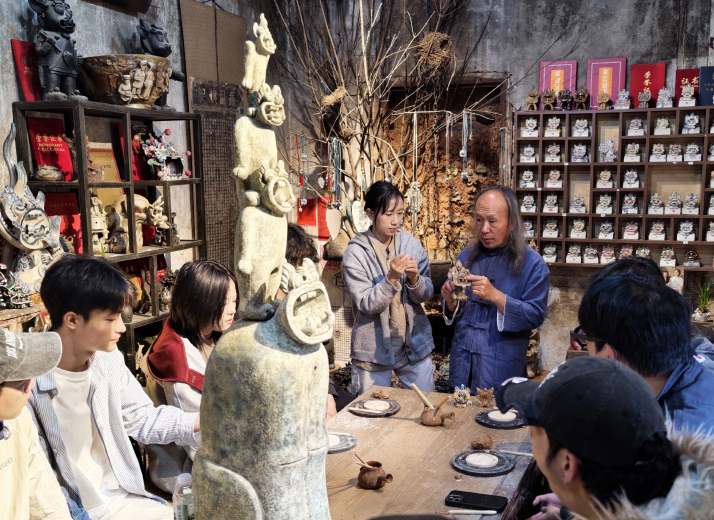 Young people learn how to make Wamao at a workshop in Dali, Yunnan Province, on April 29 (XINHUA)
Craft courses Learning a craft during time off is becoming a fresh way for young people to spend their holidays. Rather than ticking off tourist attractions, a growing number of young adults are choosing to "go to class" during their breaks, picking up a skill they've always been curious about but never had time to explore. These crafts are usually unrelated to their day jobs, and they don't expect to make money from them; it's simply a matter of personal enjoyment. Shen Qi, a young woman living in Hangzhou, Zhejiang Province, signed up for a pottery class by the city's famous West Lake during the May Day holiday. The studio offered one-day, three-day and five-day intensive courses over the holiday, with free practice time available outside of class hours. Shen, who had long been interested in pottery, chose the five-day intensive program, hoping to use the break to settle her mind and systematically learn the craft. Her course covered the complete process, including basic theory, slab construction, techniques for making cup shapes by hand, trimming and glazing. "The five-day course cost about 2,000 yuan ($290), with about two and a half hours of class each day, and the rest of the time was free to use as I liked," she said, adding that she truly valued this uninterrupted period, dedicated to learning something she genuinely enjoys. To meet the demand of young people who want to take classes during holidays, a variety of short-term handicraft courses have sprung up in many places. Liu Xiyin runs a lacquerware studio in Hangzhou. During the May Day holiday, his studio launched an introductory course consisting of 30 class hours. "The craft of lacquerware has a high barrier to entry and a long learning cycle. Thirty hours is barely enough to get a foot in the door," Liu told Hangzhou Daily. The introductory course is priced at 3,980 yuan ($585). While this price is not among the lowest for similar courses, Liu's May Day slots were fully booked a week before the holiday. Most of those enrolled were young people. Heritage in the making "The courses offered by these craft workshops not only enrich young people's holiday life but also, as they involve multiple forms of intangible cultural heritage (ICH), play a very positive role in promoting and preserving ICH," Lu Yi, a professor at Peking University's School of Journalism and Communication, told Beijing Review. In addition to spending the entire holiday taking courses, many people also make hands-on craft experiences a key part of their travels. Dali in Yunnan Province is a renowned tourist city that boasts a diverse multi-ethnic population and a wealth of ICH crafts, offering various experiential workshops such as tie-dying, making rubbings and silver smithing. Wen Lili, a visitor from Beijing, had learned about the Wamao, or roof cat, before traveling to Yunnan Province this April. Originally a distinctive roof ornament made of grey pottery, the Wamao was traditionally placed on rooftops to ward off evil spirits and bring good fortune. Over time, this traditional architectural element, imbued with the symbolism of protecting the household and attracting blessings, has gradually moved down from the eaves and transformed into a popular cultural and creative figurine among young people. In 2023, the Wamao was inscribed on the fifth batch of Yunnan Province's provincial-level intangible cultural heritage representative items list. She discovered that some workshops in Dali offered classes on making Wamao by hand. She signed up in advance and spent an entire afternoon at a Wamao studio learning the craft. "I learned some interesting stories about Wamao at the class and met quite a few friends who also like Wamao. I believe that the Wamao's unique shape and the folk stories associated with it will attract more people to pay attention to this ICH item," she told Beijing Review. Alongside the growing ranks of holiday learners, Li Huan represents the other side of the trend—she is one of those who have taken the initiative to start a workshop herself. Based in Xi'an, Shaanxi Province, she came across Tangguozi, a type of dessert inspired by the culture of the Tang Dynasty (618-907), by chance. Known for its exquisite designs and vibrant colors, Tangguozi is often served alongside tea. The techniques of making Tangguozi have been recognized as a form of local intangible cultural heritage in Lichuan City, Hubei Province, among other places. With years of experience in baking, Li decided to establish a company dedicated to this craft in Xi'an in 2020. By carefully tweaking recipes to incorporate healthy ingredients and modern flavor preferences, they have made their Tangguozi products increasingly popular. They have also launched hands-on Tangguozi-making experience programs to attract tourists and educational study groups. "Traditional culture is an inexhaustible source of creative inspiration, and consumer experiences and scenarios built on cultural innovation allow people to experience the charm of Chinese history and culture in a more tangible way," she told Xinhua News Agency. Copyedited by G.P. Wilson Comments to yuanyuan@cicgamericas.com |
|
||||||||||||||||||||||||||||||
|