
|
| China |
| The smart path to AI | |
|
|
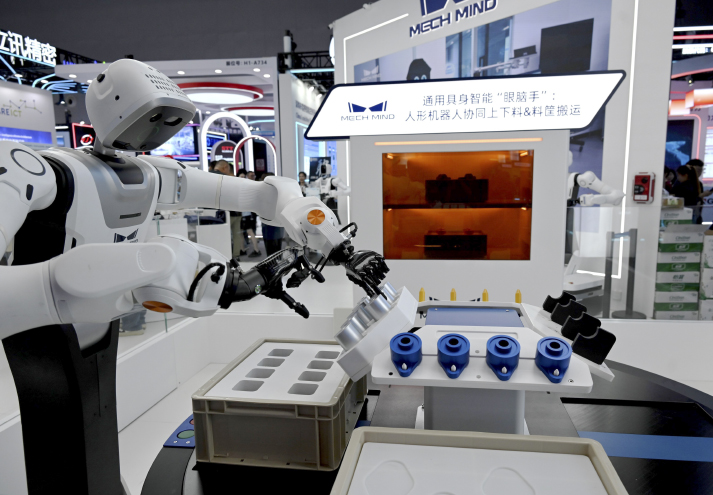 A robot demonstrates precision operation during the 2026 World AI Conference and High-Level Meeting on Global AI Governance in Shanghai on July 19 (XINHUA)
Over the past two years, Matt White, Global Chief Technology Officer of AI at the Linux Foundation, has logged more than a dozen trips to China, all driven by a single objective: to gauge the true speed of the country's sprawling AI landscape. After having toured more than 100 Chinese companies, ranging from electric vehicle pioneers to advanced robotics labs, he found that what struck him the most is not any single product or company, but what he calls the density of innovation. "The pace here is astonishing," White remarked during an interview with China Central Television on July 17. "When I visited in late April, I watched Chinese AI labs roll out a wave of new models in just a single week." Barely three months later, he returned to Shanghai for the 2026 World AI Conference (WAIC) and High-Level Meeting on Global AI Governance, held from July 17 to 20. There, over four days, more than 1,100 domestic and international exhibitors showcased upwards of 4,400 technological achievements, including over 300 global product debuts. 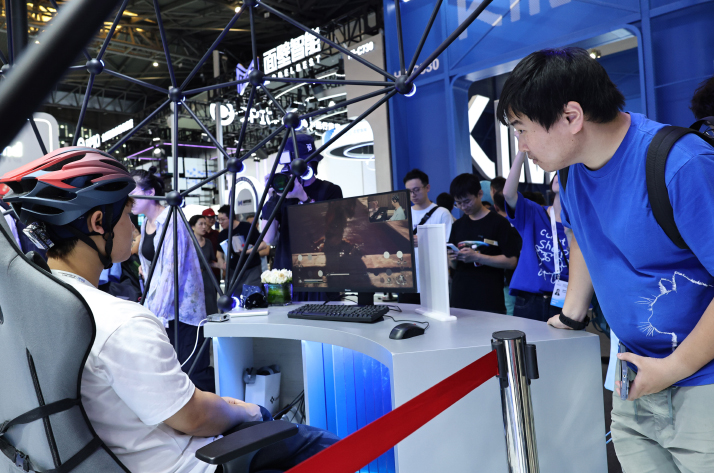 A visitor (right) watches a staff member operating a computer game via a non-invasive brain-computer interface during the 2026 World AI Conference and High-Level Meeting on Global AI Governance on July 19 (XINHUA)
AI in action "Seventy years ago, a group of young scholars proposed the concept of AI for the first time at the Dartmouth Workshop in New Hampshire of the United States," Chinese President Xi Jinping said in his keynote speech at the opening ceremony of the conference. "In the subsequent 70 years, AI scientists and researchers from around the world ventured into this unknown territory, forged ahead through twists and turns and made breakthroughs with persistent hard work. Today, seven decades later, amid the new wave of AI development, we are gathering by the Huangpu River to discuss how to promote AI globally for the positive, for good and for humanity," he added. Since the conference's debut in Shanghai in 2018, the annual flagship event has grown significantly. Now in its ninth edition, participation has more than doubled, expanding from fewer than 40 countries and regions at its inception to over 100 today, reflecting the profound transformation of the global AI industry over the period. This year's conference spanned three venues across Shanghai, offering a comprehensive look at the latest milestones in AI, from laboratory breakthroughs to widespread industrial adoption. The exhibition area surpassed 100,000 square meters for the first time, setting a record for the event. Running alongside the exhibition are more than 150 thematic forums and dozens of bilateral, multilateral and business-matching sessions. At this year's embodied AI exhibition, the focus shifted noticeably from the crowd-pleasing robot dances and acrobatic flips of previous years to practical, industrial applications. Inside the Embodied AI Pavilion at the Shanghai World Expo Exhibition and Convention Center, exhibitors instead showcased humanoid machines performing actual tasks on simulated production lines. Among them, Chinese firm JAKA Robotics unveiled its JAKA K1-25, a heavy-duty dual-arm humanoid robot. Built with a combined payload capacity of 50 kg, its arms achieve a repeat positioning accuracy within 0.05 mm. In collaboration with Huayu Automotive Electric Drive System Co. Ltd., JAKA has developed a wheeled humanoid collaborative assembly system that is already deployed on real-world mass-production lines. The system fully automates the entire process—from motor-housing transfers to the precision fastening of 0.5-mm micro-screws—locking each screw in just 10 seconds. "This year, the industry's focus has moved from competing on technical specifications to demonstrating real-world deployment capabilities," Li Mingyang, founder and chairman of JAKA Robotics, told the People's Daily. According to Li, the ultimate goal of AI-robotics integration is human-machine symbiosis: "Robots assist humans with fundamental physical tasks, allowing people to devote more energy to creative and intellectual pursuits." On the consumer AI front, Shanghai Kochao Technology introduced the world's first AI-powered emotional-wellness smart ring. Utilizing high-precision biosensors and proprietary algorithms, the ring translates physiological signals such as heart rate into a visual "emotional weather" interface, generating personalized mood trajectories and stress-trend curves. The company's founder Shu Changjun said he believes the next phase of smart wearables must extend beyond basic physical data tracking to sensing and analyzing users' emotional states—turning hardware into a thoughtful companion that "understands your feelings and knows you better." In the environmental technology sector, the MAZU intelligent weather early-warning system, developed under the leadership of the China Meteorological Administration, is the world's first national-level action plan aligned with the United Nations' Early Warnings for All initiative. Pan Jinjun, chief engineer of the administration, explained that the system deeply integrates cutting-edge tools, including Fengyun meteorological satellites and AI-driven forecasting models, to build a full-chain framework covering monitoring, forecasting, alerts and response services. To date, MAZU has been deployed in seven countries and is accessible via cloud platforms in more than 40 countries. AI for all "China's understanding of AI is shifting from 'how to develop the technology' to 'how to better harness it in the service of all humanity,'" Chen Baihui, Dean of the Asian Academy of Digital Economics in Singapore, told Xinhua News Agency. He noted that China has consistently advanced global AI governance and international cooperation in recent years, steering AI in a positive direction through conceptual initiatives, institutional frameworks and practical measures. Chen pointed out that while AI can boost productivity and transform fields such as education, healthcare and scientific research, it also introduces significant risks, including deepfakes, disinformation, algorithmic bias and privacy breaches. Furthermore, because AI risks are transnational, dynamic and highly contagious, he emphasized the need for proper risk classification, behavioral verification, emergency response mechanisms, and cross-border coordination, all while balancing innovation and security within a unified framework. Speaking from the perspective of Singapore and the broader Southeast Asian region, Chen observed that small and medium-sized nations aim to balance security, openness, innovation and compliance. "What ASEAN (Association of Southeast Asian Nations) countries need is not a closed technology ecosystem, but an open and cooperative environment in which they can participate, benefit and help shape the rules," he said. In recent years, China has leveraged platforms such as the Global Digital Economy Conference, the World Internet Conference and the World AI Intelligence Conference to facilitate dialogue among governments, enterprises, international organizations, research institutions and civil society. Beyond showcasing technological breakthroughs, these venues serve as key channels for building mutual understanding, managing differences and deepening international cooperation. Chen noted that China's push to enhance global collaboration on AI capacity-building holds particular significance for the Global South. "While many developing nations aspire to build AI capabilities, they often lack sufficient computing power, data, talent, infrastructure and regulatory frameworks," he said. "If global AI governance focuses strictly on risk mitigation without helping developing nations build capacity, it risks entrenching new forms of technological inequality." During the conference, a series of action initiatives and cooperation frameworks were proposed by China that directly addressed these practical needs. On July 16, representatives from 29 countries gathered in Shanghai to sign an agreement establishing the World AI Cooperation Organization as founding members. Robert Lisinge, Director of the Technology, Innovation, Connectivity and Infrastructure Division at the United Nations Economic Commission for Africa, said in a recent interview with Xinhua that strengthening cooperation with China in AI expertise and capacity-building could accelerate Africa's digital transformation and socioeconomic development. Lisinge noted that less than 1 percent of online content is currently available in indigenous African languages, severely hampering the accessibility of digital technologies across the continent. "We would like to see African indigenous languages being used in the technology domain," he said. He also commended China's contributions to advancing open-source models, which have significantly lowered data access costs for African universities and research institutions. This accessibility enables local scientists to innovate and design practical digital solutions tailored to agriculture, education and healthcare, delivering benefits to communities in remote parts of the continent. On July 17, China announced that over the next five years, it will offer 5,000 specialized training slots in AI to developing nations. In parallel, Beijing plans to establish international AI application centers in partnership with the Association of Southeast Asian Nations, the Arab League, the African Union, the Community of Latin American and Caribbean States, the Shanghai Cooperation Organization and BRICS (a group of emerging economies that cooperate to promote and pursue the interests of the Global South—Ed.) Abdunur M. Sekindi, Director General of the Science and Technology Department of the Organization of Islamic Cooperation, commended China's commitment to dismantling technological barriers through open collaboration and bridging the digital divide through capacity-building. He noted that this offers a concrete, viable path for Global South countries to participate in the digital economy, adding that China's major initiative to support global AI development is a practical, multilateral act of goodwill that fully embodies the principles of technology for good and inclusive, shared benefits. Copyedited by G.P. Wilson Comments to yuanyuan@cicgamericas.com |
|
||||||||||||||||||||||||||||
|